M42 Duster

M42 Duster

RoleSelf-Propelled Anti-Aircraft Gun
CountryUSA
Built3200

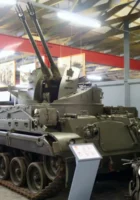
The M42 40 mm Self-Propelled Anti-Aircraft Gun, or “Duster,” is an armored light air-defense gun built for the U.S. Army from 1952 until December 1959. Production of this vehicle was performed by the tank division of the General Motors Corporation. It used components from the M41 light tank and was constructed of all welded steel. A total of 3,700 M42s were built. The vehicle has a crew of six and weighs 22,500 kg (49,500 lb) fully loaded. Maximum speed is 45 mph with a range of 100 miles. Armament consists of fully automatic twin 40 mm M2A1 Bofors, with a rate of fire of 2×120 rounds per minute (rpm) and either a .30 caliber Browning M1919A4 or 7.62mm M60 machine gun. The 500 hp, six-cylinder, air-cooled, gasoline engine is located in the rear of the vehicle. Although the M42 Duster was initially designed for an anti-aircraft role, it proved highly successful when used in the Vietnam War against unarmored ground forces.

Source: M42 Duster on Wiki

Continue reading

Views : 5451

Russian Navy Alfa Class SSN - HOBBY BOSS 83528

Hobby Boss

Subject

Russian Navy Alfa Class SSN

Scale1/350
Ref83528

A model of the brand HobbyBoss the kit : Russian Navy Alfa Class SSN – HOBBY BOSS 83528

Features : The kit consists of over 30 parts , includes over 10 Photo etched parts – Photo Etched parts for nameplate and propeller etc. – contains display stand

The Soviet Union/Russian Navy Project 705 (Лира/Lira, “Lyre”) was a submarine class of hunter/killer nuclear powered vessels (abbreviated PLA: Podvodnaya lodka atomnaya, nuclear submarine). The class is also known by the NATO reporting name of Alfa. They were the fastest and deepest diving class of military submarines built, with only the prototype K-278 Komsomolets (NATO “Mike” class) exceeding in crush depth and the prototype K-222 (NATO “Papa” class) exceeding in submerged speed.

Source: Russian Navy Alfa Class SSN on Hobby Boss

Continue reading

Views : 1748

Soviet D-30 122mm Howitzer - Early Version - Trumpeter 02328

Trumpeter

Ref 02328
TypeModels
Scale1/35
Topic

Soviet D-30 122mm Howitzer – Early Version

A model of the brand Trumpeter the kit: Soviet D-30 122mm Howitzer – Early Version – Trumpeter 02328.

Features : The kit consists of 150+ parts ,1 pieces of Photo Etched parts – Details finely represented by newly tooled parts – Rubber tires

The D-30, or 122-mm howitzer D-30 (GRAU index 2A18), is a Soviet howitzer that first entered service in the 1960s. It is a relatively light and handy weapon despite being heavy enough for sustained long range fire in the field. The D-30 has a maximum range of 15.4 kilometers, or over 21 km using RAP ammunition. With its striking three-leg stabilising system the D-30 can be rapidly traversed through 360 degrees. Although no longer manufactured in FSU nations the D-30 is still manufactured internationally and is in service in more than 60 countries’ armed forces. The 2A18 gun is the primary weapon of the 2S1 self-propelled howitzer. There are also Egyptian, Chinese, and Syrian Self-propelled variants and conversions. The Syrian conversion utilizes the hull of a T-34 tank.

Source: Soviet D-30 122mm Howitze by Trumpeter

Continue reading

Views : 1364

AH-1F Cobra Gunship Plastic Model Kit - Revell 85-5321

Revell

Ref 85-5321
TypeHelicopter
Scale1/48
Topic

AH-1F Cobra Gunship

A model of the brand Revell the kit: AH-1F Cobra Gunship – Revell 85-5321.

Favored by the U.S. Army, the AH-1F Cobra is a purpose-built attack heli with extreme firepower. Its nose-mounted, 20 mm Gatling gun delivers devastating destruction with extreme accuracy. Kit features a moveable, nose-mounted Gatling gun, side-mounted mini-guns, side-mounted rocket pods, Weapons Officer and pilot figures, plus decals for 1. AH-1F Cobra, 67-15771, First Air Calvary, C Troop “Jaws of Death;” 2. AH-1F, 67-15883 “Trigger and Boomer’s Excellent Adventure, Operation Desert Storm and 3. AH-1F, 67-15843, N Troop, 4th Squadron, 2nd Armored Cavalry Regiment, U.S. Army, Iraq, 1991.

Source: AH-1F Cobra Gunship on Revell

Continue reading

Views : 1491

Soviet 76-mm Gun - Zvezda 6145

Zvezda

Ref6145
TopicModel
Scale1/72
Description

«Soviet 76-mm Gun»

A model of the brand Zvezda the kit: Soviet 76-mm Gun – Zvezda 6145.

The 76-mm divisional gun M1936 (F-22) was a Soviet divisional semi-universal gun, adopted for Red Army service in 1936. This gun was used in conflicts between the USSR and Japan on the Far East, in the Winter War and in World War II. Many F-22s were captured by Wehrmacht, modernized by the Germans and used against Soviet forces.

Source: Zvezda

Continue reading

Views : 804

Hawker Sea Fury

Hawker Sea Fury

CountryUK
RoleFighter aircraft
First flight21 February 1945
Built864

The Hawker Sea Fury is a British fighter aircraft designed and manufactured by Hawker. It was the last propeller-driven fighter to serve with the Royal Navy, and one of the fastest production single piston-engined aircraft ever built. Developed during the Second World War, the Sea Fury entered service two years after the war ended. The Sea Fury proved to be a popular aircraft with a number of overseas militaries, and was used during the Korean War in the early 1950s, as well as against the 1961 Bay of Pigs Invasion of Cuba.

Source: Hawker Sea Fury on Wikipedia

Continue reading

Views : 4420

Débarquement de Dieppe - After The Battle 005

After The Battle

SeriesAfter The Battle
Réf005
PeriodWorld War II

A signed book After The Battle the book "Dieppe Landings – After The Battle 005".

The landing of dieppe or operation Jubilee fut une tentative ratée de débarquement des Alliés en France occupée, menée le 19 août 1942 sur le port de Dieppe. Cette opération laisse un goût amer aux Canadiens car les troupes engagées furent décimées alors que la tournure des opérations aurait dû faire annuler l’opération rapidement et que l’on parle encore d’un second front en Europe, qui est totalement absurde à cette date. Dans l’aube brumeuse d’un jour d’août 1942, une armada de 250 navires de toutes tailles se dirige vers les côtes françaises de la Manche. Elle mobilise près de 8 000 hommes dont plus de 2 000 y laisseront leur vie, pour ce qui sera le plus grand raid de la Seconde Guerre mondiale. 74 escadrilles de chasseurs et de bombardiers en assureront la couverture aérienne. Pour la première fois dans la Seconde Guerre mondiale, des hommes vont se ruer à l’assaut de ce que les Nazis appellent Festung Europa, la « Forteresse Europe. »

Source: Débarquement de Dieppe sur Wikipedia

Continue reading

Views : 1227

Panzerkampfwagen III - VANGUARD 16

Vanguard

AuthorBryan Perrett
Réf16
Sujet

Panzerkampfwagen III

A signed book Osprey Publishing the book "Panzerkampfwagen III - VANGUARD 16".

The SdKfz 141 Panzerkampfwagen III (PzKpfw III), or Panzer III, is a German tank, designed in the late 1930s and used extensively during the first phase of World War II. It was developed to engage enemy armoured vehicles (first with a 3.7-cm KwK 36 L/45 anti-tank gun, then from October 1940 with a 5-cm KwK 38 L/42, then a 5-cm L/60 in June 1942), while the Panzer IV, which was contemporary to it, had been planned to provide support fire to infantry troops with a 7.5-cm KwK 37 L/24. However, with the emergence of increasingly protected Allied tanks, only the Panzer IV was able to carry weapons capable of destroying them (with a 7.5-cm KwK 40 L/43 cannon from March 1942), and it supplanted the Panzer III as the main tank of the Wehrmacht. But despite the fact that the Panzer III was totally overtaken by the beginning of 1942, it was still engaged en masse at the Battle of Kursk in July 1943.

Source: Wikipedia

Continue reading

Views : 904

Schwimmküpel - Waffen Arsenal Sonderband 71

Waffen Arsenal

Sujet

Floating balls type 166

RéfS-71

Signed documentation Waffen Arsenal la revue "Swimming balls - Weapons Arsenal Special Band 71" .

Créée par l’ingénieur Porsche, la VW 166 Schwimmwagen est une voiture amphibie montée sur des éléments mécaniques ressemblant au ceux de la Volkswagen Coccinelle. Des réducteurs de roues augmentent la garde au sol et le couple de propulsion et une prise de force transmet le mouvement au différentiel de l’avant train, donnant la capacité 4X4 en première et marche arrière seulement. Les différentiels sont du type auto-bloquant à galets. Ce train de roulement et cette transmission ont été aussi installés sur les carrosseries de Kübelwagen et de “Coccinelle” (Kommandeurwagen”). Un embout d’hélice relevable, connecté au moteur en position basse, permet la propulsion dans l’eau en marche avant seulement. Elle était particulièrement bien adaptée au front russe où les chemins étaient trop boueux pour être accessibles par d’autres véhicules.

Source: Wikipedia

Continue reading

Views: 688