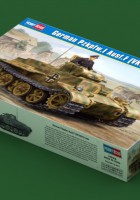
German Pzkpfw.I Ausf.F (VK18.01)- Late - HOBBY BOSS 83805

Hobby Boss

Topic

German Pzkpfw.I Ausf.F (VK18.01)-Late

Scale1/35
Ref83805

A model of the brand HobbyBoss the kit : German Pzkpfw.I Ausf.F (VK18.01)- Late – HOBBY BOSS 83805

Features : the kit consists of over 290 parts – multi-directional slide molded lower hull w/fine detail – photo-etched parts included

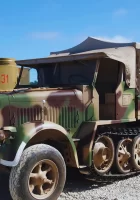
The second vehicle, the Ausf F, was as different from the Ausf C as it was from the Ausf A and B. Intended as an infantry support tank, the Panzer I Ausf F had a maximum armour thickness of 80 millimeters (3.15 in) and weighed between 18 and 21 tonnes. The Ausf F was armed with two 7.92-millimeter MG-34s. Thirty were produced in 1940, and a second order of 100 was later canceled. In order to compensate for the increased weight, a new 150 horsepower (110 kW) Maybach HL45 Otto engine was used, allowing a maximum road speed of 25 kilometers per hour (15.5 mph). Eight of the thirty tanks produced were sent to the 1 Panzer Division in 1943 and saw combat at the Battle of Kursk. The rest were given to several army schools for training and evaluation purposes.

Source: Hobby Boss

Continue reading

Views : 2643

B-17 Flying Fortress

B-17 Flying Fortress

CountryUSA
RoleHeavy bomber
First fly2 September 1947
Built12731

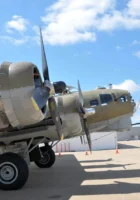
The Boeing B-17 Flying Fortress is a four-engine heavy bomber developed in the 1930s for the United States Army Air Corps (USAAC). Competing against Douglas and Martin for a contract to build 200 bombers, the Boeing entry (prototype Model 299/XB-17) outperformed both competitors and exceeded the air corps’ performance specifications. Although Boeing lost the contract (to the Douglas B-18 Bolo) because the prototype crashed, the air corps ordered 13 more B-17s for further evaluation. From its introduction in 1938, the B-17 Flying Fortress evolved through numerous design advances, becoming the third-most produced bomber of all time, behind the B-24 and the multirole Ju 88.

Source: B-17 Flying Fortress on Wikipedia

Continue reading

Views : 7903

2cm Flak 28

2cm Oerlikon – Flak-28

CountryURSS & Others
RoleAnti-Aircraft Gun
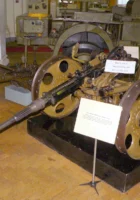
Photo gallery of a 2cm Oerlikon, The design of this legendary weapon since 1914! The German army was the first to use it on its aircraft during the Great War. Its designer, Reinhold Becker, transfer its invention in 1919 to Switzerland, which entrusts the production Semag firm soon absorbed by the Werkzeug Maschinenfabrik Oerlikon. The UK, like the main belligerents in the second world war, acquires the license.
Continue reading

Views : 5845

Chieftain AVRE

Chieftain AVRE

CountryUK
TypeAVRE
Photo gallery of a Chieftain AVRE, Armoured Vehicle Royal Engineers (AVRE) is the title given to a series of armoured vehicles operated by the Royal Engineers (RE) for the purpose of battlefield engineer support. These vehicles have been either purpose-built or post-production modifications of existing tank-based armoured vehicles. A common feature of most AVREs to date has been the retention of a large calibre main gun or its replacement by a weapon of a larger calibre. The most recent vehicle to be called an AVRE is the Challenger-based Trojan; however this vehicle breaks the trend by not having a large calibre weapon. With the multitude of functions now required of the RE, new vehicles have come into use which are given alternative names, but which are to all intents and purposes, AVREs.
Source: Wikipedia
Continue reading

Views : 4039

A-36 Apache - ITALERI 2729

Italeri

Ref 2729
TypeModel kit
Scale1/48
Topic

A-36 Apache

The A-36 Apache was the ground-attack and dive bomber version developed on the first batches of the famous fighter North American P-51 Mustang. The “Apache” was used by several U.S Air Force Squadrons during the last stages of North African campaign, during the invasion of Sicily and the campaign of Italy. Thanks to Its powerful V12 engine, with 1,325 HP, A-36 was able to reach a maximum speed of 600 Km/h. Armed with 6 Browning M2 0.5 machine guns, the A-36 Apache was able to load, in its two under wings hard points, up to 1,000 lb. of bombs. The dive breaks and the reinforced wing structures gave the A-36 a great stability and a great efficiency and precision in ground-attack missions. However, by mid of 1944, the A-36 were replaced, to perform ground-attack operating duties, by the more modern and more powerful Republic P-47 Thunderbolts

Source: Italeri

Continue reading

Views : 3027

CR.32 ''Chirri'' - ITALERI 1322

Italeri

Ref 1322
TypeModel kit
Scale1/72
Topic

CR.32 ”Chirri”

Designed in the early part of the ’30s, the Fiat CR 32 was powered by an V 12-cylinders, producing 600 hp. It was able to reach, as maximum speed, 375 Km / h. Among the most famous biplanes of aviation History the CR 32 was characterized by an extraordinary maneuverability. It was also strong, very reliable and well armed for the historical period, with two 12.7 mm Breda-Safat machine gun located on the top of engine and firing through the propeller disc. The Fiat CR 32 had its baptism of fire with the Legionary Air Forces, during the Spanish Civil War, and soon obtained the air superiority against the Soviet-made monoplane fighters, like the Polikarpov I-16, that formed the Squadrons of Republican Aviation. Thanks to the extraordinary mobility and the training of pilots, the Italian fighters prevailed even on from more modern enemy airplanes such as the Soviet-made Tupolev SB-2 bomber considered, thanks to its speed, impossible to be intercepted.

Source: Italeri

Continue reading

Views : 1672

GAZ-69A 4X4 Personnel Truck - Bronco CB35093

Bronco

RefCB35093
TypePersonnel Truck
Scale1/35
Topic

GAZ-69A 4X4 Personnel Truck

A kit from the brand Bronco the kit: GAZ-69A 4X4 Personnel Truck – Bronco CB35093.

The GAZ-69 was a Soviet 4×4 truck very similar to the American Dodge WC51 Weapons Carrier and WC57 Command Car of WWII vintage. The original GAZ-69 was built at Gorky Automobile Factory from 1953 to 1955, before production was switched to UAZ. Though technically all vehicles built after 1955 should be designated the UAZ-69, the GAZ-69 designation continued to be used. Originally the GAZ-69 was built as a 2-door truck that could carry 8 troops or 1/2 ton of cargo, powered by a 55bhp 4-cylinder engine. The GAZ-69A was a 4-door field car variant with seating for 5 men, mostly used as Officer transport. Both types were built at UAZ until 1972, as well as several other models such as the GAZ-69M export model 69 bhp engine, GAZ-69B repair truck and GAZ-69E Radio Car. All members of the GAZ-69 family were widely exported to Soviet client states as well as Third World countries.

Source: Bronco

Continue reading

Views : 1405

70mm Type 92 Howitzer

70mm Type 92 Howitzer

CountryJapan
TypeHowitzer
PhotographVladimir Yakubov
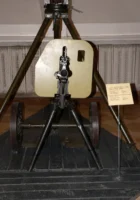
The Type 92 Battalion Gun was a light howitzer used by the Imperial Japanese Army during the Second Sino-Japanese War and World War II. The Type 92 number was designated for the year the gun was accepted, 2592 in the Japanese imperial year calendar, or 1932 in the Gregorian calendar. Each infantry battalion included two Type 92 guns; therefore, the Type 92 was referred to as “‘Battalion Artillery'”.
Source: Wikipedia
Continue reading

Views : 2987

Tank T-34 Polish - WalkAround

Tank T-34 Polish

CountryPolska
TypeMedium tank
Topic

Album of 31 photos walk-around of a tank T-34 Polish

photo gallery of a Tank T-34 Polish, The Tank T-34 was the most important weapon fielded by the Red Army in World War II. Sloping armour increased protection, the V-2 diesel engine used a less flammable fuel, the Christie suspension was fast on rough terrain, and wide tracks gave low ground pressure for good mobility in mud and snow, although reliability and manufacturing issues dogged the wartime production models. The 76.2 mm main armament remained effective to decreasing degrees through the end of the war; the improved 85 mm gun was among the world’s best in early 1944, and ensured that the overall T-34 design would remain competitive with German designs.

Source: Wikipedia

Seen on forum

Continue reading

Views : 5408