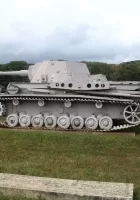
Heuschrecke IVb 10

Heuschrecke IVb 10 – Grasshopper

CountryGermany
TypeAnti-tank gun
Topic

Album of 48 photos walk-around of a Heuschrecke IVb 10

Photo gallery of a Heuschrecke IVb 10, The Heuschrecke 10 (English: Grasshopper 10) was a prototype self-propelled gun and Waffenträger (English: “Weapon carrier”) developed by Krupp-Gruson between 1943 and 1944. The official designation of the vehicle was 105 mm leichte Feldhaubitze 18/1 L/28 auf Waffenträger Geschützwagen IVb and was to be built in Magdeburg, Germany. The Heuschrecke featured a removable turret which could be deployed as a pillbox or towed behind the vehicle as an artillery piece. Krupp produced only three prototypes from 1942–1943. The Heuschrecke initially made use of a shortened Panzerkampfwagen IV (Panzer IV) chassis, but it was later switched to the Geschützwagen IV chassis, developed for the Hummel self-propelled gun. Mass production of the Heuschrecke 10 was scheduled to start in February 1945, but never occurred.

Source: Wikipedia

Continue reading

Views : 3882

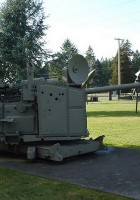
75mm M51 Skysweeper - WalkAround

75mm M51 Skysweeper

CountryUSA
TypeAntiaircraft gun

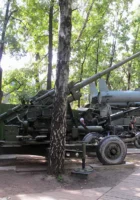
Photo gallery of a 75mm M51 Skysweeper, Skysweeper (Gun, M51, Antiaircraft or D48 Gun automatic, 75-mm T83E6, and E7, recoil mechanism, and loader rammer) was an anti-aircraft gun deployed in the early 1950s by both the U.S. Army and U.S. Air Force. It was the first such gun to combine a gun laying radar, M10 analog computer (director), and an autoloader on a single carriage.

Source: Wikipedia

Continue reading

Views : 3346

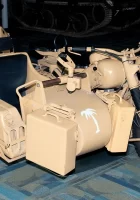
BMW R75

BMW R75 with Anhänger JF8

CountryGermany
TypeMoto

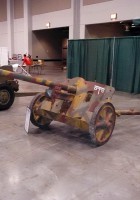
The BMW R75 was a motorcycle and sidecar combination that was developed and manufactured by the German company BMW from 1940 to 1944. It was one of the most advanced motorcycles of its time, and was specially designed to cope with the harsh conditions of the World War II battlefields. The motorcycle had a four-speed gearbox with a reverse gear that allowed it to maneuver in tight spaces. It also had a locking differential that enabled it to switch between two-wheel drive and three-wheel drive, depending on the terrain. The sidecar was rigidly attached to the frame of the motorcycle and had a driven wheel that could be engaged or disengaged by a clutch lever on the handlebar. The sidecar also had a brake pedal that could be operated by either the rider or the passenger. The BMW R75 could carry up to three people, including the rider, the passenger in the sidecar, and another passenger on the pillion seat behind the rider. It also had a towing capacity of 500 kg, and could be fitted with various accessories, such as a machine gun mount, a radio set, or a spare fuel tank. One of the trailers that could be towed by the BMW R75 was the Anhänger JF8, which was a small cargo trailer with a wooden box and a canvas cover. The Anhänger JF8 had a single wheel and a drawbar that connected to the sidecar by a ball hitch. The trailer could carry up to 250 kg of equipment or supplies, such as ammunition, food, or tools. It also had a spare wheel mounted on the front of the box, which could be used to replace a flat tire on the motorcycle or the sidecar. The BMW R75 with Anhänger JF8 was used by various units of the German army, especially in the Eastern Front, where it faced mud, snow, and ice. It proved to be reliable and versatile, and was able to traverse difficult terrain that other vehicles could not.

Source: Wikipedia
Continue reading

Views : 5564

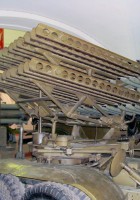
BM-31 12 Katyusha rocket launcher - WalkAround

BM-8 48

CountryURSS
TypeKatyusha rocket launcher
Topic

Album of 41 photos walk-around of a BM-8 48 Katyusha

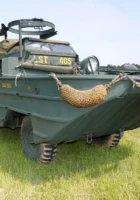
Photo gallery of a BM-8 48 Katyusha, Katyusha multiple rocket launchers are a type of rocket artillery first built and fielded by the Soviet Union in World War II. Multiple rocket launchers such as these deliver a devastating amount of explosives to a target area more quickly than conventional artillery, but with lower accuracy and requiring a longer time to reload. They are fragile compared to artillery guns, but are inexpensive and easy to produce. Katyushas of World War II, the first self-propelled artillery mass-produced by the Soviet Union, were usually mounted on trucks. This mobility gave the Katyusha (and other self-propelled artillery) another advantage: being able to deliver a large blow all at once, and then move before being located and attacked with counter-battery fire.

Version BM-8 48: calibre:82 mm, rockets:48, Truck:ZiS-6,Studebaker US6 U3, Other:rail carriage

Source: Wikipedia

Continue reading

Views : 4649

SdKfz 10 Demag

SdKfz.10 Demag

CountryGermany
TypeHalf-Track
Topic

Album of 21 photos of a SdKfz.10 Demag

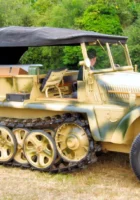
Photo gallery of a SdKfz.10 Demag, The Sd.Kfz. 10 (Sonderkraftfahrzeug – special motorized vehicle) was a German half-track that saw very widespread use in World War II. Its main role was as a prime mover for small towed guns such as the 2 cm FlaK 30, the 7.5 cm leIG, or the 3.7 cm PaK 36 anti-tank gun. It could carry eight troops in addition to towing a gun or trailer.

Source: SdKfz 10 on Wikipedia

Continue reading

Views : 8102

SdKfz 10 Demag

SdKfz.10 Demag

CountryGermany
TypeHalf-Track
Topic

Album of 126 photos of a SdKfz.10 Demag

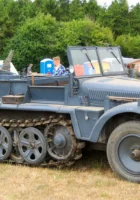
Photo gallery of a SdKfz.10 Demag, The Sd.Kfz. 10 (Sonderkraftfahrzeug – special motorized vehicle) was a German half-track that saw very widespread use in World War II. Its main role was as a prime mover for small towed guns such as the 2 cm FlaK 30, the 7.5 cm leIG, or the 3.7 cm PaK 36 anti-tank gun. It could carry eight troops in addition to towing a gun or trailer.

Source: SdKfz 10 on Wikipedia

Continue reading

Views : 14584