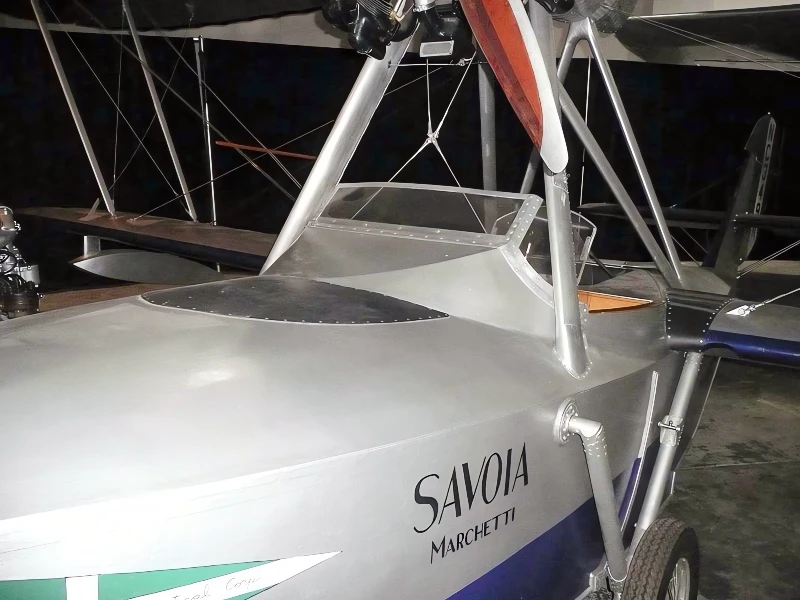
Savoia-Marchetti S.56 | |
|---|---|
| 国 | イタリア |
| 役割 | 複葉飛行艇 |
| 初飛行 | 1924 |
| 構築 | 70 |
ザ サヴォワ=マルケッティ S.56 was an Italian single-engine biplane flying boat trainer and tourer, built by Savoia-Marchetti. Of unequal span, the upper longer than the lower, of wooden construction. Instructor and student sat side by side in separate cockpits, with dual controls; a third cockpit was located just aft that. It used a 52 kW (70 hp) Anzani.
| サヴォワ=マルケッティ S-56 ウォークアラウンド | |
|---|---|
| カメラマン | ウラジーミル・ヤクボフ |
| ローカライズ | 航空博物館のゆりかご |
| 写真 | 55 |

| サヴォワ=マルケッティ S-56 ウォークアラウンド | |
|---|---|
| カメラマン | ファブリツィオ・ダン#8217;イサント |
| ローカライズ | イタリア航空機博物館 |
| 写真 | 19 |
関連項目:


The Elegant Italian Trainer and Prohibition-Era Coastal Patrol Flying Boat
ザ サヴォワ=マルケッティ S.56 was a three-seat, light amphibious biplane flying boat designed by Alessandro Marchetti and manufactured by the Italian aerospace firm Società Idrovolanti Alta Italia (SIAI-Marchetti) in the late 1920s. Designed originally as a military primary trainer and private touring aircraft, the S.56 featured a dual side-by-side cockpit, a lower single wing mounted to a hydrodynamic wooden hull, and a high-mounted engine operating in a tractor or pusher configuration depending on the variant. Licensed for production in the United States by the American Aeronautical Corporation (AAC) in Port Washington, New York, the S.56 gained immense fame during the Prohibition era as a fast, agile coastal patrol aircraft used by the US Coast Guard—and covertly by rum-runners—to navigate the inlets of the American East Coast.
| Attribute | Technical Specification (Savoia-Marchetti S.56 / American AAC S.56B) |
|---|---|
| 役割 | 3-Seat Light Utility Amphibian / Primary Trainer / Coastal Patrol Flying Boat |
| 乗組員 | 1 Pilot + 2 Passengers (or Instructor and Student in side-by-side seating) |
| パワープラント | 1 × Kinner K-5 5-cylinder air-cooled radial engine (100 hp) or Wright J-6 Whirlwind (225 hp on S.56C) |
| 最高速度 | 158 km/h (98 mph / 85 knots) max speed | ~132 km/h (82 mph) cruise speed |
| Gross / Takeoff Weight | 975 kg (2,150 lbs) maximum gross weight | ~650 kg (1,433 lbs) empty weight |
| Service Ceiling / Operational Range | 3,900 m (12,800 ft) ceiling | ~560 km (350 miles) maximum range |
| Wing Structure & Dimensions | Wingspan: 10.72 m (35 ft 2 in) | Sesquiplane wing design with fabric-covered wood framework |
| Hull Construction | Multi-ply wooden planking over ash and cedar framing with hydrodynamic step bottom |
| Landing Gear System | Manually retractable main landing gear pivoting upward alongside the outer hull sides |
| Production Total | ~60+ units built across Italian production lines and US license-assembly by AAC |
Design Engineering: Sesquiplane Aerodynamics, Plywood Hulls, and Side-by-Side Dual Controls
- Side-by-Side Dual Cockpit Layout: Unlike most military biplane trainers of the late 1920s that arranged student and instructor in tandem (one behind the other), the S.56 featured dual controls placed side-by-side in the front cockpit. This allowed flight instructors to directly observe student hand-and-rudder inputs and communicate clearly without needing acoustic speaking tubes.
- Lightweight Wooden Hydrodynamic Hull: Built following classic Italian boatbuilding techniques, the hull was constructed from layered cedar and ash ribbing skinned with waterproof mahogany plywood. The V-bottom hull incorporated a single hydrodynamic step that created a high air-water mixture cushion, allowing the light aircraft to lift off calm water surfaces quickly.
- High-Mounted Engine Nacelle: The engine was mounted on a strut-supported steel frame central structure above the hull, well clear of water spray. On American-built models powered by Kinner or Wright radial engines, this elevated thrust line kept the propeller blades safe from ocean spray corrosion and wave impacts during taxiing.
- Side-Folding Retractable Landing Gear: Designed for true amphibious capability, the main wheel assemblies were hinged to the upper hull sides. Using a manual lever system inside the cockpit, the pilot could swing the wheels up out of the water line for aquatic landings or drop them down for tarmac runway operations.
Operational History: US Coast Guard Rum-Patrols and Long Island Aviation Heritage
- American Licensing in Port Washington: In 1929, the American Aeronautical Corporation (AAC) acquired licensing rights to build SIAI-Marchetti designs in the US. AAC constructed a dedicated factory and seaplane ramp on Manhasset Bay in Port Washington, Long Island, assembling Americanized S.56s fitted with Kinner radial engines for wealthy civilian sport pilots.
- Prohibition Battles and the US Coast Guard: During the height of Prohibition, the US Coast Guard acquired a fleet of S.56s (designated as coastal reconnaissance flying boats) to combat illegal offshore alcohol smuggling. Operating out of coastal air stations, the nimble S.56s searched tidal estuaries and shallow bays to spot fast “rum-runner” motorboats hiding cargo along the coastline.
- The Private “Air Yacht” Boom: Before the Great Depression crippled luxury aviation manufacturing, the S.56 was marketed heavily to affluent Wall Street executives and Long Island estate owners as a personal “flying commuter car,” allowing owners to fly directly from estate docks to Manhattan’s East River seaplane terminals.
- Preserved Aviation Treasures: Very few S.56 airframes survived the 1930s. Today, an original, restored American-built Savoia-Marchetti S.56 is prominently displayed at the Cradle of Aviation Museum in Garden City, New York, celebrating Long Island’s pioneering golden age of flying boat manufacturing.
再生 : 1756
また、次の項目もご覧ください。
 Zmaj Fizir FN – 写真 & ビデオ
 シコルスキー VS-44 – 写真と動画
 Savoia Marchetti S.55 – 写真&動画
 SPAD S.XIII – PHOTOS& VIDEOS
 Short Solent – Photos & Video
 Sikorsky S-43 – Photos & VIdeos
 Douglas O-38 – Photos & Video
 Naval Aircraft Factory N3N – Photos & Video
 IMAM Ro 37bis – 写真&ビデオ
 Royal Aircraft Factory BE2A – Photos & Video