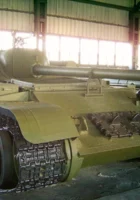
Su-101 Uralmash

Su-101 Uralmash

PaeseUnione Sovietica
RuoloSelf-propelled gun (prototype)
progettato1944-1945

Le Uralmash-1 (Уралмаш-1) was a Soviet prototype self-propelled gun developed during World War II. It was a turretless, tracked armoured fighting vehicle designed by the Yekaterinburg-based Uralmash design bureau (UZTM) between autumn 1944 and spring 1945. It used the chassis of the T-44 medium tank and was intended to replace the SU-100 which itself had only entered service with the Red Army in late 1944. Two prototypes of the Uralmash-1 with different armament were built in early 1945, one with the 100 mm D-10 tank gun, the other with the 122 mm D-25S tank gun. While mass production was initially recommended, the end of the war with Germany in May 1945 eventually caused the project to be cancelled due to lack of necessity. If the Uralmash-1 had entered service, the 100 mm variant would have been designated SU-101 (СУ-101) while the 122 mm variant would have been designated SU-102 (СУ-102), in accordance with Soviet military nomenclature, where the “SU”-label stood for Samokhodnaya Ustanovka, or self-propelled gun.

fonte: Su-101 Uralmash su Wiki

Continua a leggere

Visualizzazioni : 2603

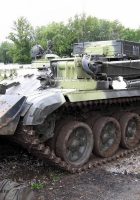
BREM-1

PaeseUnione Sovietica
RuoloArmoured repair and recovery vehicle

An Veicolo blindato di recupero (ARV) is an armoured vehicle used during combat for recovery or repair of battle-damaged and inoperable armoured fighting vehicles. The term “Armoured Repair and Recovery Vehicle” (ARRV) is also used. The Russian acronym BREM (cyr. БРЭМ) stands for “бронированная ремонтно-эвакуационная машина”, literally “armoured repair and recovery vehicle”. BTS-2 (T-54 Chassis) BTS-4A (T-54 Chassis) BREM-1 (T-72 Chassis) BREM-2 (BMP-1 Chassis) BREM-L (BMP-3 Chassis) BREM-K (BTR-80 Chassis) BREM-80U (T-80U Chassis)

fonte: BREM-1 on Wiki

Continua a leggere

Punti di vista : 3779

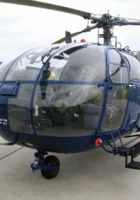
Alouette III

Alouette III

PaeseFrancia
RuoloElicottero utility leggero
Prodotto1961-1985
Costruito2000+

Le Aérospatiale Alouette III is a single-engine, light utility helicopter developed by Sud Aviation. It was manufactured by Aérospatiale of France, and under license by Hindustan Aeronautics Limited in India as the HAL Chetak, by Industria Aeronautică Română in Romania as the IAR 316 and F+W Emmen (de) in Switzerland. The Alouette III is the successor to the Alouette II, being larger and having more seating.

fonte: Alouette III su Wiki

Continua a leggere

Visualizzazioni : 6530

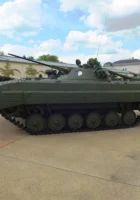
BMP-2

BMP-2

PaeseUnione Sovietica
RuoloVeicolo da combattimento di fanteria
ProdottoDal 1980 ad oggi
In servizioDal 1980 ad oggi

Le BMP-2 (Boyevaya Mashina Pekhoty, russo: Боевая Машина Пехоты; veicolo da combattimento di fanteria) è un veicolo da combattimento anfibio di seconda generazione introdotto negli anni '80 in Unione Sovietica, in seguito al BMP-1 degli anni '60.

fonte: BMP-2 su Wiki

Continua a leggere

Punti di vista: 3772

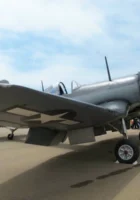
Vought F4U-1A Corsair

Vought F4U Corsair

PaeseUsa
RuoloCacciabombardardo imbarcato su portaerei
Prodotto1942–53
Numero costruito12571

Le Vought F4U Corsair è un aereo da combattimento americano che ha visto il servizio principalmente nella seconda guerra mondiale e nella guerra di Corea. La domanda per l'aereo ha presto sopraffatto la capacità produttiva di Vought, con conseguente produzione da parte di Goodyear e Brewster: i Corsair costruiti da Goodyear sono stati designati FG e aerei costruiti da Brewster F3A. Dal primo prototipo di consegna alla U.S. Navy nel 1940, alla consegna finale nel 1953 ai francesi, 12.571 Corsair F4U furono prodotti, in 16 modelli separati, nella più lunga produzione di qualsiasi caccia a pistoni nella storia degli Stati Uniti (1942-53)

fonte: Vought F4U Corsair su Wiki

Continua a leggere

Visualizzazioni : 19309

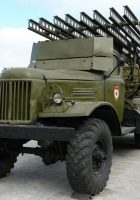
BM-13

PaeseUnione Sovietica
RuoloLanciatore a razzo multiplo
In servizio1939–presente
Prodotto1939–presente

Le Katyusha multiple rocket launcher (Russian: Катю́ша; IPA: [kɐˈtʲuʂə] (About this sound listen)) is a type of rocket artillery first built and fielded by the Soviet Union in World War II. Multiple rocket launchers such as these deliver explosives to a target area more quickly than conventional artillery, but with lower accuracy and requiring a longer time to reload. They are fragile compared to artillery guns, but are inexpensive, easy to produce, and usable on any chassis. The Katyushas of World War II, the first self-propelled artillery mass-produced by the Soviet Union, were usually mounted on ordinary trucks. This mobility gave the Katyusha, and other self-propelled artillery, another advantage: being able to deliver a large blow all at once, and then move before being located and attacked with counter-battery fire. Katyusha weapons of World War II included the BM-13 launcher, light BM-8, and heavy BM-31. Today, the nickname is also applied to newer truck-mounted post-Soviet – in addition to non-Soviet – multiple rocket launchers, notably the common BM-21 Grad and its derivatives.

fonte: BM-13 su ZiL-157 su Wiki

Continua a leggere

Visualizzazioni : 4767

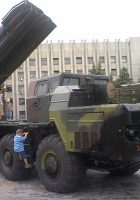
BM Smerch

BM-30 Smerch

PaeseUnione Sovietica
RuoloLanciatore a razzo multiplo
In servizio1989–presente
Prodotto1989–presente

Le BM-30 Smerch (russo: Смерч, "tromba d'aria"), 9K58 Smerch o 9A52-2 Smerch-M è un lanciarazzi multiplo pesante sovietico. Il sistema è progettato per sconfiggere bersagli di personale, corazzati e bersagli morbidi in aree di concentramento, batterie di artiglieria, posti di comando e depositi di munizioni. È stato creato nei primi anni 1980 ed è entrato in servizio nell'esercito sovietico nel 1989. Quando è stato osservato per la prima volta dall'Occidente nel 1983, ha ricevuto il codice MRL 280mm M1983. Si prevede che sarà sostituito dal 9A52-4 Tornado

fonte: BM-30 Smerch su Wiki

Continua a leggere

Punti di vista: 2474

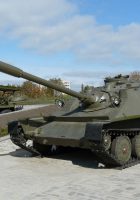
Asu-85

Asu-85

PaeseUnione Sovietica
RuoloCannone semovente
In servizio1959–1993
Prodotto1959–1966

L'ASU-85 (russo: Авиадесантная самоходная установка, АСУ-85, Aviadesantnaya Samokhodnaya Ustanovka, 'cavalcatura semovente aviotrasportata') è un semovente semovente di design sovietico dell'era della Guerra Fredda. Dal 1959, iniziò a sostituire l'ASU-57 a punta aperta in servizio. A sua volta, fu sostituito dal BMD-1 a partire dal 1969.

fonte: ASU-85 su Wiki

Continua a leggere

Visualizzazioni : 5690

M103A2 ·

M103 ·

PaeseUsa
RuoloCarro pesante
In servizio1957–74
Costruito300

L'M103 Heavy Tank (ufficialmente designato 120mm Gun Combat Tank M103) prestò servizio nell'esercito degli Stati Uniti e nel Corpo dei Marines degli Stati Uniti durante la Guerra Fredda. Gli ultimi M103 furono ritirati dal servizio nel 1974. L'M103 è stato l'ultimo carro pesante ad essere utilizzato dall'esercito americano mentre il concetto di Main Battle Tank si evolveva, rendendo obsoleti i carri pesanti.

fonte: M103 su Wiki

Continua a leggere

Views : 161

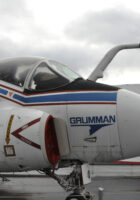
Grumman A-6DSD Intruso

Grumman A-6A Intruso

PaeseUsa
RuoloAerei d'attacco
Prodotto1962–1990
Costruito693

Le Grumman A-6 Intruso Il era un aereo da attacco statunitense bimotore ad ala media costruito dalla Grumman Aerospace. In servizio con la Marina degli Stati Uniti e il Corpo dei Marines tra il 1963 e il 1997, l'Intruder fu progettato come un aereo ad attacco medio per tutte le condizioni atmosferiche per sostituire il Douglas A-1 Skyraider a pistoni. Poiché l'A-6E era previsto per il ritiro, la sua missione di attacco di precisione fu presa in consegna dal Grumman F-14 Tomcat equipaggiato con un pod LANTIRN. Dall'A-6, fu sviluppato un derivato della guerra elettronica specializzata, l'EA-6.

fonte: Grumman A-6A Intruder - su Wiki

Continua a leggere

Views : 14346