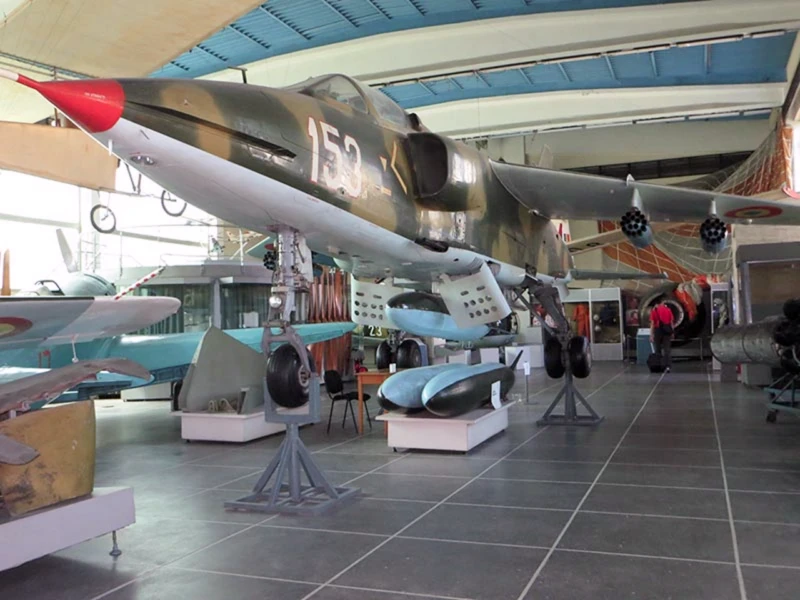
IAR-93 Vultur | |
|---|---|
| Pays | Roumanie |
| Rôle | Avion d’attaque au sol – Intercepteur à basse vitesse |
| Premier vol | Le 31 octobre 1974 |
| Construit | 88 |
Lla Avioane Craiova IAR-93 Vultur (Vautour) est un avion à double jet, subsonique, de soutien rapproché, d’attaque au sol et de reconnaissance tactique avec une capacité secondaire en tant qu’intercepteur de bas niveau. Construit comme version d’attaque principale monoplace ou version deux places capable de combat pour l’entraînement avancé au vol et aux armes, il a été développé comme un projet conjoint yougoslave-roumain dans les années 1970 pour les forces aériennes des deux nations. L’avion roumain a été construit par I.R.Av. Craiova sous le nom d’IAR-93, et son homologue yougoslave par Soko sous le nom de Soko J-22 Orao. Pour la Roumanie, l’IAR-93 devait remplacer les MiG-15 et les MiG-17 dans le rôle de chasseur-bombardier.
Source: IAR-93 Vultur sur Wikipedia
| IAR-93A Vultur Se promener | |
|---|---|
| Photographe | Bruno Ghuijs |
| Localisation | Inconnu |
| Photos | 29 |

Voir aussi :


Roumanie’s Cold War Eagle of Non-Aligned Ambition
Lla Aigle IAR-93 (Vulture) represents a rare and remarkable chapter in Eastern Bloc military aviation: a modern military jet engine development program independent of Moscow’s direct control. Developed in the 1970s as a joint venture between Communist Romania (IAR Craiova) and Non-Aligned Yugoslavia (SOKO), the aircraft was designated as the IAR-93 in Romania and the J-22 Orao in Yugoslavia. Designed under the joint « YUROM » project to replace aging Soviet MiG-15 and MiG-17 fighters, the Vultur was tailored for close air support, tactical reconnaissance, and ground attack. Operating under Nicolae Ceaușescu’s nationalist-leaning government, Romania sought to break its total dependence on Soviet weapon imports. While hampered by Western technology embargoes and modest performance, the IAR-93 emerged as a capable, highly rugged ground-attack platform built to operate from austere tactical airfields.
| Attribute | Technical Specification (IAR-93B Afterburning Variant Standard) |
|---|---|
| Rôle | Close Air Support / Tactical Reconnaissance / Ground Attack Aircraft |
| Crew | 1 (Single-seat A/B combat models) or 2 (Two-seat MB/DC trainer variants) |
| Groupe motopropulseur | 2 × Turbomeca/Rolls-Royce Viper Mk 633-47 afterburning turbojets (1,770 kgf / 4,000 lbf thrust each with afterburner) |
| Vitesse maximale | 1,086 km/h (675 mph / Mach 0.90) at sea level | Subsonic to low transonic |
| Combat Weight | 10,900 kg (24,030 lbs) maximum takeoff weight |
| Service Ceiling / Operational Range | 13,000 m (42,650 ft) ceiling | ~1,320 km (820 miles) ferry range with drop tanks |
| Primary Armament | 2 × 23 mm Gryazev-Shipunov GSh-23L twin-barrel autocannons (200 rounds per gun) mounted in lower fuselage |
| Armement secondaire | 5 hardpoints for up to 2,800 kg (6,170 lbs) of ordnance, including unguided rocket pods (LPR 57), general-purpose bombs (BE 100 to BE 500), and air-to-air missiles (A-91 / K-13) |
| Avionics & Flight Controls | Analog flight controls, radio altimeter, VHF/UHF comms, optical strike sight, radar warning receiver (RWR) |
| Production Total | 88 units manufactured by Avioane Craiova between 1975 and 1992 (excluding Yugoslav J-22s) |
Design Engineering: British Power, Yugoslav Airframes, and Rough-Field Legs
- The YUROM Anglo-French Engine Solution: Unable to buy modern military jet engines from the USSR without strict operational strings attached, Romania and Yugoslavia bypassed Moscow entirely. They secured a license from the UK to produce the British Rolls-Royce Viper turbojet domestically (manufactured as the *Viper Mk 632/633* by Turbomeca/METAV in Bucharest). While reliable and rugged, the un-afterburnt early Viper engines left the aircraft severely underpowered, requiring later variants (IAR-93B) to incorporate locally engineered afterburners.
- Rugged Multi-Wheel Landing Gear: Designed to operate in a high-intensity European war where main runways would be bombed out instantly, the Vultur was fitted with heavily reinforced, levered-suspension landing gear equipped with twin low-pressure tires on the main gear units. This allowed the aircraft to take off and land safely on short, unpaved grass strips and improvised highway stretches.
- High-Wing Swept Aerodynamics: The IAR-93 featured a high-mounted shoulder wing with a moderate 43-degree leading-edge sweep, small dog-tooth wing cuts, and leading-edge slats. This layout maximized low-altitude handling stability, allowing pilots to fly fast, low-level ground-attack profiles beneath enemy air defense radar networks.
- Twin-Engine Redundancy for Survivability: Placing two independent engines side-by-side inside the rear fuselage provided vital combat survivability against ground-based anti-aircraft artillery (AAA) and shoulder-fired surface-to-air missiles (MANPADS). If one engine was damaged or caught fire over enemy territory, the pilot could shut it down and return to base on the remaining engine.
Operational History: Cold War Patrols, Balkan Contrasts, and Early Retirement
- Forming the Romanian Tactical Attack Squadrons: Entering active service with the Romanian Air Force in 1979, the IAR-93 was deployed primarily with the 67th Fighter-Bomber Regiment based at Craiova and the 49th Fighter-Bomber Regiment at Ianca. Pilots trained extensively for low-level strike missions against enemy armor formations and logistics chokepoints.
- A Tale of Two Sister Aircraft: While Romania’s IAR-93 never saw active combat service, its Yugoslav twin—the *SOKO J-22 Orao*—saw extensive, heavy combat during the Yugoslav Wars of the 1990s. Yugoslav Oraos performed dozens of close air support and tactical bombing sorties over Croatia and Bosnia, demonstrating the effectiveness of the joint YUROM airframe design under combat conditions.
- The 1980s Structural Upgrades: Early-production models (IAR-93A) suffered from fatigue cracks near the engine bays due to heat and structural resonance. Romanian engineers at Craiova addressed these issues in the late 1980s by introducing the upgraded IAR-93B, which featured an extended fuselage, redesigned air intakes, improved hydraulics, and afterburning engines that finally unlocked the aircraft’s intended performance potential.
- Post-Cold War Retirement (1998): Following the fall of communism in 1989 and the economic turmoil of the 1990s, Romania struggled to maintain multiple jet platforms simultaneously. Faced with NATO standardization requirements, high maintenance costs for aging British-derived engines, and a shortage of spare parts, the Romanian Air Force officially retired the entire IAR-93 fleet in 1998. The remaining airframes were placed into outdoor storage or distributed to military museums, leaving the modern IAR-99 Soim as Romania’s primary domestic jet production legacy.
Vues : 2486
Vous pouvez voir aussi :
 Fokker S.14 Machtrainer – Photos & Vidéos
 Aichi D3A – Photos & Vidéos
 Pitcairn PA-5 Mailwing – Photos & Vidéos
 Northrop Tacit Blue – Photos & Vidéos
 Lockheed P-80 Shooting Star – Photos et vidéos
 Sikorsky S-39 – Photos et vidéos
 North American NA-64 Yale – Photos et vidéos
 Sud-Ouest Triton – Photos & Vidéo
 Culver PQ-14 Cadet – Photos et vidéo
 Northrop F-20 Tigershark – Photos et vidéo