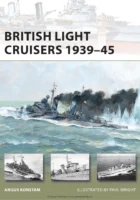
194 - Croiseurs légers britanniques 1939-45

Osprey Publishing

Ref

New Vanguard 194

ISBN9781849086844
Author
IllustratorPaul Wright

Un livre signé Éditions Osprey le livre « British Light Cruisers 1939-45 – NEW VANGUARD 194 ».

Le croiseur léger était un développement naturel de la frégate à voile – un navire de guerre polyvalent rapide qui pouvait patrouiller les voies maritimes, protéger les convois et repérer les flottes de combat ennemies. Dans l’entre-deux-guerres, le besoin de ce type de navire était encore plus important, compte tenu du besoin croissant de protection contre les avions et de la nécessité de protéger la flotte contre les sous-marins ou les destroyers. L’expérience de la guerre avait montré que le croiseur léger britannique était l’un des types de navires les plus polyvalents de la Royal Navy, capable de protéger d’autres navires de guerre, de bombarder les côtes ennemies, de garder des convois vitaux et d’intercepter et de détruire les navires de guerre ennemis. C’étaient vraiment les chevaux de bataille de la Royal Navy en temps de guerre. Alors que les cuirassés et les porte-avions ont fait la une des journaux, ces navires de guerre élégants et élégants se sont tranquillement attelés à la tâche d’assurer le contrôle des mers.

Source: Osprey

Lire l’article

Vues : 815

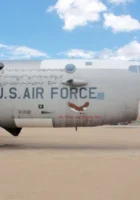
Boeing NB-52A Stratofortress

Boeing NB-52A Stratofortress

PaysUsa
Type

Bombardier stratégique à longue portée, subsonique et à réaction

Premier volLe 15 avril 1952
Construit34°

Photo gallery of a Boeing NB-52A Stratofortress, The Boeing B-52 Stratofortress is a long-range, subsonic, jet-powered strategic bomber. The B-52 was designed and built by Boeing, who have continued to provide support and upgrades. It has been operated by the United States Air Force (USAF) since the 1950s. The bomber carries up to 70,000 pounds (32,000 kg) of weapons. Beginning with the successful contract bid in June 1946, the B-52 design evolved from a straight-wing aircraft powered by six turboprop engines to the final prototype YB-52 with eight turbojet engines and swept wings. The B-52 took its maiden flight in April 1952. Built to carry nuclear weapons for Cold War-era deterrence missions, the B-52 Stratofortress replaced the Convair B-36. Although a veteran of several wars, the Stratofortress has dropped only conventional munitions in combat. Its Stratofortress name is rarely used outside of official contexts; it has been referred to by Air Force personnel as the BUFF (Big Ugly Fat/Flying Fucker/Fellow).

Source: Boeing NB-52A Stratofortress sur Wikipedia

Lire l’article

Vues : 2704

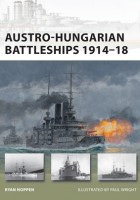
Austro-Hungarian Battleships 1914-18 - NEW VANGUARD 193

Éditions Osprey

Ref

New Vanguard 193

Isbn9781849086882
Auteur
IllustratorPaul Wright

Un livre signé Éditions Osprey the book «Austro-Hungarian Battleships 1914-18 – NEW VANGUARD 193» .

Austria-Hungary did not have an overseas empire; its empire lay within its own boundaries and the primary purpose of its navy until the beginning of the twentieth century was the defense of its coastline. As its merchant marine dramatically grew, admirals believed that the navy should take a more proactive policy of defense. The 1890s saw the beginning of a series of naval building programs that would create a well-balanced modern fleet. Cruisers were constructed for the protection of overseas trade and for “showing the flag” but the decisive projection of Austria-Hungary’s commitment to control the Adriatic was the construction of a force of modern battleships. Despite the naval arms race throughout Europe at the time, the navy had difficulty obtaining funds for new ships. The difficulties experienced in battleship funding and construction mirrored the political difficulties and ethnic rivalries within the empire. Nevertheless by August of 1914, the Austro-Hungarian had a fleet of battleships. This book details the five classes of Austro-Hungarian battleships in service during World War I.

Source: Éditions Osprey

Lire l’article

Vues : 1222

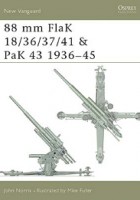
88 mm FlaK 18/36/37/41 and PaK 43 1936–45 - NEW VANGUARD 46

Éditions Osprey

Ref

New Vanguard 46

Isbn9781841763415
Auteur
IllustratorMike Fuller

Un livre signé Éditions Osprey le livre « 88 mm FlaK 18/36/37/41 et PaK 43 1936–45 – NEW VANGUARD 46 ».

Le 88 mm allemand était de loin l’arme d’artillerie la plus célèbre et la plus polyvalente de la Seconde Guerre mondiale. Il a d’abord été utilisé comme arme antiaérienne par la Légion Condor pendant la guerre civile espagnole et a été utilisé pour la première fois lors des invasions allemandes de la Pologne et de la France, où il a été utilisé pour la première fois dans son rôle antichar. Ce rôle a été particulièrement réussi et le 88 est devenu craint par les équipages de chars d’Afrique du Nord à la Russie. En dehors de ces deux rôles principaux, le 88 mm a été utilisé comme arme principale sur les chars allemands de la fin de la guerre, comme canon automoteur et même comme arme aérienne. Ce livre couvre toutes ces variantes, expliquant leur conception, leur développement et leur utilisation opérationnelle.

Source: osprey

Lire l’article

Views : 1125

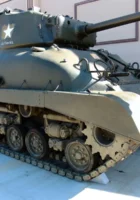
M4A1 ShermanM4A1 Sherman

M4A1 Sherman

PaysUsa
Rôle

Réservoir moyen

Galerie de photos d’un Sherman M4A1, Le M4 Sherman, formally Medium Tank, M4, was the primary tank used by the United States during World War II. Thousands were also distributed to the Allies, including the British Commonwealth and the Soviet Union, via lend-lease. In the United Kingdom, the M4 was named after Union General William Tecumseh Sherman, following the British practice of naming their American-built tanks after famous American Civil War generals. Subsequently, the British name found its way into common use in the U.S. The Sherman evolved from the Grant and Lee medium tanks, which had an unusual side-sponson mounted 75 mm gun. It retained much of the previous mechanical design, but added the first American main 75 mm gun mounted on a fully traversing turret, with a gyrostabilizer enabling the crew to fire with reasonable accuracy while the tank was on the move. The designers stressed mechanical reliability, ease of production and maintenance, durability, standardization of parts and ammunition in a limited number of variants, and moderate size and weight. These factors made the Sherman superior in some regards to the earlier German light and medium tanks of 1939-41. The Sherman ended up being produced in large numbers and formed the backbone of most Allied offensives, starting in late 1942.

Source: M4A1 sur Wikipedia

Lire l’article

Views : 11085

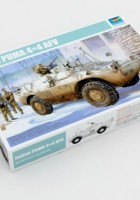
Puma italien 4×4 AFV - Trompettiste 05525

Trumpeter

Ref 05525
SujetModèles
Échelle1/35
Sujet

PUMA 4×4 AFV italien

Un modèle de la marque Trumpeter le kit: Italian PUMA 4×4 AFV – Trumpeter 05525.

Features : The kit consists of over 410 parts -multi-slide moulded upper hull -the kit w/refined detail -Rubber tyres w/fine detail -Included Photo-etched parts

The Puma Armoured Fighting Vehicles are a family of light wheeled armoured vehicles developed in a 4×4 and 6×6 configuration by the Consorzio Iveco Fiat – Oto Melara based in Rome. The Puma were developed for the Italian Army to complement the fleet of Centauro Tank Destroyer. Iveco Fiat were awarded a contract by the Italian Army for the development of Puma platforms carrying missiles, a mortar carrier, an ambulance and a command post vehicle. At the end of 1999, the Italian Army ordered 580 Puma vehicles, 250 of the 6×6 configuration, and 330 4×4 vehicles. First vehicles were completed in mid-2003. The Puma was first deployed operationally in Southern Iraq in early 2005.

Source: Italian PUMA 4×4 AFV on Trumpeter

Lire l’article

Vues : 1043

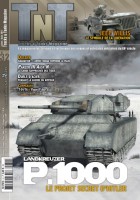
P.1000 Ratte Le Léviathan terrestre - Revue TnT 32

Trucks & Tanks Magazine

Editeur Caraktère
TitreP.1000 Ratte Le Léviathan terrestre
Réf32
Sujets

P.1000 Ratte,Jeep Willys,Panzer III,Bagration…

P.1000 Ratte : Le Léviathan terrestre – La Jeep Willys : Le symbole de la Victoire – Panzer III Ausf. N : La garde rapprochée des Tiger – Dossier : Bagration : L’Armée Rouge reprend la main – Duels d’acier : Les combats de chars pendant la guerre du Kippour – Camouflage : LT vz. 35 sous les couleurs étrangères – Comparatif : T-34/76 vs. Panzer IV Ausf. G
Source: Trucks & Tanks Magazine
Lire l’article

Views : 1258

NOUVEAU VANGUARD 33

Osprey Publishing

Réf33
SérieNouvelle avant-garde
Isbn9781855329119
AuteurSteven J Zaloga
IllustrationurJim Laurier

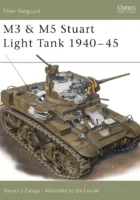
Un livre signé Éditions Osprey le livre « M3 & M5 Stuart Light Tank 1940-45 - NEW VANGUARD 33 » .

La famille de chars légers M3 et M5 a été l’aboutissement du développement de chars américains dans les années 1930. Au moment du déclenchement de la Seconde Guerre mondiale, ils approchaient de l’obsolescence, alors que les chars en Europe passaient des chars légers aux chars moyens comme élément principal de leurs forces blindées. Entré pour la première fois au combat à l’automne 1941 dans le désert occidental avec l’armée britannique, le Stuart a rapidement prouvé ses insuffisances. Les chars légers M3 et M5 se sont avérés plus appropriés dans le théâtre du Pacifique qu’en Europe, et ont combattu avec succès dans de nombreuses batailles majeures, y compris Guadalcanal, Tarawa et Peleliu. Ce titre raconte ce véhicule de combat distinctif et inhabituel’l’histoire.

Source: osprey

Lire l’article

Vues : 1073