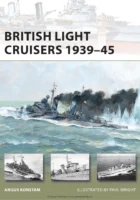
194 - British Light Cruisers 1939-45

Osprey Publishing

Ref

New Vanguard 194

ISBN9781849086844
Author
IllustratorPaul Wright
 

A book signed Osprey Publishing the book «British Light Cruisers 1939-45 – NEW VANGUARD 194» .

The light cruiser was a natural development of the sailing frigate – a fast multi-purpose warship that could patrol the sea lanes, protect convoys and scout for enemy battle fleets. By the inter-war period the need for this type of ship was even more important, given the increasing need for protection from aircraft, and the need to screen the fleet from submarines or destroyers. Wartime experience had shown that the British light cruiser was one of the most versatile types of ship in the Royal Navy, able to protect other warships, bombard enemy shores, guard life-saving convoys and intercept and destroy enemy warships. These were truly the workhorses of the wartime Royal Navy. While the battleships and carriers grabbed the headlines, these sleek, elegant warships quietly got on with the job of securing control of the seas.

Source: Osprey

Continue reading

Views : 691

Boeing NB-52A Stratofortress

Boeing NB-52A Stratofortress

CountryUSA
Type

Long-range, subsonic, jet-powered strategic bomber

First flight15 April 1952
Built744

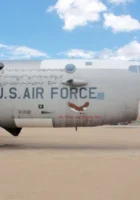
Photo gallery of a Boeing NB-52A Stratofortress, The Boeing B-52 Stratofortress is a long-range, subsonic, jet-powered strategic bomber. The B-52 was designed and built by Boeing, who have continued to provide support and upgrades. It has been operated by the United States Air Force (USAF) since the 1950s. The bomber carries up to 70,000 pounds (32,000 kg) of weapons. Beginning with the successful contract bid in June 1946, the B-52 design evolved from a straight-wing aircraft powered by six turboprop engines to the final prototype YB-52 with eight turbojet engines and swept wings. The B-52 took its maiden flight in April 1952. Built to carry nuclear weapons for Cold War-era deterrence missions, the B-52 Stratofortress replaced the Convair B-36. Although a veteran of several wars, the Stratofortress has dropped only conventional munitions in combat. Its Stratofortress name is rarely used outside of official contexts; it has been referred to by Air Force personnel as the BUFF (Big Ugly Fat/Flying Fucker/Fellow).

Source: Boeing NB-52A Stratofortress on Wikipedia

Continue reading

Views : 2361

Austro-Hungarian Battleships 1914-18 - NEW VANGUARD 193

Osprey Publishing

Ref

New Vanguard 193

ISBN9781849086882
Author
IllustratorPaul Wright
 

A book signed Osprey Publishing the book «Austro-Hungarian Battleships 1914-18 – NEW VANGUARD 193» .

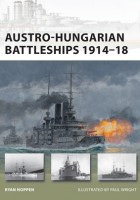
Austria-Hungary did not have an overseas empire; its empire lay within its own boundaries and the primary purpose of its navy until the beginning of the twentieth century was the defense of its coastline. As its merchant marine dramatically grew, admirals believed that the navy should take a more proactive policy of defense. The 1890s saw the beginning of a series of naval building programs that would create a well-balanced modern fleet. Cruisers were constructed for the protection of overseas trade and for “showing the flag” but the decisive projection of Austria-Hungary’s commitment to control the Adriatic was the construction of a force of modern battleships. Despite the naval arms race throughout Europe at the time, the navy had difficulty obtaining funds for new ships. The difficulties experienced in battleship funding and construction mirrored the political difficulties and ethnic rivalries within the empire. Nevertheless by August of 1914, the Austro-Hungarian had a fleet of battleships. This book details the five classes of Austro-Hungarian battleships in service during World War I.

Source: Osprey Publishing

Continue reading

Views : 1098

88 mm FlaK 18/36/37/41 and PaK 43 1936–45 - NEW VANGUARD 46

Osprey Publishing

Ref

New Vanguard 46

ISBN9781841763415
Author
IllustratorMike Fuller

Un livre signé Osprey Publishing le livre «88 mm FlaK 18/36/37/41 and PaK 43 1936–45 – NEW VANGUARD 46» .

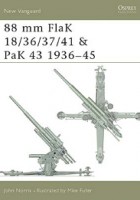
The German 88 mm was by far the most famous and versatile artillery weapon of World War II. It was first used as an anti-aircraft weapon by the Condor Legion during the Spanish Civil War and saw further service in the German invasions of Poland and France, where it was first used in its anti-tank role. This role was particularly successful and the 88 became feared by tank crews from North Africa to Russia. Apart from these two main roles the 88 mm was used as the main weapon on late-war German tanks, as a self-propelled gun, and even as an aerial weapon. This book covers all these variants, explaining their design, development and operational use.

Source: osprey

Continue reading

Views : 986

M4A1 Sherman - WalkAround

M4A1 Sherman

CountryUSA
Role

Medium tank

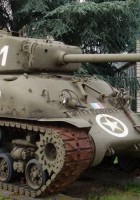
Photo gallery of a M4A1 Sherman, The M4 Sherman, formally Medium Tank, M4, was the primary tank used by the United States during World War II. Thousands were also distributed to the Allies, including the British Commonwealth and the Soviet Union, via lend-lease. In the United Kingdom, the M4 was named after Union General William Tecumseh Sherman, following the British practice of naming their American-built tanks after famous American Civil War generals. Subsequently, the British name found its way into common use in the U.S. The Sherman evolved from the Grant and Lee medium tanks, which had an unusual side-sponson mounted 75 mm gun. It retained much of the previous mechanical design, but added the first American main 75 mm gun mounted on a fully traversing turret, with a gyrostabilizer enabling the crew to fire with reasonable accuracy while the tank was on the move. The designers stressed mechanical reliability, ease of production and maintenance, durability, standardization of parts and ammunition in a limited number of variants, and moderate size and weight. These factors made the Sherman superior in some regards to the earlier German light and medium tanks of 1939-41. The Sherman ended up being produced in large numbers and formed the backbone of most Allied offensives, starting in late 1942.

Source: M4A1 on Wikipedia

Continue reading

Views : 10242

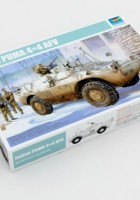
Italian PUMA 4×4 AFV - Trumpeter 05525

Trumpeter

Ref 05525
TopicModels
Scale1/35
Sujet

Italian PUMA 4×4 AFV

A model of the brand Trumpeter the kit: Italian PUMA 4×4 AFV – Trumpeter 05525.

Features : The kit consists of over 410 parts -multi-slide moulded upper hull -the kit w/refined detail -Rubber tyres w/fine detail -Included Photo-etched parts

The Puma Armoured Fighting Vehicles are a family of light wheeled armoured vehicles developed in a 4×4 and 6×6 configuration by the Consorzio Iveco Fiat – Oto Melara based in Rome. The Puma were developed for the Italian Army to complement the fleet of Centauro Tank Destroyer. Iveco Fiat were awarded a contract by the Italian Army for the development of Puma platforms carrying missiles, a mortar carrier, an ambulance and a command post vehicle. At the end of 1999, the Italian Army ordered 580 Puma vehicles, 250 of the 6×6 configuration, and 330 4×4 vehicles. First vehicles were completed in mid-2003. The Puma was first deployed operationally in Southern Iraq in early 2005.

Source: Italian PUMA 4×4 AFV on Trumpeter

Continue reading

Views : 932

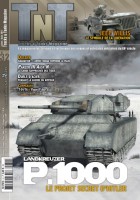
P.1000 Ratte Le Léviathan terrestre - Revue TnT 32

Trucks and Tanks Magazine

Publisher Caraktère
TitleP.1000 Ratte The Land Leviathan
Réf32
Topics

P.1000 Ratte,Jeep Willys,Panzer III,Bagration...

S.1000 Ratte : Le Léviathan terrestre – The Jeep Willys : Le symbole de la Victoire – Panzer III Ausf. n : La garde rapprochée des Tiger – File: Bagration : L’Armée Rouge reprend la main – Steel duels : Les combats de chars pendant la guerre du Kippour – camouflage : LT vz. 35 sous les couleurs étrangères – comparative In: T-34/76 vs. Ausf Panzer IV. g
Source: Trucks and Tanks Magazine
Continue reading

Views : 1150

NEW VANGUARD 33

Osprey Publishing

Réf33
SérieNew Vanguard
ISBN9781855329119
AuteurSteven J Zaloga
IllustrateurJim Laurier

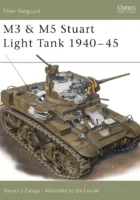
Un livre signé Osprey Publishing le livre «M3 & M5 Stuart Light Tank 1940–45 – NEW VANGUARD 33» .

The M3 and M5 family of light tanks were the culmination of American tank development of the 1930s. By the time of the outbreak of the World War II, they were approaching obsolescence, as tank forces in Europe were shifting from light to medium tanks as the main element of their armored forces. First entering combat in the autumn of 1941 in the Western Desert with the British Army, the Stuart quickly proved its inadequacies. The M3 and M5 light tanks proved more suitable in the Pacific theater than in Europe, and fought successfully in many of the major battles including Guadalcanal, Tarawa and Peleliu. This title narrates this distinctive and unusual fighting vehicle’s history.

Source: osprey

Continue reading

Views : 915