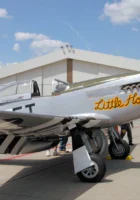
P-51D Mustang

P-51D Mustang

RiikUSA
Rolli

Ühekohaline võitleja

Esimene lend26. oktoober 1940
Ehitatud15000+0

Põhja-Ameerika lennundus P-51 Mustang was an American long-range, single-seat fighter and fighter-bomber used during World War II, the Korean War and other conflicts. The Mustang was conceived, designed and built by North American Aviation (NAA) in response to a specification issued directly to NAA by the British Purchasing Commission. The prototype NA-73X airframe was rolled out on 9 September 1940, 102 days after the contract was signed and, with an engine installed, first flew on 26 October. The Mustang was originally designed to use the Allison V-1710 engine, which had limited high-altitude performance. It was first flown operationally by the Royal Air Force (RAF) as a tactical-reconnaissance aircraft and fighter-bomber. The addition of the Rolls-Royce Merlin to the P-51B/C model transformed the Mustang’s performance at altitudes above 15,000 ft, giving it a performance that matched or bettered the majority of the Luftwaffe’s fighters at altitude. The definitive version, the P-51D, was powered by the Packard V-1650-7, a license-built version of the Rolls-Royce Merlin 60 series two-stage two-speed supercharged engine, and armed with six .50 caliber (12.7 mm) M2 Browning machine guns.

Allikas:P-51D Mustang Vikipeedias

Jätka lugemist

Views : 4990

SdKfz 02 - Kettenkrad - jalutage ringi

SdKfz 02 – Kettenkrad

CountryGermany
TypeLight half-track gun tractor
In service1941–1945

2007 SdKfz 2, paremini tuntud kui Kleines Kettenkraftrad HK 101 või Kettenkrad lühidalt (kus Ketten tähendab "kett" või "rajad" ja krad on sõjaline lühend saksakeelsest sõnast Kraftrad, administratiivne saksakeelne termin mootorratta kohta), alustas oma elu õhudessantvägede kerge traktorina. Sõiduk oli mõeldud tarnimiseks Junkers Ju 52 lennukiga, kuigi mitte langevarjuga. Sõiduki eeliseks oli see, et see oli ainus püstraktor, mis oli piisavalt väike, et mahtuda Ju 52 trümmi sisse, ja see oli kõige kergem masstoodetud Saksa sõjaväesõiduk, mis kasutas keerukat Schachtellaufwerki kattuvat ja põimitud maanteeratast, mida kasutati peaaegu kõigil Teise maailmasõja Saksa sõjaväe poolroomikutel.

Allikas: Kettenkrad Vikipeedias

Jätka lugemist

Views : 13226

SdKfz 162 - Jagdpanzer IV

Jagdpanzer IV – Sdkfz.162

RiikSaksamaa
TüüpTanki hävitaja
ToodetudDetsember 1943 – aprill 1945
Ehitatud2000+

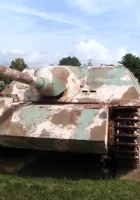
2007 Jagdpanzer IV, Sd.Kfz. 162, oli Saksa tankihävitaja, mis põhines Panzer IV šassiil ja ehitati kolmes põhivariandis. Ühe kasemati stiilis tornita Jagdpanzeri (tankihävitaja, sõna otseses mõttes "jahipaak") kujundusena töötati see välja Panzertruppeni peainspektori Heinz Guderiani soovide vastaselt Sturmgeschütz III (StuG III) asendajana. Guderian vaidles vastu Panzer IV tankitootmise ressursside tarbetule ümbersuunamisele, kuna Sturmgeschütz III oli oma rolli jaoks endiselt enam kui piisav.

Allikas: Vikipeedia

Jätka lugemist

Views : 3405

Saksa hävitaja Z-7 1942 - Trompet 05793

Trumpeter

Ref 05793
TüüpMudelikomplekt
Skaala1/700
Teema

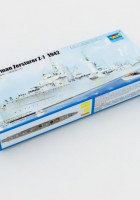
German Destroyer Z-7 1942

Brändi mudel Trumpeter komplekt: GGerman Destroyer Z-7 1942 – Trumpeter 05793.

Features : Hull -slide-molded upper hull and lower hull -Deck w/fine detail -Either waterline or full-hull version can be assembled -Phote Etched parts for mast, stand etc.

Z-7 hävitaja kuulub 1934A tüüpi, tuntud ka kui Z5 calss, käivitati 16. juulil 1936.Alustas teenistust 9. septembril 1937.Hävitaja alates 1934. aasta tüübikujundustunnist muutis laeva peremeesorganismi disaini ja parandas merepidamist, lihtsustatud konstruktsiooni kiirendatud ehitus paranes, nii et mõned laevad ja isegi 1934. aasta sünkronismiteenistus, kuid kasutati ainult vana relva meretulistamiseks, kogu jõudluses ei saa võrrelda ja Briti hävitajat. Võitlus kasutatakse peamiselt miinipildujana. Laev uppus lõpuks 2. mail 1942 HMS Edinburghi poolt.

Source: Trumpeter

Jätka lugemist

Vaadatud : 1580

MK.23 MTVR kaubaauto - Trumpeter 01011

Trumpeter

Ref 01011
TüüpMudelikomplekt
Skaala1/35
Teema

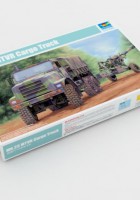
MK.23 MTVR Cargo Truck

Brändi mudel Trumpeter komplekt: MK.23 MTVR Cargo Truck – Trumpeter 01011.

Features : Detailed multi-directional slide-molded cab. > Full drive train assembly complete with engine transmission, differential housing and suspension units. > The main tires are hollow rubber with very good tread pattern included as well as sidewall details consisting of raised section ribs. > Wheel hubs are in great details > The windshield and side windows are made of clear parts. > Photo-etched parts included

Medium Tactical Vehicle Replacement (MTVR) is a six-wheel drive all-terrain vehicle used by the USMC and US Navy. It is designed to replace the old M939 tactical trucks, and was first fielded in 1998, after the contract was awarded to Oshkosh Truck Corporation. The MTVR comes in several variants, for a wide spectrum of tasks. It offers a major improvement in off-road capability. The MTVR is often referred to as a 7-Ton as this denotes the vehicle’s off-road cargo capacity. The MTVR’s maximum payload on paved surfaces is 15 tons. The MTVR is the Marine Corps prime mover for the M777 howitzer, fuel and water assets, troops and a wide variety of equipment. Its wide versatility and off-road capability make the MTVR an integral part of the Marine Corps logistical backbone.

Source: Trumpeter

Jätka lugemist

Vaated : 1990

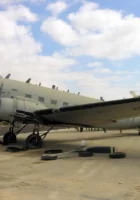
Douglas C-47

Douglas C-47 Skytrain

RiikUSA
TüüpSõjaväe transpordilennukid
Esimene lend23. detsember 1941
Ehitatud10174

Fotogalerii Douglas C-47 Dakota, The Douglas C-47 Skytrain or Dakota (RAF designation) is a military transport aircraft that was developed from the Douglas DC-3 airliner. It was used extensively by the Allies during World War II and remained in front line service with various military operators through the 1950s. The C-47 differed from the civilian DC-3 in numerous modifications that included being fitted with a cargo door and a strengthened floor. During World War II, the armed forces of many countries used the C-47 and modified DC-3s for the transport of troops, cargo, and wounded. The U.S. Naval designation was R4D. More than 10,000 aircraft were produced in Long Beach and Santa Monica, California and Oklahoma City, Oklahoma. The Oklahoma City plant produced 5,354 C-47s from March 1943 until August 1945.

Allikas: Vikipeedia

Jätka lugemist

Vaatamisi : 6326

saksa Pz.Sfl.Iva Dicker Max - Trompet 07108

Trumpeter

Ref 07108
TüüpMudelikomplekt
Skaala1/72
Teema

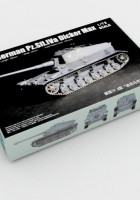
German Pz.Sfl.Iva Dicker Max

Brändi mudel Trumpeter komplekt: German Pz.Sfl.Iva Dicker Max – Trumpeter 07108.

Features : The kit consists of over 100 parts -detailed hull and turret

Oma 1938. majandusaasta aruandes paljastas Krupp, et algas 105 mm K L/52 Selbstfahrlafette projekteerimine. Masin oli kuulus kui "Dicker max". See oli relvastatud 105 mm K 18 L/52 Kruppiga. Püstol oli varustatud topeltdeflektoriga koonupiduriga, see relv suutis läbida 111 mm varjestust vertikaalse nurga all 30 kraadi kuni 2000 meetrit. See Panzerjagder oli kergelt soomustatud (10-50 mm) ja pealisehitis oli avatud. Mootoriks oli standardne 12-silindriline (bensiin) Maybach HL 120, mis tagas maanteel maksimaalse kiiruse 40 km/h. Operatsiooni "Barbarossa" esimestel kuudel Venemaal määrati nad Abt.521-le. Üks mõlemast hävis lahingus ja teine kaotati 1941. aastal. Kaks prototüüpi olid väga tõhusad, kuid vastukaaluks kõik venelaste poolt sel ajal lahingusse pandud mudelid.

Allikas: Trompetist

Jätka lugemist

Vaadatud: 1219

Nõukogude 2S3 152mm iseliikuv howitzer - varajane versioon - Trompet 05543

Trumpeter

Ref 05543
TüüpMudelikomplekt
Skaala1/35
Teema

Soviet 2S3 152mm Self-Propeller Howitzer – Early Version

Brändi mudel Trumpeter komplekt: Soviet 2S3 152mm Self-Propeller Howitzer – Early Version – Trumpeter 05543.

Features : The kit consists of over 530 parts -the kit w/refined detail -multi-slide moulded turret, upper hull and lower hull -240 individual tracks links

Designated M1973 by the US Army, the Akatsiya is armed with a 152.4 mm howitzer based on the Soviet 152.4 mm D-20 howitzer and is sometimes confused with the M109 self-propelled artillery. The artillery system was developed at the design bureau No. 9 of Kalinin Machine-Building Plant in Sverdlovsk. The factory designation of the howitzer is D-22 and the GRAU designation, 2A33. The chassis was developed by Uraltransmash. Driver’s and engine-transmission compartments are located in a front part of a hull, fighting compartment with rotatory turret – in middle and rear parts of the hull. The armour is welded rolled steel. Howitzer is equipped with R-123 radio set, R-124 intercom, automatic NBC system with filtration unit and fire-fighting equipment. The V-59 12-cylinder four stroke water-cooled diesel engine connects with a mechanical twin gear transmission, a gear box is in one block with a planetary steering gear. SO-152 has self-entrenching equipment which allows to prepare a trench within 20-40 min. The crew consists of 4-6 men: a driver, a gunner, a loader, a commander, and two ammunition bearers, which are positioned to the rear of the vehicle feeding rounds through two hatches in the hull rear when in masked firing position.

Source: Trumpeter

Jätka lugemist

Vaadatud : 1925