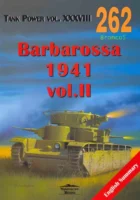
Wydawnictwo Militaria 262 Barbarossa 1941 vol. II

Wydawnictwo Militaria

SeriesTank Power
Sujet

Opération Barbarossa

Réf262

Signed documentation Wydawnictwo Militaria le livre «Barbarossa 1941 – Publishing House 262» .

Operation Barbarossa (German, Unternehmen Barbarossa), named after Emperor Frederick Barbarossa, is the code name for the Third Reich's invasion of the Union of Soviet Socialist Republics (USSR) during World War II. Launched on 22 June 1941, a year to the day after the signing of the armistice between France and the Third Reich, it opened the Eastern Front which became the main theatre of operations of the land war in Europe (from 1941 to 1945, 80% of the losses of the Wehrmacht were suffered on the Russian front1) and the crucial factor in the success or defeat of the Third Nazi Reich. This front will be the scene of the greatest and bloodiest ground battles of the Second World War. This invasion also marked a turning point in the war, until then still quite localized and European. It will soon set the whole world ablaze.

Source: Wikipedia

Continue reading

Views: 699

Wydawnictwo-Militaria-257-Belgrad-1944

Wydawnictwo Militaria

SeriesTank Power
Sujet

Liberation of Belgrade 1944

Réf257

Signed documentation Wydawnictwo Militaria the book "Liberation of Belgrade 1944 - Wydawnictwo 257" .

Alors que l’Armée rouge remonte vers la Hongrie après être entrée dans Sofia le 9 septembre 44, les Partisans de Tito libèrent Belgrade October 20, 1944. The Germans resisted in parts of Bosnia, Croatia and Slovenia until May 1945. On 14 May and 15 May, when Germany had already surrendered for a week, Tito's troops cut off the retreat of a column of German soldiers and collaborators: the Battle of Poljana, remportée par les Partisans, est le dernier combat de la Seconde Guerre mondiale en Europe.

Source: Wikipedia

Continue reading

Views : 859

Wydawnictwo-Militaria-255-T-27

Wydawnictwo Militaria

SeriesTank Power
Sujet

Chenillette T-27

Réf255

Signed documentation Wydawnictwo Militaria the book "Chenillette T-27 – Wydawnictwo 255" .

The T-27 chenillette is a light armored vehicle, produced in the Soviet Union during the 1930s. It is derived from the British Bren Carrier, whose production license the Soviets acquired.

Source: Wikipedia

Continue reading

Views : 406

Wydawnictwo Militaria 254 Marder I

Marder I

PublisherWydawnictwo Militaria
Series

Tank Power

Réf254

Signed documentation Wydawnictwo Militaria the book "Marder I - Wydawnictwo 254" .

The Marder I (Sd. Kfz. 135) was a German tank destroyer of the Second World War, armed with a 75 mm anti-tank gun. Most of the Marder I were built on the base of the armoured tractor 37L (Lorraine), an artillery tractor and armoured personnel carrier whose Germans had been able to seize more than three hundred copies after the defeat of France in 1940.

Source: Wikipedia

Continue reading

Views : 1389

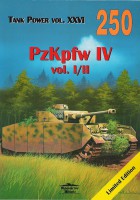
Panzer IV - Wydawnictwo 250

Wydawnictwo Militaria

SérieTank Power
Sujet

Panzer IV

Réf250

Une documentation signée Wydawnictwo Militaria le livre «Panzer IV – Wydawnictwo 250» .

Le Panzerkampfwagen IV (PzKpfW IV), souvent appelé Panzer IV était un char d’assaut utilisé par l’Allemagne nazie durant la Seconde Guerre mondiale. Conçu initialement comme char d’appui-feu, avec un canon de 75 mm court, pour le Panzerkampfwagen III, il finit par remplacer ce dernier quand les chars alliés devinrent trop protégés pour celui-ci. Rééquipé avec un canon long antichar, le PzKpfW IV fut le principal char allemand pendant la seconde partie de la guerre avec plus de 9000 exemplaires produits et donna naissance à de nombreuses versions.

Source: Wikipedia

Continue reading

Views : 946

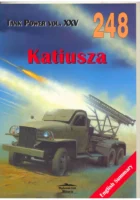
Wydawnictwo Militaria 248 Kataiusza

Wydawnictwo Militaria

SeriesWydawnictwo Militaria
PeriodWorld War II
Sujet

Katyusha - Katyusha - Stalin's Organ

Réf248

Signed documentation Wydawnictwo Militaria the book "Katyusha - Wydawnictwo 248" .

The Katyusha (en russe Катюша), diminutif russe de Catherine, est le surnom donné par les Soviétiques à un lance-roquettes en rafales de la Seconde Guerre mondiale. Ce nom vient de la chanson traditionnelle Katioucha. Surnommé par les Allemands « orgue de Staline » (Stalinorgel) à cause de ses caractéristiques, elle consistait en un camion tirant des roquettes en rafales. Plusieurs batteries de Katiouchas étaient généralement alignées, dans le but de créer un tir de barrage et de destruction très important. Leur formidable puissance de feu était néanmoins altérée par une forte imprécision du tir. Il existe deux versions de ce lance-roquettes en rafale, le BM-8 de 82 mm et le BM-13 132 mm (BM for Boïevaïa Machina, "combat vehicle"). Each truck had between 14 and 48 launchers.

Source: Wikipedia

Continue reading

Views : 994

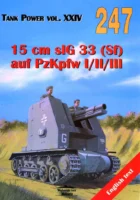
Wydawnictwo Militaria 247 15 cm sIG 33 (Sf) auf PzKpfw I II III

Wydawnictwo Militaria

SeriesWydawnictwo Militaria
SujetSIG 33 on Panzer I/II/II
Réf247

Signed documentation Wydawnictwo Militaria the book "SIG 33 - Wydawnictwo 247" .

The GIS 33 est un canon mis au point en Allemagne dans les années 1920, 1930 et 1940. Il fut mis en service à partir de 1933 et délaissé après la Seconde Guerre mondiale. N’ayant pas réussi à le rendre plus léger, les techniciens essayèrent de le rendre plus maniable en l’installant sur des châssis chenillés déclassés, avec plus ou moins de succès. D’abord installé sur le Panzer I, il s’avéra rapidement que le moteur de celui-ci était trop faible pour propulser le SIG 33. Des conversions sur châssis de PzKpfw II, 38 (t) surnommé Buffalo, Lorraine and PzKpfw III were more effective. Another evolution was the adoption of rims equipped with rubber bandages allowing traction by trucks or semi-tracked vehicles. Some of the rims were equipped with wooden spokes, somewhat lightening the lookout. He was placed in the infantry battalion's howitzer company (13th company) and assigned to the 4th Platoon, whose staff was one officer, five non-commissioned officers and thirty-three gunners, responsible for the implementation and relocation of the 2 GIS. Each howitzer was towed by a six-horse team led by three soldiers. The other part of the crew was transported to the forearm of the room. The other personnel were tasked with protecting, transmitting requests for support, receiving orders and adjusting fire, as well as administrative and support missions. The quality of the training often allowed the infantry unit to manage the information and transmit it effectively to the next level. In the summer of 1941, the Wehrmacht was equipped with a fleet of 867 SIG 33 heavy infantry guns.

Source: Wikipedia

Continue reading

Views : 865