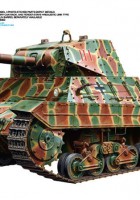
Italian Heavy Tank P40 - Tamiya 89792

Tamiya

Ref 89792
TopicScale model
Scale1/35
Sujet

Italian Heavy Tank P40

A model of the brand Tamiya the kit: Italian Heavy Tank P40 – Tamiya 89792 .

During WWII, the only heavy tank produced by Italy was the P40. The P stands for Pesante, or heavy in Italian, and the number 40 for the year of adoption, 1940. The tank featured bogey-style wheels on a lead spring suspension. The riveted hull construction was the same as the earlier Carro Armato M13/40 (Item 32596). The tank was equipped with a 75mm gun and an 8mm Breda machine gun and was powered by a 330hp V12 diesel engine. The P40 adopted sloped armor after encountering the Soviet T-34s in battle. Roughly 1,200 tanks were order, but only a few were completed before the Italian Armistice in 1943. Approximately 100 tanks were use from then to the end of the war in Northern Italy and Yugoslavia.

-Limited edition 1/35 scale plastic assembly kit of the Italian Heavy Tank P40. -Made by Italeri. -Length: 165mm. -Riveted hull, sloped armor, and leaf spring suspension have all been realistically reproduced. -Assembly type tracks included. -Photo-etched parts include exhaust covers, jerry can racks, and fender stays. -Markings included to depict Fiat Ansaldo’s prototype tank as well as German vehicles. (3 types of markings total). -40 page photo reference book included. -Item 89796 1/35 Metal Gun Barrel for Italian Heavy Tank P40 (Available Seperately.

Source: Tamiya
Continue reading

Views : 3505

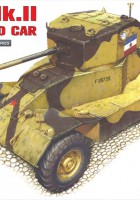
AEC Mk.II Armoured Car - MiniArt 35155

MiniArt

Ref35155
TypeArmoured Car
Scale1/35
Topic

AEC Mk.II Armoured Car

A model of the brand MiniArt the kit: AEC Mk.II Armoured Car – MiniArt 35155. AEC Armoured Car is a series of heavy armoured cars built by the Associated Equipment Company (AEC) during the Second World War. The first example was demonstrated in early 1941, and an order was placed in June of that year. The first version carried a Valentine Mk II turret with 2 pounder gun. Vehicles of later variant designs carried heavier armament. Mk II version has heavier turret with a 6 pounder gun, redesigned front hull, 158 hp diesel engine. The weight of Mk II is 12.0 t. Mk II and Mk III armored cars were used on continental Europe. Production of all the AEC armoured car marks ceased after 629 had been produced. The Mk II / Mk III took part in the fighting in Europe with British and British Indian Army units. In 1944 a batch of AEC armoured cars was send into Yugoslavia for use by partisans, transferred cars were used more than 10 years.

Model details: ·Highly detailed model ·487 plastic parts ·44 PE parts ·Decals are included ·Full-color instruction ·All New Tooling. Up-to-date technology using sliding moulds. ·Fully detailed interior ·Highly detailed engine compartment ·Engine is accurately represented ·Fighting compartment is truly reproduced ·Crews vision periscopes with clear plastic parts ·Driving compartment interior is fully detailed and correctly done ·All doors and hatches can be assembled open or closed ·Slide-molded tire made by 1 detail in plastic

Source:Miniart

Continue reading

Views : 1400

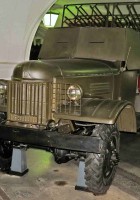
BM-31 12 Katyusha rocket launcher - WalkAround

BM-31 12

CountryURSS
TypeKatyusha rocket launcher
Topic

Album of 200 photos walk-around of a BM-31 12 Katyusha

Photo gallery of a BM-31 12 Katyusha rocket launcher, Katyusha multiple rocket launchers are a type of rocket artillery first built and fielded by the Soviet Union in World War II. Multiple rocket launchers such as these deliver a devastating amount of explosives to a target area more quickly than conventional artillery, but with lower accuracy and requiring a longer time to reload. They are fragile compared to artillery guns, but are inexpensive and easy to produce. Katyushas of World War II, the first self-propelled artillery mass-produced by the Soviet Union, were usually mounted on trucks. This mobility gave the Katyusha (and other self-propelled artillery) another advantage: being able to deliver a large blow all at once, and then move before being located and attacked with counter-battery fire. Katyusha weapons of World War II included the BM-13 launcher, light BM-8, and heavy BM-31. Today, the nickname is also applied to newer truck-mounted Soviet multiple rocket launchers—notably the common BM-21—and derivatives.

Source: Wikipedia

Continue reading

Views : 13317

SdKfz 9 Famo

Sd.Kfz. 9 Famo

CountryGermany
TypeHeavy half-track
Produced 1939–45
Built2500+

The Sd.Kfz. 9 also known as “Famo” was a German half-track that saw widespread use in World War II, and the heaviest half-track vehicle of any type built in quantity in Nazi Germany during the war years. Its main roles were as a prime mover for very heavy towed guns such as the 24 cm Kanone 3 and as a tank recovery vehicle. Approximately 2,500 were produced between 1938 and 1945.

Source: Famo on Wikipedia

Continue reading

Views : 5475

Pz.Kpfw VI Ausf B

Pz.Kpfw VI Ausf B

CountryGermany
TypeHeavy tank
Topic

Album of 57 photos walk-around of a tank «Pz.Kpfw VI Ausf B»

Photo gallery of a Pz.Kpfw VI Ausf B, Tiger II is the common name of a German heavy tank of the Second World War. The final official German designation was Panzerkampfwagen Tiger Ausf. B, often shortened to Tiger B. The ordnance inventory designation was Sd.Kfz. 182. It is also known under the informal name Königstiger (the German name for the “Bengal tiger”), often mistranslated as King Tiger or Royal Tiger by Allied soldiers.

Source: Wikipedia

Continue reading

Views : 8195

Messerschmitt Bf 109G

Messerschmitt Bf 109G

CountryGermany
TypeFighter aircraft
First flight29 May 1935
Built33984+

Photo gallery of a Messerschmitt Bf 109G, The Messerschmitt Bf 109, often called Me 109, was a German World War II fighter aircraft designed by Willy Messerschmitt and Robert Lusser during the early to mid-1930s. It was one of the first truly modern fighters of the era, including such features as all-metal monocoque construction, a closed canopy, a retractable landing gear, and was powered by a liquid-cooled, inverted-V12 aeroengine

Source: Messerschmitt Bf 109G on Wikipedia

Continue reading

Views : 7209

CH-46E

Boeing Vertol CH-46 Sea Knight

CountryUSA
TypeMedium-lift tandem rotor transport helicopter
Period1964 – 2015

The Boeing Vertol CH-46 Sea Knight is a medium-lift tandem rotor transport helicopter. It is used by the United States Marine Corps (USMC) to provide all-weather, day-or-night assault transport of combat troops, supplies and equipment. Additional tasks include combat support, search and rescue (SAR), support for forward refueling and rearming points, CASEVAC and Tactical Recovery of Aircraft and Personnel (TRAP). The Sea Knight was also the U.S. Navy’s standard medium-lift utility helicopter until it was phased out in favor of the MH-60S Knighthawk in the early 2000s. Canada also operated the Sea Knight, designated as CH-113, and operated them in the SAR role until 2004. Other export customers include Japan, Sweden, and Saudi Arabia. The commercial version is the BV 107-II, commonly referred to simply as the “Vertol”.

Source: Wikipedia

Continue reading

Views : 9337

T-55

Tank T-55

CountryURSS
TypeMain battle tank
In service1947–present
Built86000+

The T-54 and T-55 tanks are a series of Soviet main battle tanks introduced just as the Second World War ended. The first T-54 prototype appeared in March 1945 and entered full production in 1947. It became the main tank for armoured units of the Soviet Army, armies of the Warsaw Pact countries, and many others. T-54s and T-55s were involved in many of the world’s armed conflicts during the late 20th century.

46 T-55 on Wikipedia

Continue reading

Views : 9152

Kdf 82 Kubelwagen

Kubel Type 8

CountryGermany
TypeLight military vehicle

The Volkswagen Kübelwagen was a light military vehicle designed by Ferdinand Porsche and built by Volkswagen during World War II for use by the German military (both Wehrmacht and Waffen-SS). Based heavily on the Volkswagen Beetle, it was prototyped as the Type 62, but eventually became known internally as the Type 82. With its rolling chassis and mechanics built at Stadt des KdF-Wagens (renamed Wolfsburg after 1945), and its body built by US-owned firm Ambi Budd Presswerke in Berlin, the Kübelwagen was for the Germans what the jeep was for the Allies.

Source: Wikipedia

Continue reading

Views : 7772