
Curtiss F11C Goshawk | |
|---|---|
| Country | USA |
| Role | Carrier-borne Fighter & Fighter-Bomber |
| First flight | September 1932 |
| Buily | 30 |
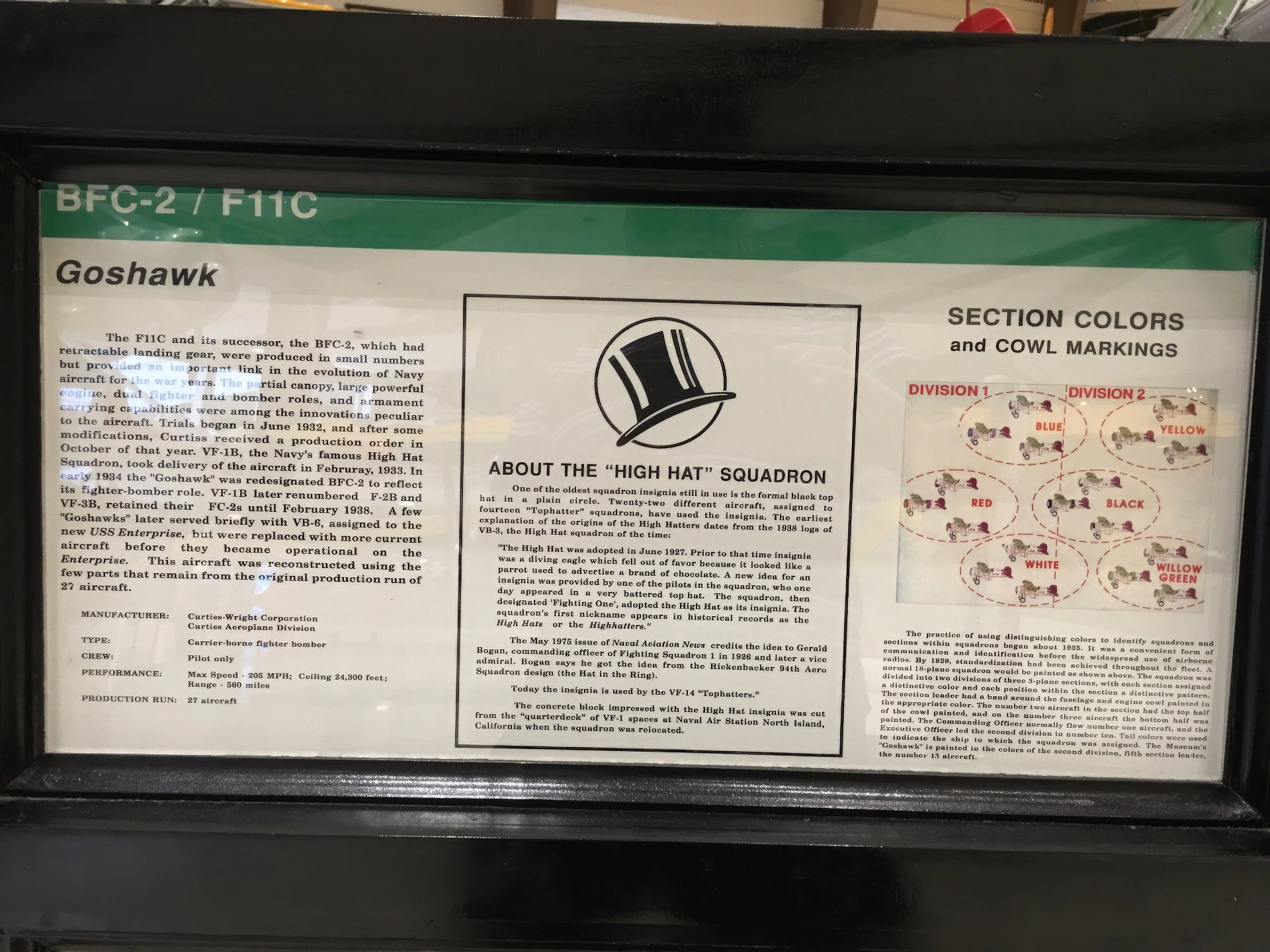
The Curtiss F11C Goshawk was a 1930s United States naval biplane fighter aircraft that saw limited success but was part of a long line of Curtiss Hawk airplanes built by the Curtiss Aeroplane and Motor Company for the American military.
Source: RCurtiss F11C Goshawk on Wikipedia
| BFC-2 Walk Around | |
|---|---|
| Photographer | Fotios Rouch |
| Localisation | Unknow |
| Photos | 22 |




See also:


by Michael Sharpe
324 Pages · 2000
General Characteristics and Role
The Curtiss F11C Goshawk was a single-seat biplane fighter and dive bomber developed for the United States Navy in the early 1930s. It was the last in the line of Curtiss biplane fighters, evolved from the Curtiss Hawk family. Although initially designated as a fighter (F11C), its role quickly expanded, and the production version was re-designated as a two-seat fighter-bomber/scout (BFC-2). The Goshawk was a highly maneuverable aircraft, serving briefly as a primary fighter aboard US Navy aircraft carriers before being quickly superseded by the shift to monoplane designs in the mid-1930s.
| Property | Typical Value (F11C-2 / BFC-2) |
|---|---|
| Role | Carrier-Based Fighter / Scout-Bomber |
| National Origin | United States |
| Manufacturer | Curtiss Aeroplane and Motor Company |
| First Flight | March 1932 |
| Crew | 1 (Pilot) or 2 (BFC-2/BF2C-1) |
| Length | 7.62 m (25 ft 0 in) |
| Wingspan | 9.60 m (31 ft 6 in) |
| Height | 3.35 m (11 ft 0 in) |
| Empty Weight | 1,217 kg (2,683 lb) |
| Gross Weight | 1,739 kg (3,835 lb) |
Powerplant and Performance
- Engine: One Wright R-1820-78 Cyclone nine-cylinder, air-cooled radial engine.
- Power Output: 522 kW (700 hp).
- Maximum Speed: 331 km/h (206 mph; 179 kn) at 1,370 m (4,500 ft).
- Cruise Speed: Approx. 257 km/h (160 mph; 140 kn).
- Range: 868 km (539 mi; 469 nmi).
- Service Ceiling: 7,830 m (25,700 ft).
- Retractable Landing Gear: Later variants (like the BF2C-1) introduced a fully retractable undercarriage, a crucial step toward monoplane design adoption.
Armament and Variants
- Fixed Armament: 2 x .30 in (7.62 mm) forward-firing Browning machine guns mounted above the engine cowling.
- Bomb Load: 1 x 474 lb (215 kg) bomb carried under the fuselage.
- Dive Bomber Role: The aircraft was equipped with a trapeze mechanism under the fuselage that swung the bomb clear of the propeller arc during a vertical dive.
- Major Variants:
- F11C-2: Initial fighter version.
- BFC-2: Redesignated production model focusing on the fighter-bomber/scout role.
- BF2C-1: Final variant with a fully retractable landing gear, quickly withdrawn due to structural failures caused by the new gear mechanism.
- Export: F11C-2s were sold to the Chinese Nationalist Air Force and the Turkish Air Force.
Views : 1859
You can see also :
 Curtiss P-36 Hawk – Photos & Videos
 Curtiss O-52 Owl – Photos & Video
 Curtiss C-46 Commando – Photos & Video
 Curtiss JN-4D Jenny – Photos & Video
 Curtiss P-6 Hawk – Photos & Video
 Curtiss-Wright SNC-1 Falcon – Photos & Video
 Curtiss N-9H – Photos & Video
 Curtiss F9C-2 Sparrowhawk – Photos & Video
 Curtiss XF15C-1 – Photos & Video
 Douglas A-26 Invader – WalkAround