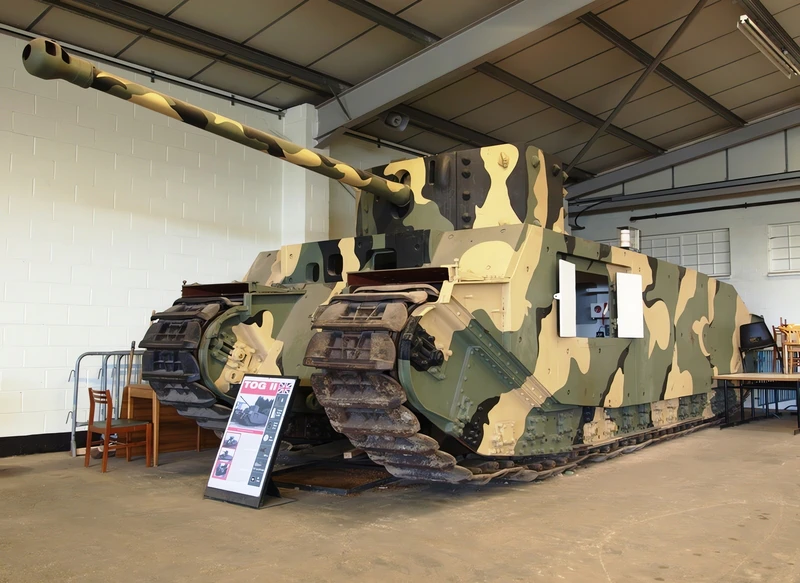
TOG2 | |
|---|---|
| Šalies | Jk |
| Vaidmenį | Itin sunkus bakas |
| Pagamintas | 1941 |
| Pastatytas | 1 prototipas |
bakas, sunkus, TOG II was a prototype British tank design produced in the early part of the Second World War in case the battlefields of northern France devolved into a morass of mud, trenches and craters as had happened during the First World War. When this did not happen the tank was deemed unnecessary and the project terminated. A development of the TOG I design, only a single prototype was built before the project was dropped.
Šaltinis: TOG2 Vikipedijoje
| TOG II Walk Around | |
|---|---|
| Fotografai | Nežinoti |
| Lokalizavimo | Nežinoti |
| Nuotraukos | 14 |


Taip pat žiūrėkite:


General Characteristics
The TOG II* (The Old Gang Mark II) was a British experimental super heavy tank designed early in World War II by the Special Vehicle Development Committee, a group nicknamed “The Old Gang” for having designed the original tanks of World War I. It was conceived for a worst-case scenario where the battlefields of Europe returned to the muddy, trench-filled conditions of WWI. Only a single prototype was built, and due to its slow speed and the shift toward mobile warfare, it was already obsolete by the time it was fully trialed in 1943, and never entered service.
| Property | Typical Value (TOG II*) |
|---|---|
| Vaidmenį | Experimental Super Heavy Tank / Trench Warfare |
| Gamintojas | William Foster & Co. Ltd. (Lincoln) |
| Pagamintas | 1941 (Prototype built) |
| No. Built | 1 (Prototype) |
| Įgulos | 6 (Commander, Gunner, 2 Loaders, Driver, Co-driver) |
| Mass (Weight) | 80–81.3 tonnes (Approx. 179,200 lb) |
| Ilgis | 10.13 m (33 ft 3 in) |
| Plotis | 3.12 m (10 ft 3 in) |
Powerplant and Mobility
- Engine: Paxman-Ricardo V12 diesel engine.
- Engine Power: 447 kW (600 hp).
- Power/Weight Ratio: Very low, approximately 7.5 hp/tonne.
- Maximum Speed (Road): 13.7 km/h (8.5 mph).
- Transmission: Diesel-electric drive (using two electric motors).
- Suspension: Initially unsprung, later modified to use **torsion bar suspension** in 1943.
- Design Concept: Its extremely long hull was specifically designed to bridge and cross wide trenches.
Armament and Armor
- Main Armament: The prototype was tested with several guns; it is historically fitted with the **Ordnance QF 28-pounder (94 mm) gun**, derived from a 3.7-inch anti-aircraft gun with a 17-pounder breech.
- Secondary Armament: One coaxial 7.92 mm Besa machine gun.
- Maximum Turret Armor: 114 mm (4.5 in) (Front of Turret).
- Maximum Hull Armor: 76 mm (3 in) (Front/Sides).
- Armament Significance: It was one of the first British tanks capable of mounting the powerful **QF 17-pounder (76.2 mm)** gun (or the 94mm derivation) in its large turret, making it highly effective against German armor of the time.
- Status: The single prototype remains a static display at The Tank Museum in Bovington, UK.
Peržiūrėta: 922
Taip pat galite pamatyti:
 P26/40 bakas - nuotraukos ir vaizdo įrašai
 M103 – Nuotraukos ir vaizdo įrašai
 Mark V maketas – nuotraukos ir vaizdo įrašas
 T-72 – WalkAround
 A39 vėžlys – WalkAround
 IS-2 vol3 – pasivaikščiojimas
 PzKpfw VIH Tigras - Vaikščioti aplink
 Tigras II – Königstiger vol3 – Walk Around
 Tigras I - Vaikščioti aplink
 JS2-M – Pasivaikščiojimas aplink