
Moto in guerra | |
|---|---|
| Descrizione | Album di foto "Motos in War" |
| Periodo | Seconda guerra mondiale |
| Oggetto | Moto militari |
Album fotografico di varie moto usate da tutti gli eserciti coinvolti nel conflitto della seconda guerra mondiale
Views : 6790
Moto in guerra | |
|---|---|
| Descrizione | Album di foto "Motos in War" |
| Periodo | Seconda guerra mondiale |
| Oggetto | Moto militari |
Album fotografico di varie moto usate da tutti gli eserciti coinvolti nel conflitto della seconda guerra mondiale
Views : 6790
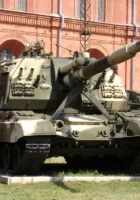
Obice semovente 2C19 MSTA-S | |
|---|---|
| Paese | Russia |
| Ruolo | Obice semovente |
Le 152 millimetri self-propelled howitzer 2C19 is a modern combat tracked vehicle with powerful armament, NB protection, high mobility and it conforms to all modern artillery requirements. The 2C19 can fire against observed targets from indirect position and by direct laying including mountain conditions and contaminated environment (elevation up to +50° C in the mountains). The 2C19 fires both the on-board rounds and the rounds from the ground with a high firing rate. The rounds used in the howitzer make provision for all the artillery tasks. The howitzer armouring provides a protection against armour-piercing bullets and projectile fragments to crew, armament, equipment, mechanisms; onboard rounds.
Visualizzazioni: 4117
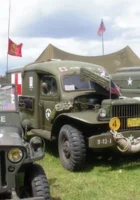
Dodge WC54 | |
|---|---|
| Paese | Usa |
| digitare | Camion leggero × 4×4 |
| Produttore | Dodge (Chrysler) |
Le Dodge WC54 3/4 Ton, designazione del catalogo di rifornimenti G502, era un camion leggero WC serie 4×4 sviluppato durante la seconda guerra mondiale. Servì come principale ambulanza utilizzata dall'esercito degli Stati Uniti dal 1942 al 1945, alcune delle quali furono utilizzate fino al 1953 durante la guerra di Corea dal Corpo medico dell'esercito degli Stati Uniti, e altre servirono fino agli anni '60 negli eserciti di alcuni paesi europei. A volte, molti sono stati utilizzati anche dagli US Signal Corps come furgoni radio.
fonte: Dodge WC54 su Wikipedia
Visualizzazioni : 6236
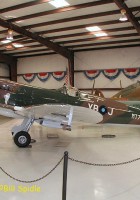
Supermarine Spitfire VIII | |
|---|---|
| Country | UK |
| Type | Single-seat fighter aircraf |
Le Supermarine Spitfire is a British single-seat fighter aircraft that was used by the Royal Air Force and many other Allied countries throughout the Second World War. The Spitfire continued to be used as a front line fighter and in secondary roles into the 1950s. It was produced in greater numbers than any other British aircraft and was the only British fighter in continuous production throughout the war. The Spitfire was designed as a short-range, high-performance interceptor aircraft by R. J. Mitchell, chief designer at Supermarine Aviation Works (which operated as a subsidiary of Vickers-Armstrong from 1928). Mitchell continued to refine the design until his death from cancer in 1937, whereupon his colleague Joseph Smith became chief designer. Where speed was seen as essential to carrying out the mission of home defence against enemy bombers, the Spitfire’s thin cross-section elliptical wing allowed it a higher top speed than several contemporary fighters, including the Hawker Hurricane.
fonte: Wikipedia
Views : 3525
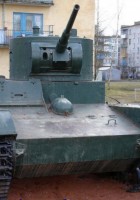
T-26 Staraya | |
|---|---|
| Paese | Unione Sovietica |
| Ruolo | Carro armato di fanteria leggera |
| In servizio | 1931–45 |
| Costruito | 10300+ |
Le T-26 Il era un carro armato di fanteria leggera sovietico utilizzato durante molti conflitti degli anni '30 e durante la seconda guerra mondiale. Fu uno sviluppo del carro armato britannico Vickers 6-Ton e fu uno dei progetti di carri armati di maggior successo degli anni '30 fino a quando la sua armatura leggera divenne vulnerabile ai nuovi cannoni anticarro. Fu prodotto in numero maggiore di qualsiasi altro serbatoio del periodo, con più di 11.000 unità prodotte. Durante gli anni '30, l'URSS sviluppò 53 varianti del T-26, tra cui carri armati lanciafiamme, veicoli da combattimento, carri armati telecomandati, cannoni semoventi, trattori di artiglieria e portaerei corazzate. Ventitré di questi erano prodotti in serie, altri erano modelli sperimentali.
fonte: T-26 su Wikipedia
Views : 5854
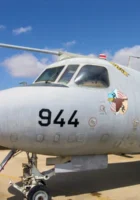
Northrop Grumman E-2 Occhio di Falco | |
|---|---|
| Paese | Usa |
| digitare | Allarme rapido tattico aereo capace di portaerei |
| Primo volo | 21 ottobre 1960 |
| Prodotto | Dal 1960 ad oggi |
Galleria fotografica di un Northrop Grumman E-2 Occhio di Falco, The Grumman E-2 Occhio di Falco è un aereo a trasmissione aerea (AEW) statunitense. Questo aereo biturboelica fu progettato e sviluppato tra la fine degli anni '50 e l'inizio degli anni '60 dalla Grumman Aircraft Company per la Marina degli Stati Uniti in sostituzione del precedente E-1 Tracer, che stava rapidamente diventando obsoleto. Le prestazioni dell'aereo sono state migliorate con le versioni E-2B ed E-2C, dove la maggior parte delle modifiche sono state apportate alle comunicazioni radar e radio a causa dei progressi nei circuiti integrati elettronici e in altre elettronica. La quarta versione dell'Occhio di Falco è l'E-2D, che volò per la prima volta nel 2007. L'E-2 fu il primo aereo progettato per essere un aereo AEW fin dall'inizio, in contrapposizione alla modifica di una cellula esistente, come l'E-3.
fonte: Wikipedia
Views : 12399
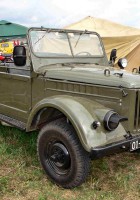
GAZ UAZ-69 | |
|---|---|
| Paese | URSS |
| digitare | Camion leggero a quattro ruote motrici |
| Descrizione | Album di 151 foto walk-around di un UAZ-69 |
GAZ-69 is a four wheel drive light truck, produced by GAZ between 1953 and 1955. From 1954 until 1972 it was produced by UAZ, as UAZ-69, though they were commonly known as GAZ-69s as well. It was also produced under licence by ARO in Romania, first as IMS-57, then as Muscel M59, later modernized as the Muscel M461. Many GAZ-69 trucks were used in Poland during the Cold War. The basic variant GAZ-69 has a pair of doors only and most often appears with standard canvas top and upper sides. Further variant GAZ-69A (UAZ-69A) has two pair of doors. From the UAZ-69 there were developed off-road van and light truck UAZ-450 and newer jeep UAZ-469.
fonte: Wikipedia
Punti di vista: 5623
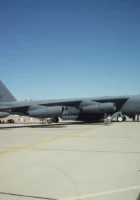
Boeing B-52 Stratofortress | |
|---|---|
| Paese | Usa |
| Ruolo | Bombardiere strategico |
| Primo volo | Il 15 aprile 1952 |
| Costruito | 744 |
Le Boeing B-52 Stratofortress è un bombardiere strategico a lungo raggio, subsonico e a reazione. Il B-52 è stato progettato e costruito da Boeing, che ha continuato a fornire supporto e aggiornamenti. È stato gestito dalla United States Air Force (USAF) dagli anni '50. L'attentatore trasporta fino a 70.000 libbre (32.000 kg) di armi. B-52B/RB-52B : The B-52B was the first version to enter service with the USAF on 29 June 1955 with the 93rd Bombardment Wing at Castle AFB in California. This version included minor changes to engines and avionics, enabling an extra 12,000 pounds of thrust to be produced using water injection. Temporary grounding of the aircraft after a crash in February 1956 and again the following July caused training delays, and at mid-year there were still no combat-ready B-52 crews. Of the 50 B-52Bs built, 27 were capable of carrying a reconnaissance pod as RB-52Bs (the crew was increased to eight in these aircraft). The 300 pound (136 kg) pod contained radio receivers, a combination of K-36, K-38, and T-11 cameras, and two operators on downward-firing ejection seats. The pod required only four hours to install.
Visualizzazioni : 4601
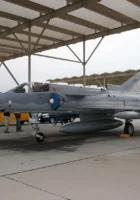
Kfir C2 | |
|---|---|
| Paese | Israele |
| Ruolo | Cacciabombardardo |
| Primo volo | Giugno I - 1973 |
| Costruito | 220+ |
Galleria fotografica di un Kfir C2, The Israel Aircraft Industries Kfir è un aereo da combattimento multiruolo costruito da Israele basato su una cellula francese Dassault Mirage 5 modificata, con avionica israeliana e una versione israeliana del motore turbogetto General Electric J79. Kfir C.2 : Un C.1 migliorato che presentava molti miglioramenti aerodinamici. I cambiamenti includevano bordi anteriori "dogtoothed" sulle ali, piccoli strakes sotto il naso e un angolo di sweep più grande dei canard.
fonte: Kfir su Wikipedia
Views : 6947
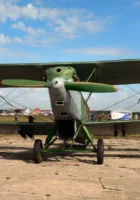
Polikarpov R-5 | |
|---|---|
| Paese | URSS |
| digitare | Aerei bombardieri da ricognizione |
| Primo volo | Autunno 1928 |
| Costruito | 7000+ |
Le Polikarpov R-5 was a Soviet reconnaissance bomber aircraft of the 1930s. It was the standard light bomber and reconnaissance aircraft with the Soviet Air Force for much of the 1930s, while also being used heavily as a civilian light transport, in the order of 7,000 being built in total. The R-5 was developed by the design bureau led by Nikolai Nikolaevich Polikarpov as a replacement for the R-1 which served as the standard reconnaissance and light bomber aircraft with the Soviet Air Force. The prototype first flew in autumn 1928, powered by an imported German BMW VI V-12 engine. It was an unequal span single bay biplane of mainly wooden construction. After extensive evaluation, the R-5 entered production in 1930, powered by Mikulin M-17s, a licence built copy of the BMW-VI, as a reconnaissance bomber. Further modified versions were produced to serve as floatplanes, ground attack aircraft and civil transports. The R-5SSS, an improved reconnaissance bomber with improved streamlining, served as the basis for the Polikarpov R-Z, which succeeded the R-5 in production.
fonte: Polikarpov R-5 su Wikipedia
Views : 3071