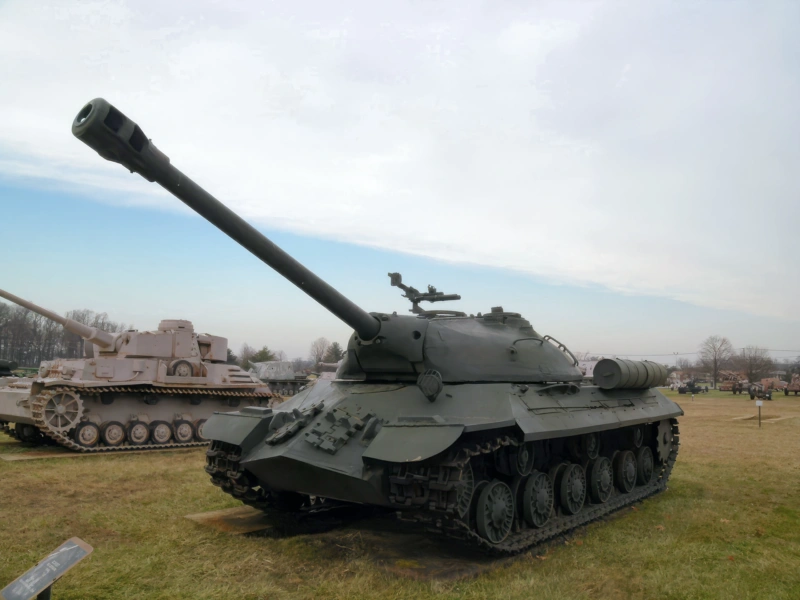
IS-3 JS-3 | |
|---|---|
| Land | URSS |
| Kategorie | Gepanzerte Fahrzeuge |
| Typ | Schwerer Panzer |
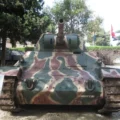
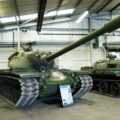
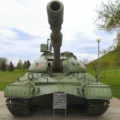
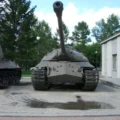
Fotogalerie auf einem schweren Panzer IS-3, Sein Debüt am Ende des Zweiten Weltkriegs der schwere Panzer IS-3Dies ist ein sowjetischer Kampfpanzer, der nicht in der Lage war, sich sehr aktiv an den Kämpfen zu beteiligen. Er nahm jedoch an der Militärparade am 7. September 1945 in Berlin teil, vor allem zu Propagandazwecken. Berechnung zahlt sich aus, da er die Beobachter der westlichen Mächte aufgrund seiner Macht und Seiner Modernität prägte. Der Name (IS oder JS) stammt aus den Initialen von Joseph Stalin dann sowjetischen ("J" für Joseph oder "I" für "Iossif" folgt, je nachdem, ob die russische Version des Vornamens verwendet wird oder nicht), die Zahl 3, die die Nummer der Version in der Serie der Josef Stalin Panzer.
Quelle: IS-3 on Wikipedia
| Char lourd IS-3 | |
|---|---|
| Fotograf | Unbekannter |
| Lokalisierung | Unbekannter |
| Fotos | 64 |

Siehe auch:


The IS-3 (or Object 703) was a heavy tank developed by the Soviet Union in the final stages of World War II. While it did not see combat during the war, it was a revolutionary design, notable for its sloped frontal hull, known as the “pike nose,” and its distinctive semi-hemispherical cast turret. The tank’s appearance at the 1945 Berlin Victory Parade greatly alarmed Western Allies, influencing post-war tank development in NATO nations.
Design und Entwicklung
Innovative Armor Layout
- Initial Requirement: To create a heavy tank with superior protection against German 88 mm guns, addressing the frontal weaknesses of its predecessor, the IS-2.
- Pike Nose: The frontal hull consisted of two heavily sloped armor plates welded together at a sharp central angle. This configuration maximized the effective thickness of the armor and increased the chance of ricochet.
- “Soup Bowl” Turret: The low-profile, cast, dome-shaped turret was inherently stronger ballistically than previous designs, offering excellent all-around protection due to its curvature and minimal vertical surfaces.
Service and Flaws
- WWII Service: Though production started in May 1945, the tank was too late for combat against Nazi Germany. It did, however, participate in the Berlin Victory Parade in September 1945.
- Mechanical Issues: Early production models suffered from significant reliability problems, including weak engine components, gearbox failures, and hull welds that cracked under stress from driving.
- Combat History: The IS-3 saw limited action with the Soviet Army during the 1956 Hungarian Revolution and was later exported, most notably to Egypt, where it saw service against Israel during the Six-Day War in 1967.
Technical Specifications (IS-3 Heavy Tank)
General Characteristics
| Spezifikation | Detail |
|---|---|
| Typ | Heavy Tank |
| Crew | 4 (Commander, Gunner, Loader, Driver) |
| Mass (Combat) | Approx. 46.5 tonnes (102,500 lb) |
| Length (Gun Forward) | 9.85 m (32 ft 4 in) |
| Breite | 3.15 m (10 ft 4 in) |
| Höhe | 2.45 m (8 ft 0 in) |
Armament and Protection
| Component | Detail |
|---|---|
| Hauptbewaffnung | 1 x 122 mm D-25T rifled gun |
| Ammunition Capacity | 28 rounds (Separate loading) |
| Sekundärbewaffnung | 1 x 12.7 mm DShK AA machine gun, 1 x 7.62 mm DT coaxial machine gun |
| Frontal Hull Armor | 110 mm at 55 to 72 degrees (Pike Nose) |
| Turret Front Armor | Up to 250 mm (Cast, hemispherical) |
Mobility and Powerplant
| Component | Detail |
|---|---|
| Motor | V-2-IS V-12 water-cooled diesel |
| Engine Power | 520 hp (388 kW) |
| Höchstgeschwindigkeit | Approx. 40 km/h (25 mph) on road |
| Federung | Torsionsstab |
| Einsatzbereich | 190 km (120 mi) |
The IS-3 was structurally flawed but strategically important. Its advanced frontal armor geometry set the design standard for future Soviet tanks, notably influencing the T-54/55 and the later T-10 heavy tank.
Ansichten : 3993
Belle béte