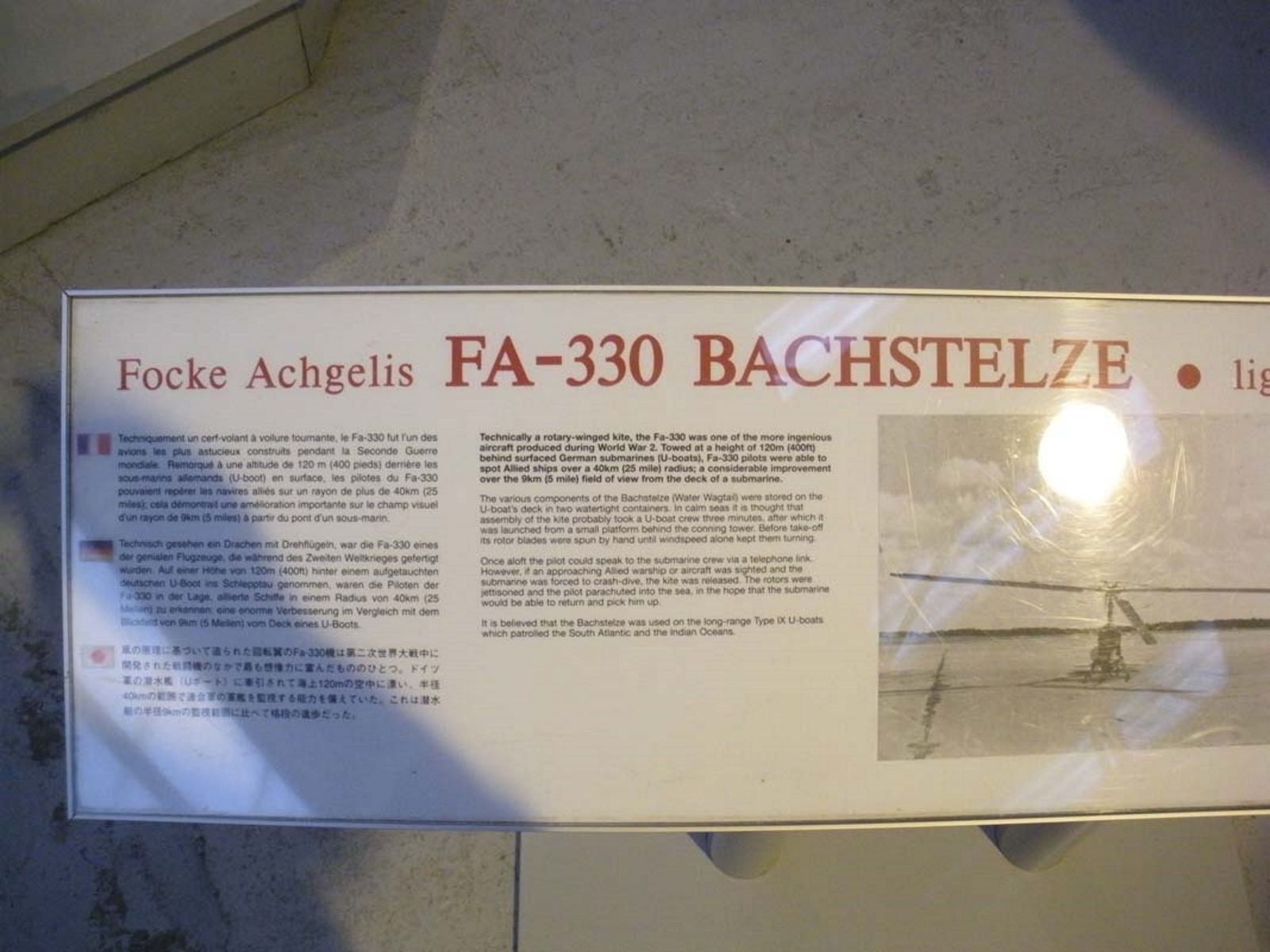
Focke-Achgelis Fa 330 | |
|---|---|
| Land | Nazityskland |
| Rolle | Autogyro drage |
| Første flyvning | Unknow |
| Bygget | 200 |
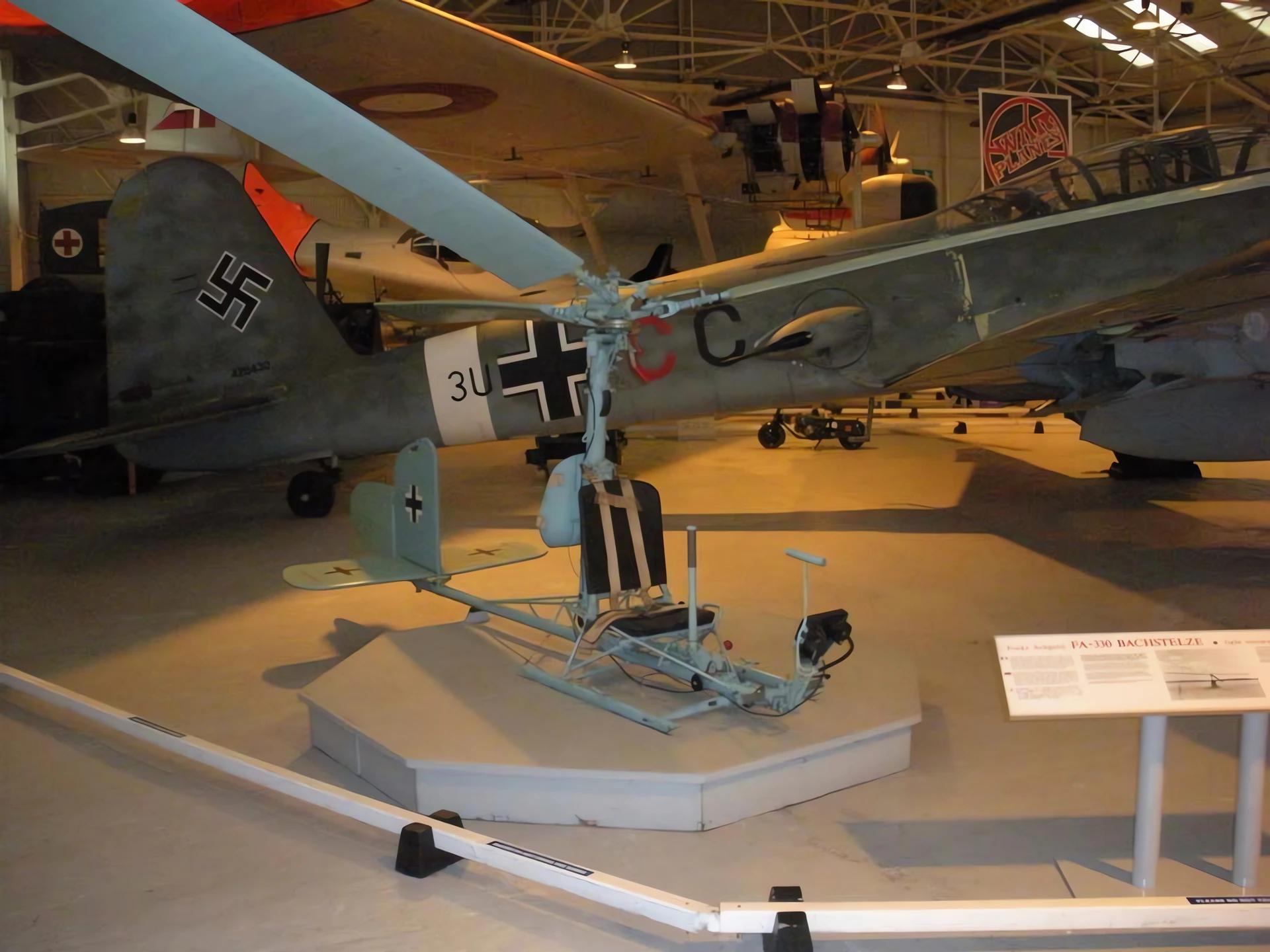
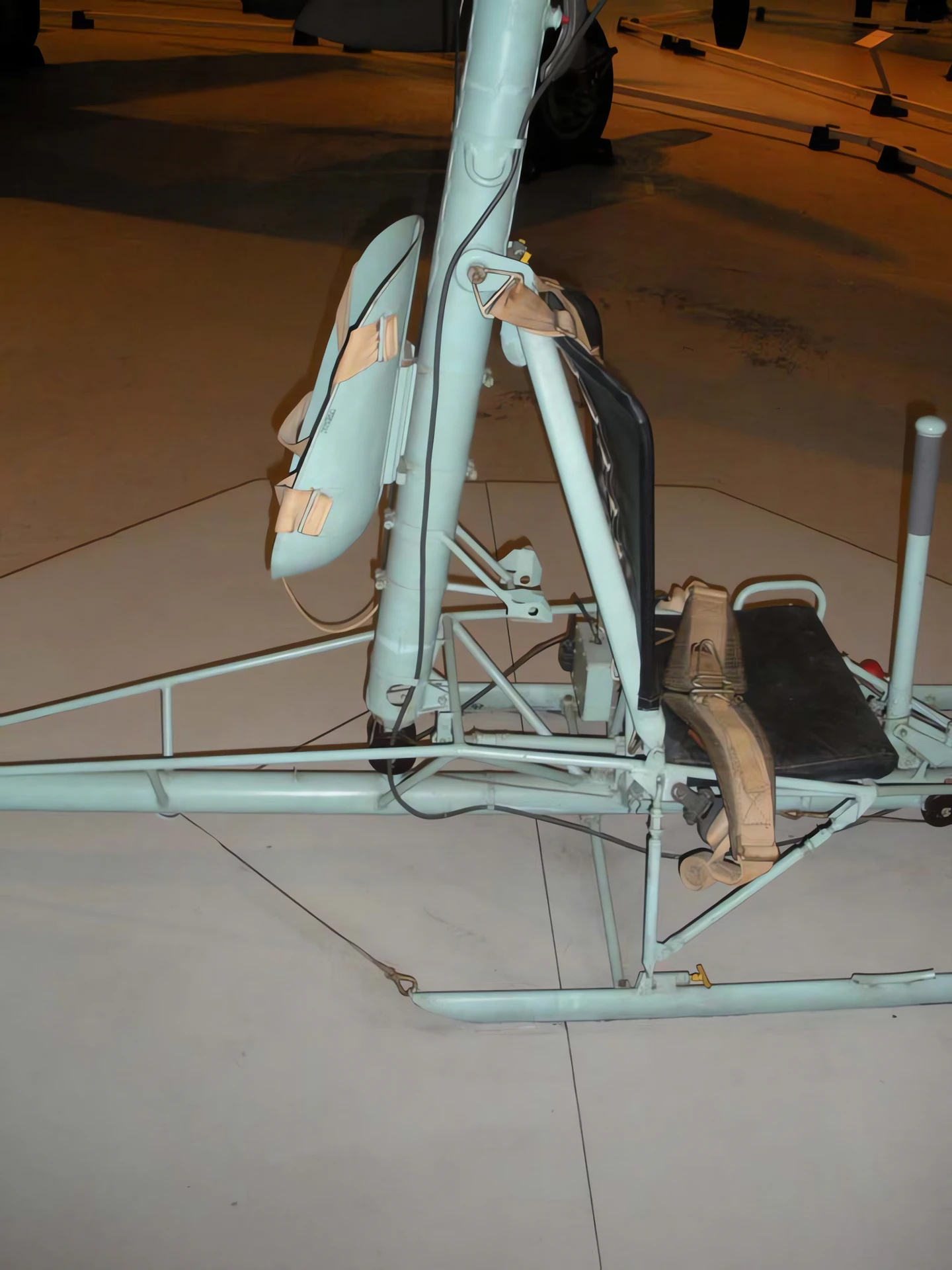
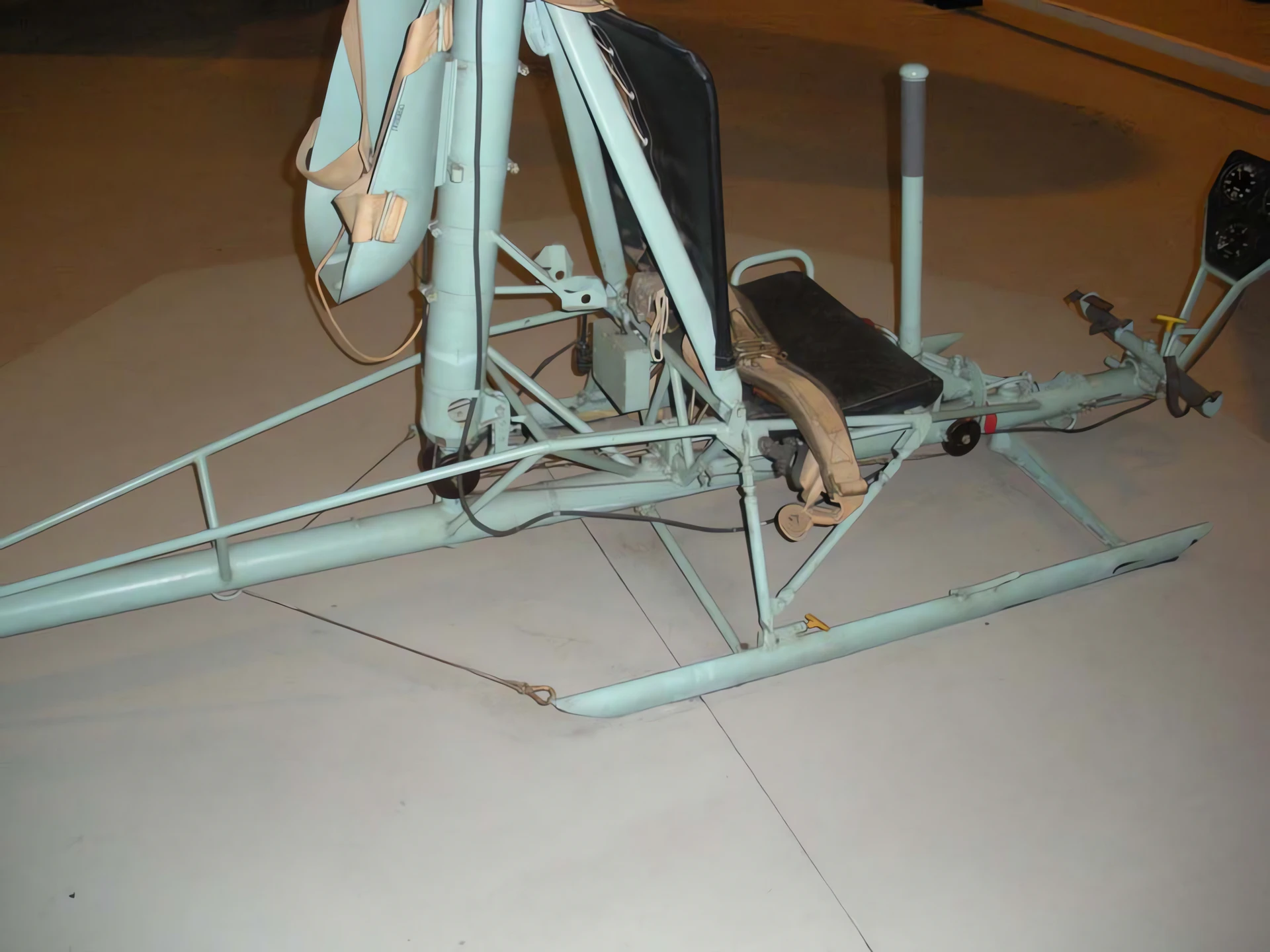
Den Focke-Achgelis Fa 330 Bachstelze Vipstjert) var en type roterende vingedrage, kendt som en gyroglider eller rotordrage. De blev trukket bag tyske ubåde under Anden Verdenskrig for at give et udkig for at se videre.
| Focke-Achgelis FA 330 Bachstelze Walk Around | |
|---|---|
| Fotografer | Vladimir Yakubov, Randy Ray |
| Lokalisering | Unknow |
| Billeder | 44 |
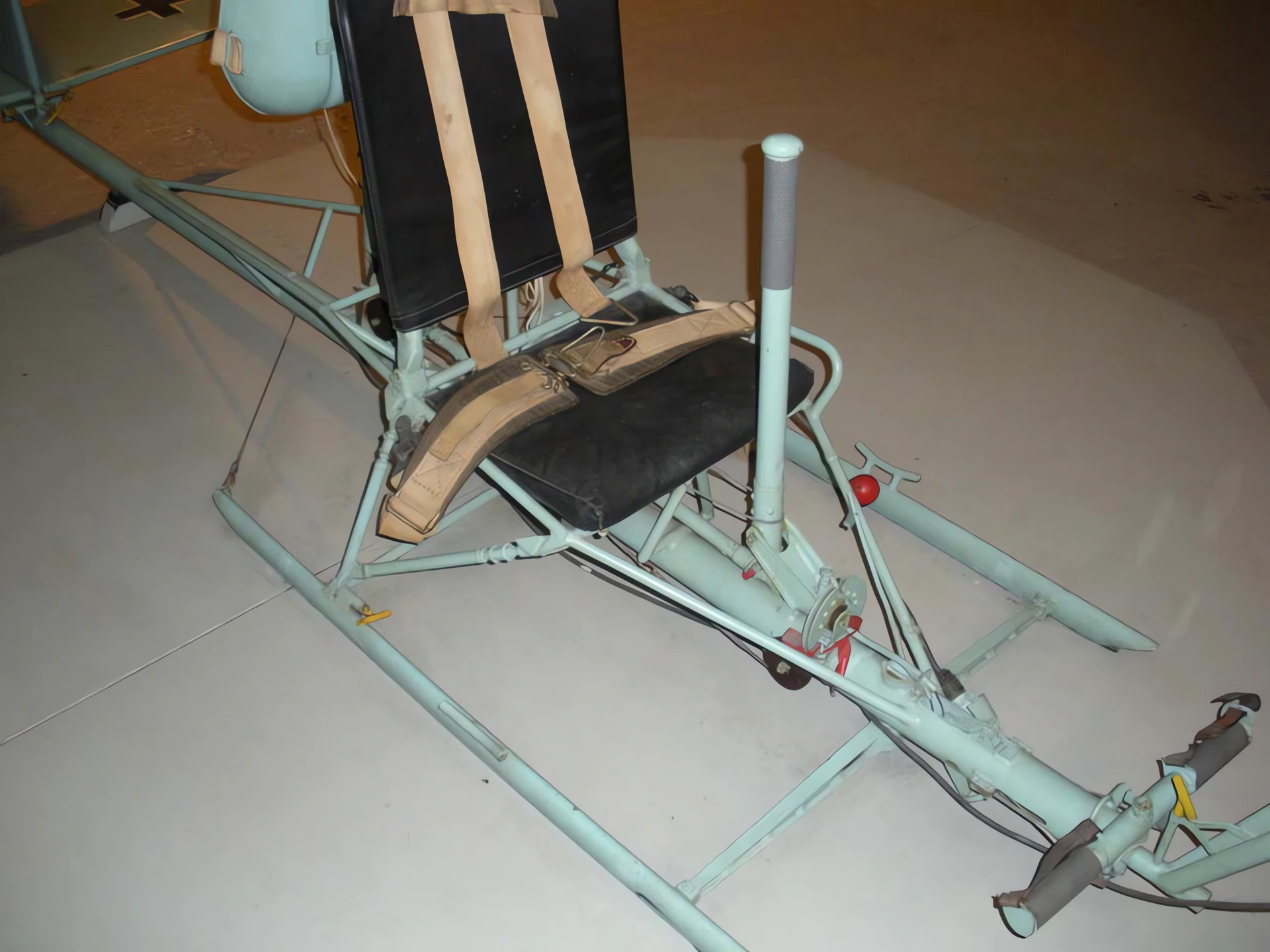
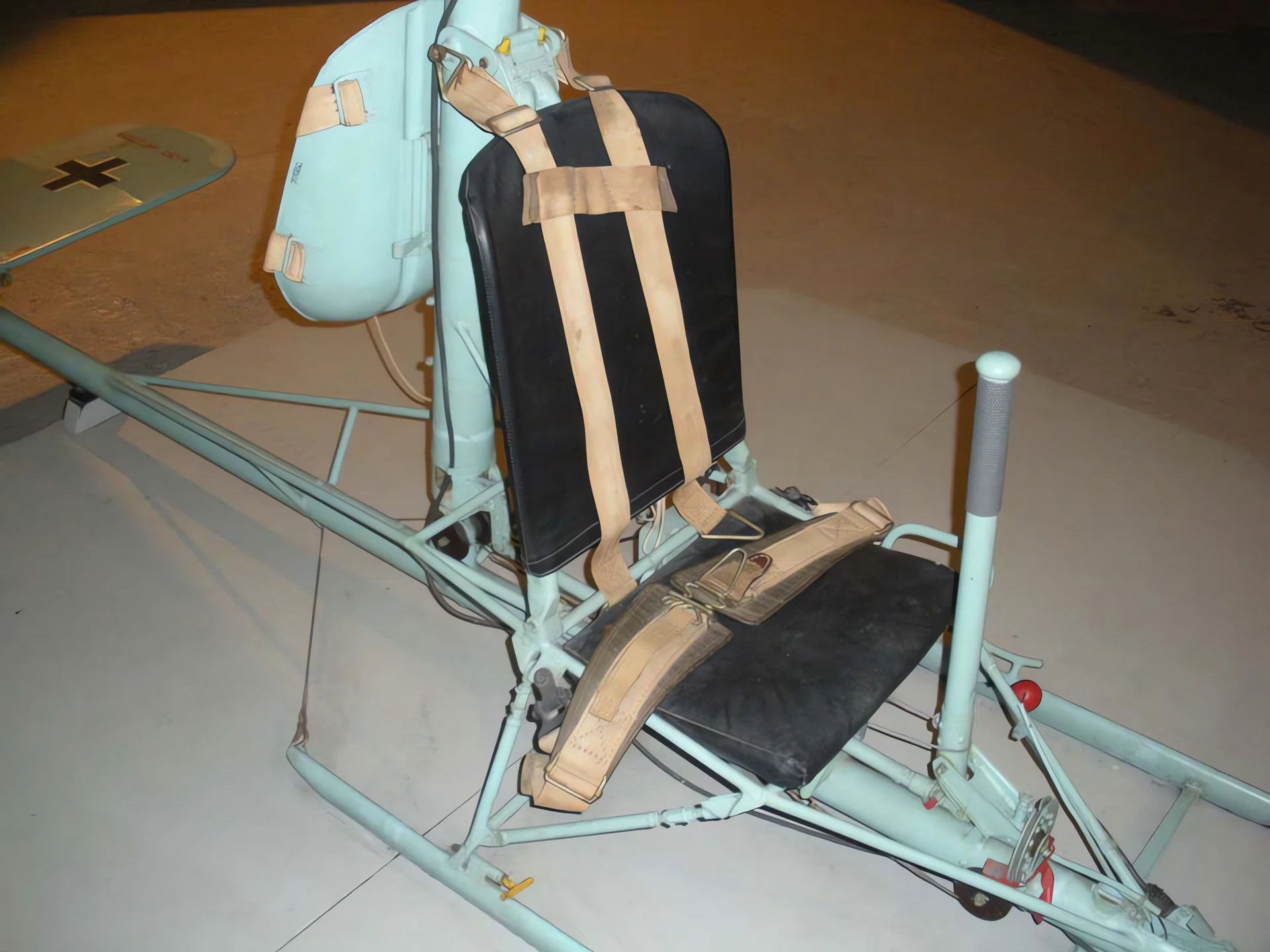
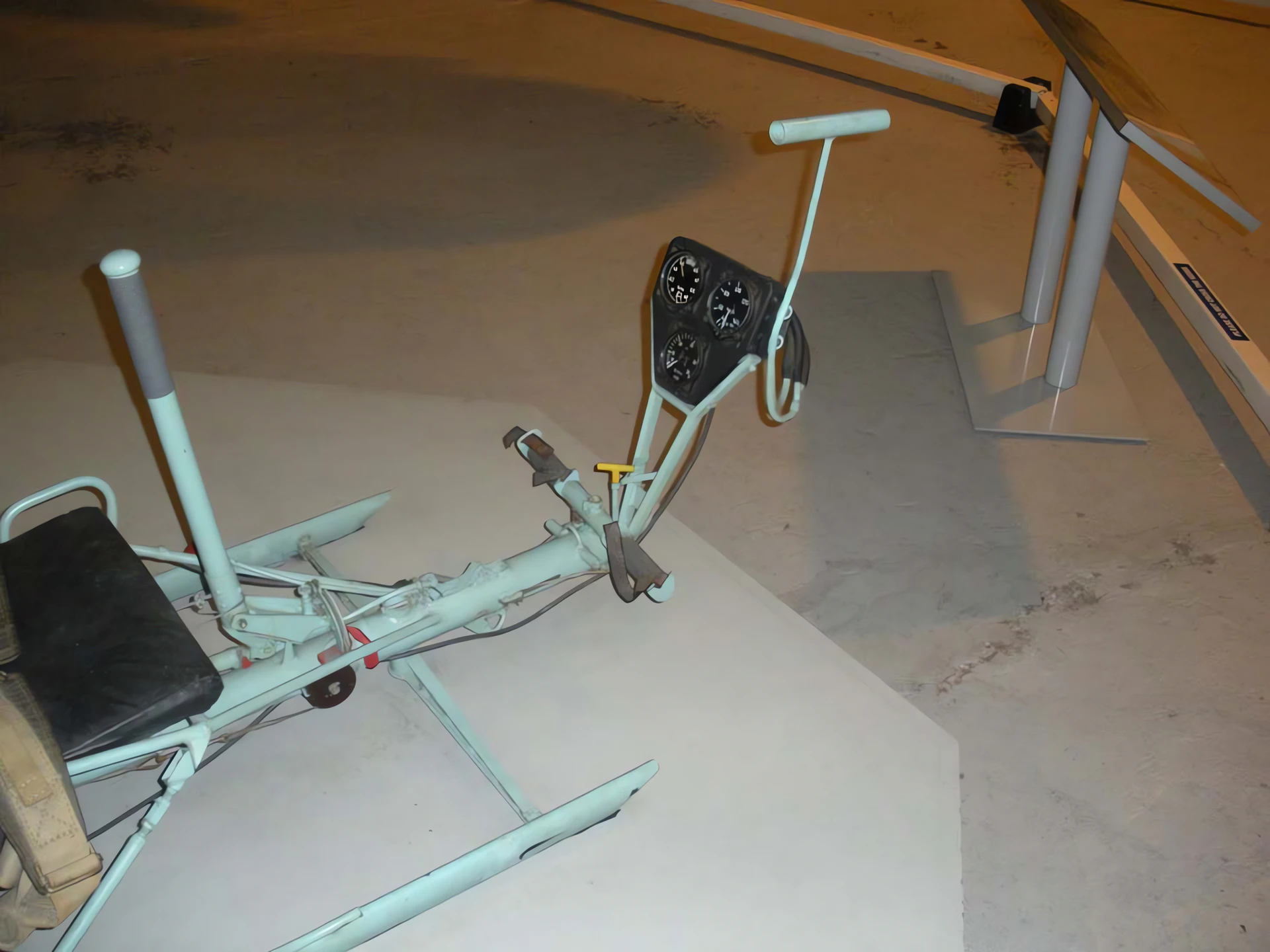
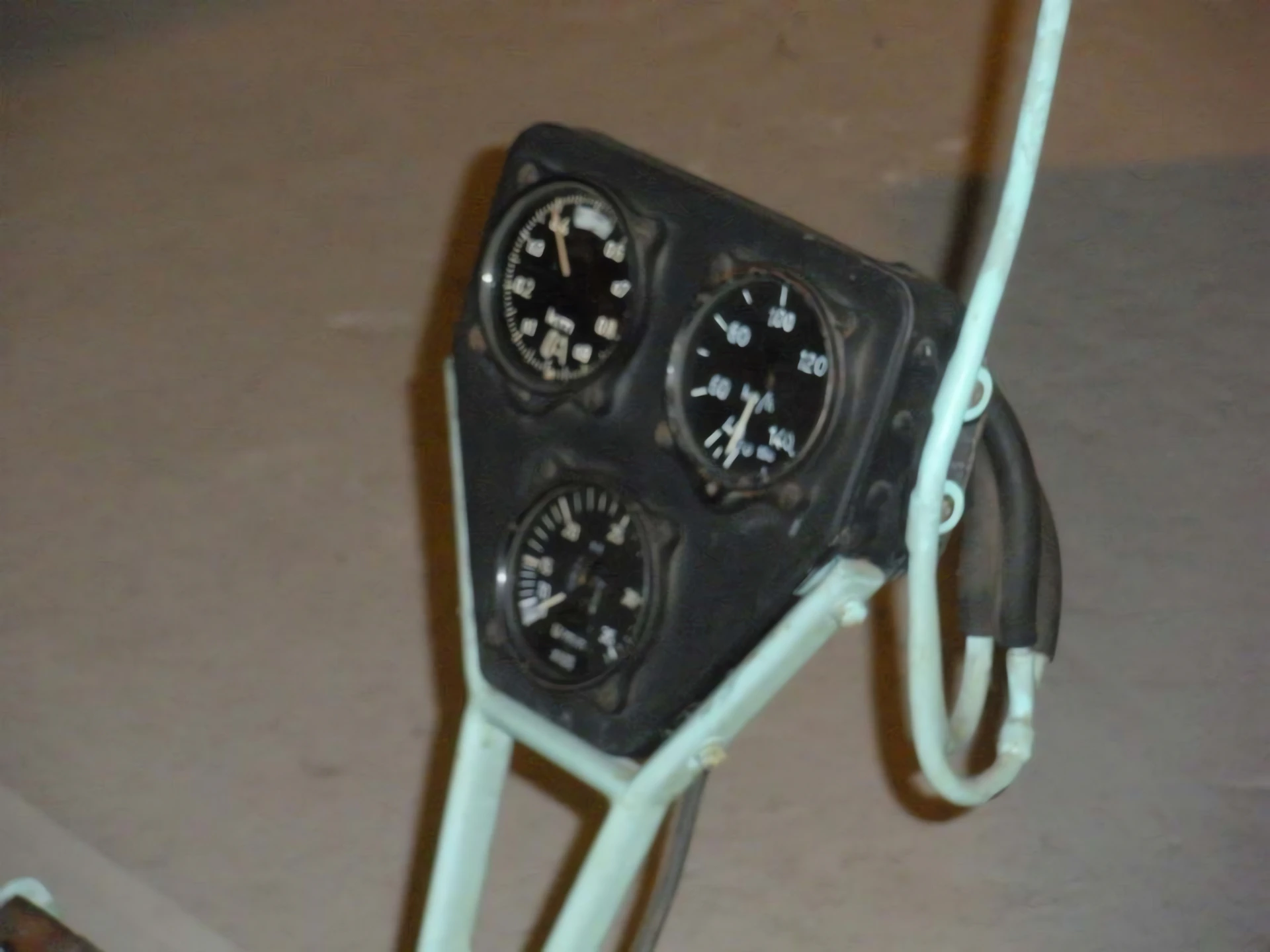

Se også:


The Kite with Rotors
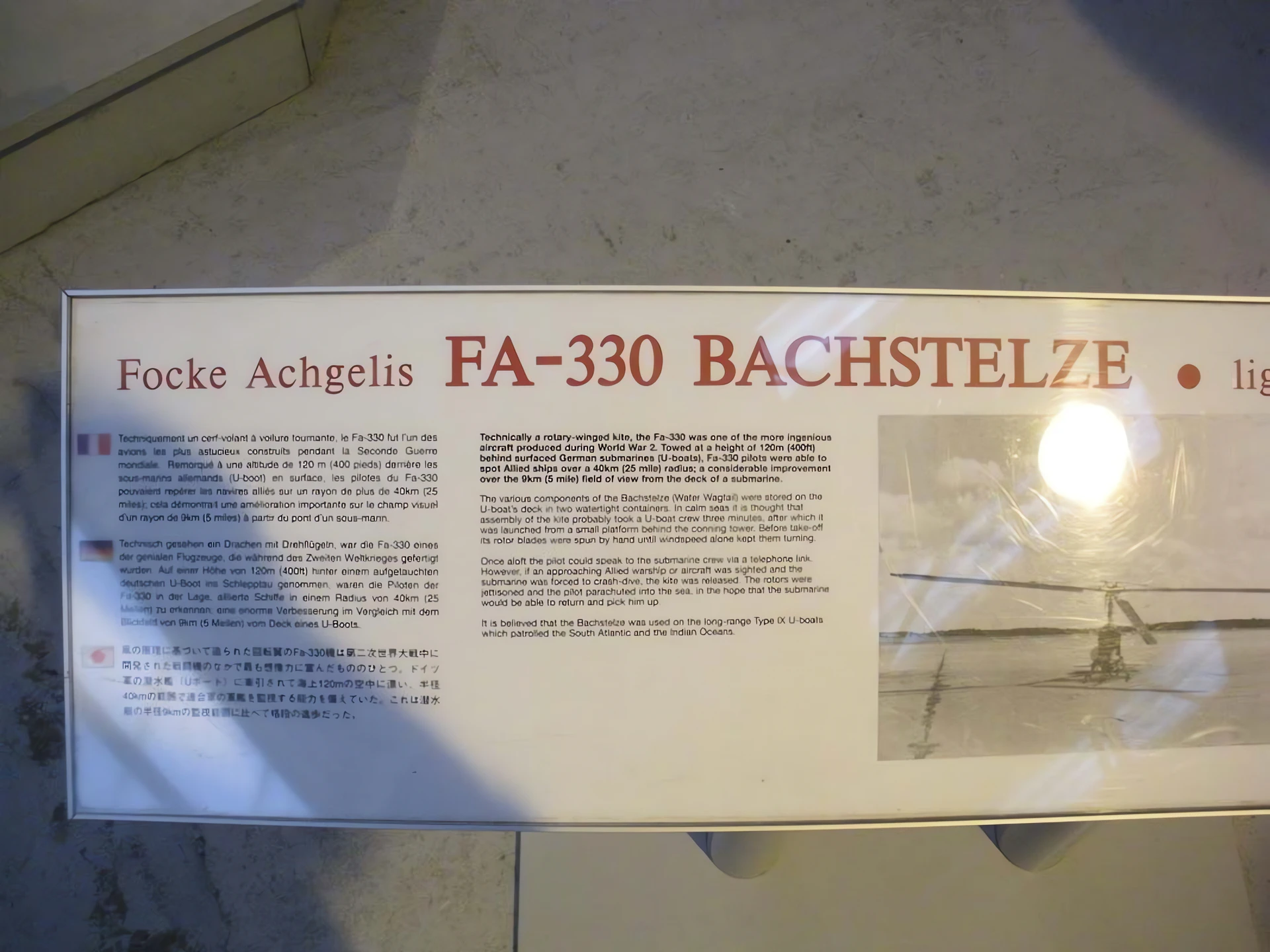
Den Focke-Achgelis Fa 330 was a unique, unpowered autogyro kite used by German U-boats during World War II. Because a submarine’s low profile limited its horizon to about 5 miles, the Fa 330 was developed to lift a lookout 400 feet into the air, extending their view to 25 miles. It had no engine; instead, it relied on the movement of the submarine and the wind to spin its rotors and provide lift. It was simple, foldable, and arguably one of the most dangerous assignments a sailor could receive.
| Attribute | Technical Specification (Fa 330) |
|---|---|
| Rolle | Ship-borne Observation Autogyro Kite |
| Besætning | 1 (Pilot/Observer) |
| First Flight | 1942 |
| Kraftværk | None (Tethered / Wind-driven) |
| Launch Method | Tethered cable and winch |
| Maximum Tow Speed | 25 mph (on surface) |
| Rotor Diameter | 24 ft (7.3 m) |
| Operational Altitude | Approx. 400 feet (120 m) |
Engineering Simplicity and Autorotation
- Autorotation Principle: Unlike a helicopter, the Fa 330’s rotors were not driven by an engine. The wind caused by the submarine’s forward motion blew upward through the blades, causing them to spin and create lift.
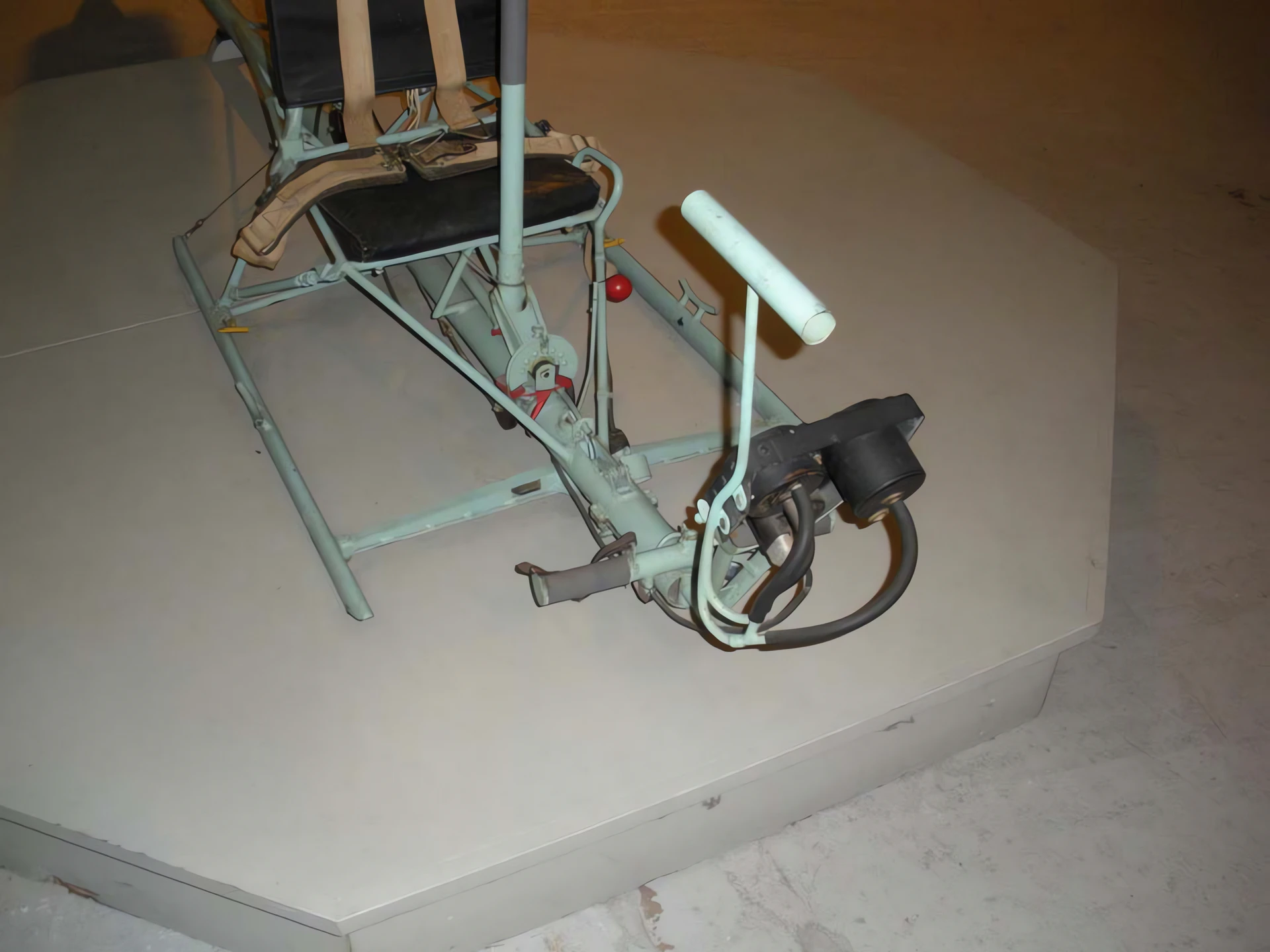
- Minimalist Airframe: The craft consisted of little more than a steel tube frame, a pilot’s seat, a small instrument panel, and a rudder. There was no fuselage to speak of, leaving the pilot completely exposed to the elements.
- Folding Design: To be stored in the limited space of a Type IX U-boat, the entire craft could be dismantled and packed into two vertical pressure-tight canisters on the deck in just a few minutes.
- Emergency Release: If the submarine had to perform an emergency dive (Alarm!), the pilot could pull a lever to jettison the rotor. A parachute would then deploy from the hub to bring the pilot (and the seat) back to the water.
The Danger of the “Wagtail”
- U-boat Vulnerability: While the Fa 330 helped find targets, it also made the submarine easier to spot from a distance. Furthermore, the time required to winch the pilot back down and stow the kite prevented the U-boat from diving instantly if attacked by Allied aircraft.
- Deployment Areas: They were mostly used in the Indian Ocean and South Atlantic, away from heavy Allied air cover where the risk of being caught on the surface was lower.
- Communications: The pilot communicated with the U-boat captain via a telephone wire integrated into the steel tethering cable.
- Survival: About 200 were built, and many survive today in museums—including the RAF Museum og Smithsonian—because they were often captured intact when U-boats surrendered.
Set antal gange : 2039
Du kan også se:
 Agusta-Bell AB.212 – Billeder & Videoer
 Denel Rooivalk – Billeder og videoer
 Eurocopter EC135 – Billeder og videoer
 TAI/AgustaWestland T129 ATAK – Billeder & Videoer
 Harbin Z-6 – Billeder og videoer
 Sikorsky H-5 – Billeder og video
 Sikorsky S-61R – Billeder & Video
 Mi-8T HIP – WalkAround
 Bell V-22 Fiskeørn – WalkAround
 Mi-24 Hind – WalkAround