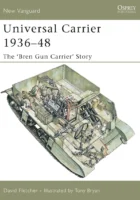
Universal Carrier 1936–48 - NY VANGUARD 110

Fiskeørn Publishing

SerieNy fortrop
Ref110
ISBN9781841768137
ForfatterDavid Fletcher
IllustratorTony Bryan

En bog signeret af Fiskeørn Publishing «Universal Carrier 1936–48 – NY VANGUARD 110» .

Den Universal Carrier var et hurtigt, let bevæbnet køretøj udviklet af den britiske hær til at transportere infanteri over terræn, der blev forsvaret af håndvåben, nærmere bestemt Bren let maskingevær, deraf navnet 'Bren Gun Carrier'. Dette navn ville holde sig til Universal Carrier og alle dens fremtidige varianter. Denne bog beskriver hangarskibet, som var benyttet i en række roller, herunder at bære ammunition og trække antiluftskyts og trailere. Alle allierede brugte Universal Carrier i vid udstrækning under praktisk talt alle felttog under 2. verdenskrig. Ved krigens slutning havde Universal Carrier vist sig at være et uvurderligt og succesfuldt langrendskøretøj, der var både adræt og hurtigt for sin tid.

Kilde: fiskeørn

Fortsæt med at læse

Udsigter: 454

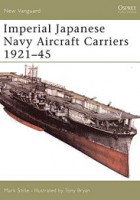
Den kejserlige japanske flådes hangarskibe 1921–45 - NY VANGUARD 109

Fiskeørn Publishing

SerieNy fortrop
Ref109
ISBN9781841768533
ForfatterMark Stille
IllustratorTony Bryan

Signeret dokumentation Fiskeørn Publishing le livre «Imperial Japanese Navy Aircraft Carriers 1921–45 – NEW VANGUARD 109» .

The Imperial Japanese Navy was a pioneer in naval aviation, having commissioned the world’s first built-from-the-keel-up carrier, the Hosho. Throughout the 1920s and 1930s, it experimented with its carriers, perfecting their design and construction. As a result, by the time Japan entered World War II and attacked the United States at Pearl Harbor in 1941, it possessed a fantastically effective naval aviation force. This book covers the design, development and operation of IJN aircraft carriers built prior to and during World War II. Pearl Harbor, Midway and the first carrier vs carrier battle, the battle of the Coral Sea, are all discussed.

Kilde: fiskeørn

Fortsæt med at læse

Udsigter : 701

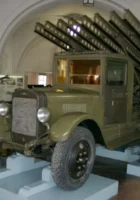
BM-13 Katyusha

BM-13 Katyusha

LandURSS
TypeRaketkaster
Emne

Album 65 billeder af "BM-13 Katyusha"

Den Katyusha (en russe Катюша), diminutif russe de Catherine, est le surnom donné par les Soviétiques à un lance-roquettes en rafales de la Seconde Guerre mondiale. Ce nom vient de la chanson traditionnelle Katioucha. Surnommé par les Allemands « orgue de Staline » (Stalinorgel) à cause de ses caractéristiques, elle consistait en un camion tirant des roquettes en rafales. Plusieurs batteries de Katiouchas étaient généralement alignées, dans le but de créer un tir de barrage et de destruction très important. Leur formidable puissance de feu était néanmoins altérée par une forte imprécision du tir. Il existe deux versions de ce lance-roquettes en rafale, le BM-8 på 82 mm og BM-13 de 132 mm (BM pour Boïevaïa Machina, « véhicule de combat »). Chaque camion comportait entre 14 et 48 lanceurs. Les roquettes du système BM-13, appelé RS-132 (RS pour Raketnyi snaryad, « roquette auto-propulsée ») étaient d’une hauteur de 1,8 m, de 132 mm de diamètre et d’un poids de 42 kg. Les roquettes étaient lancées par un propulseur solide à base de nitrocellulose disposé dans le moteur en acier de la roquette. La roquette était stabilisée par des ailerons cruciformes en tôle d’acier. L’ogive explosive, pouvant être à fragmentation, était hautement explosive et d’un poids d’environ 22 kg. La distance de tir des Katioucha était d’environ 8 km.

Kilde: Katyusha på Wikipedia

Fortsæt med at læse

Visninger : 2612

Britisk panserværnsartilleri 1939-45 - NY VANGUARD 98

Fiskeørn Publishing

SerieNy fortrop
Ref98
ISBN9781841766386
ForfatterSteven J Zaloga
IllustratorBrian Delf

Signeret dokumentation Fiskeørn Publishing le livre «British Anti-tank Artillery 1939–45 – NEW VANGUARD 98» .

The rapid development of the tank as an offensive weapon following its introduction in World War I gave artillery theorists cause for concern during the 1920s and 1930s. By the beginning of World War II anti-tank guns had been developed, initially at around 37mm and 2 pounds in weight of shot. By the end of the war, monster anti-tank weapons were being developed, able to penetrate an armour thickness of up to 200mm at a range of 1,000 yards. This book explores the British efforts to keep up in a war of development, which saw heavier and more powerful guns eventually replaced by experimental ideas in an attempt to stop the German onslaught.

Kilde: fiskeørn

Fortsæt med at læse

Udtalelse : 670

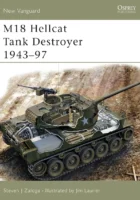
M18 Hellcat Tank Destroyer 1943–97 - NY VANGUARD 97

Fiskeørn Publishing

SerieNy fortrop
Ref97
ISBN9781841766874
ForfatterSteven J Zaloga
IllustratorUlla Tørnæs

Signeret dokumentation Fiskeørn Publishing le livre «M18 Hellcat Tank Destroyer 1943–97 – NEW VANGUARD 97» .

Den U/18 76mm Gun Motor Carriage was developed for the US Army’s Tank Destroyer Command. It was the only tank destroyer deployed during World War II actually based on their requirements for speed and firepower. This book examines the development of this vehicle, the controversies over the need for high-speed tank destroyers, and its actual performance during World War II. Special emphasis is placed on examining its performance in its intended mission. Coverage also includes derivative vehicles of the M18 such as the M39 armored utility vehicle.

Kilde: fiskeørn

Fortsæt med at læse

Visninger: 653

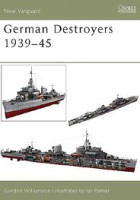
Tyske destroyere 1939-45 - NY FORTROP 91

Fiskeørn Publishing

SerieNy fortrop
Subjet

Tyske destroyere 1939-45

Periode2.
Ref91

En dokumentation fra Fiskeørn Publishing the book «German Destroyers 1939–45 – NEW VANGUARD 91» .

Den Tysk destroyer fleet of World War II consisted of nine classes: the Diether Von Roeder Class, the Leberecht Maas Class and the wartime classes Z23, Z35, Z37, Z40, Z43, Z46 and Z52. These vessels, though fewer in number than the British destroyer fleet, tended to be much bigger and more powerful than their allied counterparts. They served their country well in operations in the Channel, North Sea, the Far North and in the rescue of civilians from East Prussia during the final days of the war. This title describes their design, development and operational use from the fjords of Narvik to the final days of the war.

Kilde: Tyske Destroyers sur Osprey Publishing

Fortsæt med at læse

Set antal gange : 1094

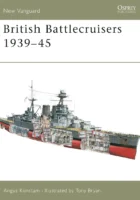
Britiske slagkrydsere 1939-45 - NY VANGUARD 88

Fiskeørn Publishing

SerieNy fortrop
Ref88
ISBN9781841766331
AuteurAngus Konstam
IllustratorTony Bryan

En bog signeret af Fiskeørn Publishing the «British Battlecruisers 1939–45 – NEW VANGUARD 88» .

When war broke out in 1939, only three true battlecruisers remained in the Royal Navy including HMS ‘Hood’, the world’s largest and fastest capital ship for much of her life, which would be destroyed in action against the German battleship ‘Bismarck’. Out of the remaining two battlecruisers (‘Repulse’ and ‘Renown’) one was sunk by Japanese aircraft off Singapore, whilst the other served with distinction until the end of the war. This book traces the pre-war development of these spectacular warships, then describes their wartime exploits, using this to demonstrate their operational and mechanical performance. It examines what life was like on these wartime battlecruisers when they sailed into action.

Kilde: Fiskeørn

Fortsæt med at læse

Visninger: 493

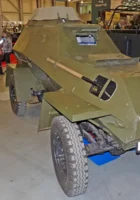
BA-64 pansret bil

BA-64 Armored Car

LandURSS
RollePansret bil
Produceret1942—1946
Bygget9110

Den BA-64 was a 4×4 light armoured car, employed by the Soviet Army from 1942 into the early 1960s for reconnaissance and liaison tasks. The BA-64B was nicknamed ‘Bobik’ by its crews. The total recorded number of BA-64s produced differs even in Russian sources. The most frequently-stated figures are 9,110 (3,901 BA-64 and 5,209 BA-64B) vehicles which were built in the GAZ automobile plant, although a memorial plaque near the pictured Nizhny Novgorod car states 9,063 cars. The Red Army representatives accepted only 8,174 BA-64s, including 3,390 with radio sets; the other vehicles were transferred to NKVD units and Soviet allies.

Kilde: BA-64B Panservogn på Wikipedia

Fortsæt med at læse

Visninger : 9290

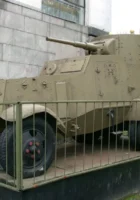
BA-6

BA-6 pansret bil

LandURSS
TypePansret bil
Emne

Album af 51 billeder af en BA-6 pansret bil

BA-3 (russisk: Broneavtomobil 3) var en tung pansret bil udviklet i Sovjetunionen i 1933, efterfulgt af en lidt ændret model BA-6 i 1936. Begge var hovedsagelig baseret på BA-I, den vigtigste udvikling var det nye tårn, det samme som i T-26 m 1933 og BT-5 kampvogne, og også udstyret med 45 mm hovedkanonen. Omkring 180 BA-3 biler blev bygget på Izhorskij og Vyksunskij fabrikkerne, indtil produktionen sluttede i 1935. BA-6 fulgte efter med 386 biler produceret mellem 1936 og 1938 på fabrikken i Izhorskij. Det meste af BA-3-produktionen var baseret på Ford-Timken-chassiset, en 6×4-modifikation af den amerikanske Ford AA 4×2-lastbil, men den sidste batch blev bygget på russisk version af det samme chassis - GAZ-AAA, fortsatte med at blive brugt i BA-6. Den største begrænsning af BA-3 var mobiliteten, begrænset til veje eller meget hårdt underlag, resultatet af unødvendig stor vægt. Den innovation, der forbedrede mobiliteten lidt, var hjælpesporene ("Overall"), der kunne monteres på de bageste tandemhjul og konvertere bilen til halvspor.

Kilde: BA-3/6 sur Wikipedia

Fortsæt med at læse

Visninger : 4513

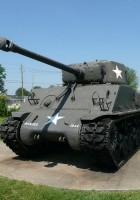
Sherman Tank - Gå rundt

Sherman

LandUsa
RolleMellemstor tank
I brug1942–1957
Bygget49000+

Den M4 Sherman, officially Medium Tank, M4, was the most widely used medium tank by the United States and Western Allies in World War II. The M4 Sherman proved to be reliable, relatively cheap to produce, and available in great numbers. Thousands were distributed through the Lend-Lease program to the British Commonwealth and Soviet Union. The tank was named by the British for the American Civil War General William Tecumseh Sherman.

Kilde: En verden af tank

Fortsæt med at læse

Views : 9044