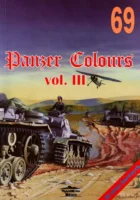
Wydawnictwo Militaria 69 Panzer Colours vol.III

Wydawnictwo Militaria

SeriesWydawnictwo Militaria
Réf069
SujetPanzers
Periodww2

Signed documentation Wydawnictwo Militaria the book "Panzers Colours III - Wydawnictwo Militaria 069" .

Panzer is a German word meaning "armored". If the word can be applied today to all German armored vehicles, from the origins to the present day, the usage makes that it refers essentially to the German turreted tanks of the Second World War (panzerkampfwagen, armored combat vehicle, for short PzKfw), lesquels eurent une conception et un emploi tactique particuliers. Le terme générique est moins utilisé pour les MBT (main battle tank) allemands de l’après-guerre (Leopard 1 et 2), similaires aux autres systèmes d’armes occidentaux. A noter que si l’historiographie française utilise le pluriel “panzers”, l’usage actuel admet le pluriel d’origine panzer en italique. De plus, certains ouvrages d’histoire militaire utilisent ce mot comme abréviation de grandes unités blindées (“2ème panzer” signifiant 2ème division blindée ou 2.Panzerdivision). Les panzer, surtout ceux de la deuxième moitié de la guerre, étaient très redoutés, moins nombreux mais souvent plus dangereux que ceux de leurs adversaires. Les chars lourds Tigre et Tigre II étaient ainsi les véhicules les plus lourdement blindés de leur époque. Le panzer IV fut le blindé allemand le plus utilisé durant la Seconde Guerre mondiale. Il a opéré sur tous les fronts : Pologne, France, Balkans, Grèce, front de l’Est, Afrique du Nord, Italie, etc.

Source: Wikipedia

Continue reading

Views : 562

Grille Ausf.M

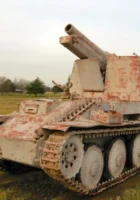
Ausf.M Grid - sdkfz.138/1

PaysGermany
TypeSelf-propelled gun
Description

Album of 79 photos of the sdkfz.138/1

Photo Gallery of an Ausf Grid.M - sdkfz.138/1, Self-propelled Guns Grid (sdkfz.138/1) were used by the Wehrmacht during World War II. This type of armoured vehicle was based on the chassis of the Czech Panzer 38(t) tank and equipped with a 150 mm sIG 33 infantry gun. It was significantly more successful than the self-propelled guns 15 cm sIG 33 (Sf) auf Panzerkampfwagen I Ausf B and the 15 cm sIG 33 auf Fahrgestell Panzerkampfwagen II Buffalo.

Source: Grid on Wikipedia

Continue reading

Views : 4224

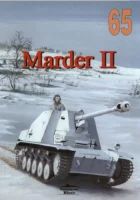
Wydawnictwo Militaria 65 Marder II

Wydawnictwo Militaria

SeriesArmor Military
Sujet

Marder II – sdkfz.131

PeriodWorld War II
Réf065

Signed documentation Wydawnictwo Militaria the book "Marder II – sdkfz.131 – Wydawnictwo Militaria 065" .

The Marder II is a German tank destroyer built from the chassis of the Panzerkampfwagen II Ausf A,B,C and F tank, armed with a German PaK 40 75 mm anti-tank gun, or a Soviet (captured) F-22 model 1936 76.2 mm rehambraked gun.

Source: Wikipedia

Continue reading

Views: 906

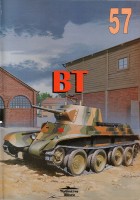
Wydawnictwo Militaria 057 - BT

Wydawnictwo Militaria

SeriesWydawnictwo Militaria
Réf057
SujetBT Tanks - Bistrokhodny Tank
Periodww2

Signed documentation Wydawnictwo Militaria the book "Chars BT - Bistrokhodny Tank - Wydawnictwo Militaria 057" .

Designed in the early 1930s, the fast tanks Bt (Bistrokhodny Tank) played a major role in the development of the Soviet armoured force. They were the first models of tanks available in large numbers that allowed the development of mechanized doctrines. Although these doctrines were brought into dispute and forgotten just before the beginning of the German invasion, they paved the way for those later who used the BT descendant, the T-34.

Source: Wikipedia

Continue reading

Views : 469

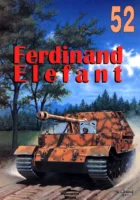
Wydawnictwo Militaria 52 Ferdinand - Elefant

Wydawnictwo Militaria

SeriesWydawnictwo Militaria
Réf052
SujetFerdinand - Elephant
Periodww2

Signed documentation Wydawnictwo Militaria the book "Ferdinand - Elephant - Wydawnictwo Militaria 052" .

Durant la Seconde Guerre mondiale, lorsque les ingénieurs allemands voulurent contrer la machine de guerre blindée alliée, un projet amenant la création d’un nouveau panzer vit le jour. Le projet Tiger I devait permettre de voir le jour à un nouveau type de char à blindage renforcé. Deux projets de châssis sont créés, l’un par Porsche appelé VK 4501 (P) et l’autre par Henschel appelé VK 4501 (H). Le projet de Porsche fut d’abord choisi, et il en lança la production. Mais on se rendit vite compte que la motorisation de Porsche faisait apparaître quelques problèmes. En octobre 1942, on ordonna de stopper la production et l’on donna le feu vert à Henschel pour lancer sa production. Henschel sera donc le concepteur du célèbre Tigre I. Porsche ayant quand même fait produire 90 châssis trouva un accord avec Hitler en 1943 pour utiliser ces châssis à bon escient. Cet accord donna naissance à un nouveau char, le Ferdinand, en l’hommage du concepteur Ferdinand Porsche. Il porta ensuite le nom de Elefant après la bataille de Koursk.

Source: Jagdpanzer Elefant sur Wikipedia

Continue reading

Views : 1021

Wydawnictwo Militaria 041 - Schwere Panzerspahwagen

Wydawnictwo Militaria

SeriesWydawnictwo Militaria
Réf041
SujetArmored Vehicles 8×8

Signed documentation Wydawnictwo Militaria the book "Armored Vehicles 8×8 - Wydawnictwo Militaria 041" .

Dans le domaine militaire, la Première Guerre mondiale a vu l’apparition des premiers chars de combat, gros véhicules tout-terrain à chenille ou à roues munis d’un canon. Dans le domaine de l’automobile civile, déjà dans les années 1920, il existait des véhicules équipés de quatre roues motrices, comme par exemple les tracteurs Latil, tandis que la Citroën Kégresse utilisait des chenilles motrices.

It was in the military environment that the need for small all-terrain motor vehicles first became clear, with the need for vehicles to have better traction than a simple conventional two-wheel drive to facilitate progression in difficult terrain, as well as angles of attack and descent conducive to progression in difficult environments. This was particularly the case for the famous Jeep Willys, an American all-terrain vehicle that appeared during the Second World War, and which will play a pioneering role in all-terrain vehicles, both military and civilian.

Source: Wikipedia

Continue reading

Views : 719

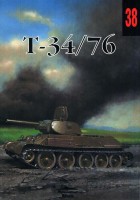
Wydawnictwo Militaria 038 - T-34-76

Wydawnictwo Militaria

SeriesWydawnictwo Militaria
Réf038
SujetT-34/76
Periodww2

Signed documentation Wydawnictwo Militaria le livre «T34/76 – Wydawnictwo Militaria 038» .

The T-34 was a medium tank that entered service in 1940 with the Red Army. At the time, it was a remarkable balance between the three major factors that defined the quality of an armoured vehicle: firepower, protection and mobility. This success made it one of the Soviet Union's strengths in the face of the invasion of the Wehrmacht. In order to counter it, it will have to revise its armoured design policy by developing, for example, the Panzer-V 'Panther', which borrowed some of its technical features from the T-34. Although quickly surpassed by foreign production, the T-34 remained in production from 1940 to 1958, with a total of units produced estimated at 84,070, making it the second most produced tank of all time, just behind its successors, the T-54 and T-55.

Source: Wikipedia

Continue reading

Views: 857

GMC CCKW 353

GMC CCKW 2½-ton 6×6 truck

CountryUSA
Role​6×6 Cargo truck
Produced1941–45
Built562750

The GMC CCKW was 2½-ton 6×6 U.S. Army cargo truck that saw heavy service in both World War II and the Korean War. The original “Deuce and a Half”, it formed the backbone of the famed Red Ball Express that kept Allied armies supplied as they pushed eastward after the Normandy invasion. The CCKW came in many variants, including open or closed cab, long wheel base (LWB 353) and short (SWB 352), and over a score of specialized models. It began to be phased out with the deployment of the 6×6 M35 in 1950, but remained in active U.S. service until the mid-1960s. It is related to the Chevrolet G506, built at the same factory.

Source: GMC on Wikipedia

Continue reading

Views : 5800

Wydawnictwo Militaria 032 - Samochody pancerne 6x4

Wydawnictwo Militaria

SeriesWydawnictwo Militaria
Réf032
SujetArmoured Vehicles 6×4

Signed documentation Wydawnictwo Militaria the book "Armored Vehicles 6×4 – Wydawnictwo Militaria 032".

Dans le domaine militaire, la Première Guerre mondiale a vu l’apparition des premiers chars de combat, gros véhicules tout-terrain à chenille ou à roues munis d’un canon. Dans le domaine de l’automobile civile, déjà dans les années 1920, il existait des véhicules équipés de quatre roues motrices, comme par exemple les tracteurs Latil, tandis que la Citroën Kégresse utilisait des chenilles motrices. C’est dans le milieu militaire que le besoin de petits véhicules automobiles tout-terrain s’est tout d’abord imposé, avec la nécessité pour les véhicules de disposer d’une meilleure motricité que celle d’une simple transmission à deux roues motrices classique pour faciliter la progression en terrain difficile, ainsi que des angles d’attaque et de descente favorables à la progression en milieu difficile. C’était notamment le cas de la célèbre Jeep Willys, véhicule tout-terrain américain, apparu lors de la Seconde Guerre mondiale, et qui jouera un rôle de précurseur dans les véhicules tout-terrain, militaires comme civils.

Source: Wikipedia

Continue reading

Views : 547

150mm s.F.H.18 Howitzer

150mm s.F.H.18

PaysGermany
TypeHowitzer
PeriodWorld War II

Photo Gallery on a 150mm cannon s.F.H.18 Howitzer , The 15 cm schwere Feldhaubitze 18 (sFH 18) is a Canon average of the Second World War with a range of 13,500 m, the weight of the shell is 43 kg and its speed is 518 m/secs.

Source: sFH18 Howitzer on Wikipedia

Continue reading

Views : 9882