Squadron Signal 2003 German Halftracks

Squadron Signal

SeriesAmor In Action
Sujet

German Half-Tracks

PeriodWorld War II
Réf

SS2003

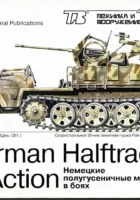
Signed documentation Squadron Signal the book "German Half-Tracks in Action - Squadron Signal SS2003" .

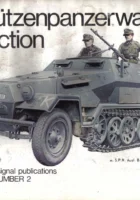
Designed to allow troops to track armoured vehicles while providing them with the protection of light armour, the schotzenpanzerwagen (front wheels, rear tracks) come almost exclusively in two models: SdKfz 250 and, as an enlarged version, the SdKfz 251. Their transport roles were diversified into a varied arms carrier, increasing the fire potential of the panzergrenadieren regiment.

Source: German Half-Tracks on Wikipedia

Continue reading

Views: 873

Squadron Signal 2002 Schutzenpanzerwagen

Squadron Signal

SeriesAmor In Action
Sujet

Sch-tzenpanzerwagen in Action

PeriodWorld War II
RéfSS2002

Signed documentation Squadron Signal the book "Schotzenpanzerwagen in Action - Squadron Signal SS2002" .

Designed to allow troops to follow the armoured vehicles while offering them the protection of light armour, the schotzenpanzerwagen (front wheels, rear tracks) come almost exclusively in two models: SdKfz 250 and, enlarged version, the SdKfz 251. Their transport roles were diversified into a varied arms carrier, increasing the fire potential of the panzergrenadieren regiment.

Source: Wikipedia

Continue reading

Views : 1212

Squadron Signal 2001 Panzer III

Squadron Signal

SeriesAmor In Action
Sujet

Panzer III in Action

PeriodWorld War II
Réf

SS2001

Signed documentation Squadron Signal le livre «Panzer III in Action – Squadron Signal SS2001» .

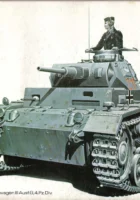
The Panzerkampfwagen III (PzKpfw III), often abbreviated as Panzer III, was a German tank designed in the late 1930s and used extensively during the first phase of World War II. It was developed to engage enemy armoured vehicles, while the contemporary Panzer IV had been intended to provide support fire to armoured formations. However, with the emergence of increasingly protected Allied tanks, only the Panzer IV was able to ship weapons capable of destroying them, and it supplanted the Panzer III as the main tank of the Wehrmacht.

Source: Wikipedia

Continue reading

Views: 980

Schwerer Zugkraftwagen 12 t - Sdkfz.8 - Nuts & Bolts 16

Nuts - Bolts

SeriesNuts - Bolts
Sujet

Heavy-duty tractor 12 t - Sdkfz.8

PeriodWorld War II
Réf16

Signed documentation Nuts - Bolts la revue "Heavy tractor 12 t - Sdkfz.8 - Nuts & Bolts 16" .

The SdKfz 8 schwerer Zugkraftwagen 12 t. fut, malgré son numéro de série “8”, le premier semi-chenillé allemand entré en production. Conçu comme tracteur d’artillerie pour les canons et obusiers de 15-cm K 16 et 21-cm Lange Morser du premier conflit mondial, dont l’armée allemande conservait quelques pièces entre 1918 et 1940, il fut utilisé pour tracter les canons modernes de 17-cm K 18 apparus en 1941, ou encore les Flak 38 et 39 de 10,5-cm… Trois variantes connues du SdKfz 8 : Le HK 1601, qui différait du vehicule original en de nombreux points, et constituait une tentative de combiner le SdKfz 8 et le SdKfz 9 de 18 tonnes. Un véhicule porteur d’un canon de 8,8-cm Flak 18, utilisé en France en 1940. Le Schwerer Zugkraftwagen 12 to Daimler-Benz DB 10, gepenzert, un tracteur d’artillerie entièrement blindé, produit à peu d’exemplaires (peut-être quatre), dont il reste un exemplaire en Pologne (le lieu exact est à déterminer).

Source: Sdkfz 8 sur Wikipedia

Continue reading

Views: 1477

Nuts & Bolts 15 - Marder III Panzerjager 38(t) fur 7.62cm Pak 36 (Sd.Kfz.139)

Nuts - Bolts

SeriesNuts - Bolts
Réf

Nuts - Bolts 15

Author
Sujet

Marder III - Panzerjager 38 (t) - Sdkfz.139

Signed documentation Nuts - Bolts "Marder III - Sdkfz.139 - Nuts - Bolts 15" .

The Marder III is a type of German world war destroyer built on the chassis of the Panzer 38(t). It was in production from 1942 to 1944 and served on all fronts until the end of the war.

Continue reading

Views : 1553

Nuts-Bolts-14-Nashorn-SdKfz-164

Nuts - Bolts

SeriesNuts - Bolts
Réf

Nuts - Bolts 14

Author
Sujet

Nashorn - Sdkfz.164

Signed documentation Nuts - Bolts "Nashorn - Sdkfz.164 - Nuts - Bolts 14" magazine .

The Nashorn (literally rhinoceros), originally referred to as Hornisse (Frelon in German) was a German tank destroyer of the Second World War. It was developed as an intermediate solution in 1942 and was armed with the powerful 88 mm anti-tank gun. Although slightly armored and with a high figure, he remained in service until the end of the war and demonstrated that he was a pretty good tank destroyer.

Continue reading

Views: 962

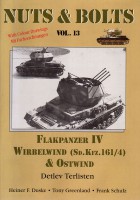
Flakpanzer IV - Wirbelwind - Ostwind - Nuts & Bolts 13

Nuts & Bolts

SérieNuts & Bolts
Réf

Nuts & Bolts 13

Auteur
Sujet

Flakpanzer IV – Wirbelwind & Ostwind

Une documentation signée Nuts & Bolts la revue «Flakpanzer IV – Wirbelwind – Ostwind – Nuts & Bolts 13» .

Le Flakpanzer IV est un char antiaérien allemand de la Seconde Guerre mondiale, qui était utilisé pour protéger les unités blindées. Il a été décliné en quatre versions, Möbelwagen, Wirbelwind, Ostwind et Kugelblitz.

Source: Flakpanzer IV sur Wikipedia

Continue reading

Views : 1500

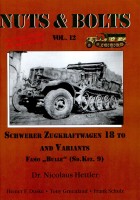
Nuts & Bolts 12 - Schwerer Zugkraftwagen 18 And Variants (SdKfz 9)

Nuts - Bolts

SeriesNuts - Bolts
SujetFamo – Sdkfz.9
Réf12

Signed documentation Nuts - Bolts la revue «Famo – Sdkfz.9 – Nuts & Bolts 12» .

The SdKfz 9 (also known as “Famo” ) was a German half-track that saw widespread use in World War II. Its main roles were as a prime mover for very heavy towed guns such as the 24 cm Kanone 3 and as a tank recovery vehicle. Approximately 2,500 were produced between 1938 and 1945.

Source: Wikipedia

Continue reading

Views : 1207

M15A1 Half-track

M15A1 Half-track

PaysUSA
TypeHalf-track
Sujet

Album de 22 photos of the "M15A1 Half-track"

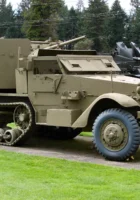
Photo gallery on an M15A1 Half-track, The search for a mobile anti-aircraft gun for the protection of mechanized troops and supply columns launched the development of this project. One will lead to the creation of the M16 MGMC, the other to the M15. The aim was to associate the chassis of the half-track M2, le canon antiaérien de 37 mm, mais le projet fut abandonné à l’automne 1942, parce que la marine, alors chargée de l’étude sur l’artillerie antiaérienne était plus séduite par l’utilisation de mitrailleuse. Néanmoins, quelques mois avant la débarquement en Afrique du Nord, l’U.S Army s’empara du projet à sa propre intention et relança l’étude. Les résultats satisfaisants du T28 conduisirent à la production en masse du modèle dès février 1943. Un seul changement résulta des tests en combat réel, l’ajout d’un bouclier de protection pour l’équipage. Le véhicule fut renommé M15 Combination Gun Motor Carriage ou M15 CGMC. Some 680 of these vehicles were produced between February and April 1943. The excessive weight of the turret to which the shield had been added, however, led to an overload for the M3 chassis, and the new combination of the same turret with the M3A1 chassis M15A1. 1652 were produced between October 1943 and February 1944.

Source: M15A1 Half-track on Wikipedia

Continue reading

Views : 4321