Vampire J28B

Vampire J28B

CountryUK
TypeFighter aircraft
PhotographerLuc Colin
Topic

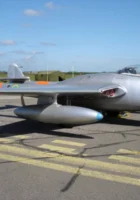
Album of 37 photos walk-around of a «Vampire J28B»

Photo gallery of a Vampire J28B, The de Havilland DH.100 Vampire was a British jet fighter developed and manufactured by de Havilland. Having been developed during the Second World War to harness the newly developed jet engine, the Vampire entered service with the Royal Air Force (RAF) in 1945. It was the second jet fighter, after the Gloster Meteor, operated by the RAF and its first to be powered by a single jet engine.

Source: Vampire J28B on Wikipedia

Continue reading

Views : 5253

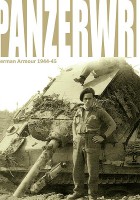
Panzerwrecks vol 1

Panzerwrecks

LanguageEnglish
Subject Panthers of I./Pz.Rgt.26
Pages11 pages
ISBN-13978-0-9754183-0-7

-This is where it started back in 2005 -11 page feature about the Panthers of I./Pz.Rgt.26 and their unique engine and turret roof armour -The only known photo of the Panther II, as found by US forces in Germany in 1945 -Ex-Allied Sherman Firefly used by the Germans and recaptured by the Canadians -Munitionspanzers of varying Ausfuhrungs on the Pz.Kpfw.II chassis -Flakpanzer Ostwind! -Unique photo of a 2cm Flak38 on Sd.Kfz.11 that looks to have been painted by Picasso -Breda 61 (Italian copy of the Sd.Kfz.7) -Panther Ausf.G with steel wheel on the last station: 2 rare photos -Hybrid Panther Ausf.A outfitted with ‘Flammenvernichter’ mufflers

Features: Modified Panthers of I./Pz.Rgt.26 Jagdtiger 323 of 3./s.Pz.Jg.Abt.653 Panzer IV/70(A) ISBN: 978-0-9754183-0-7 Date: 2005. Reprinted 2006, 2008, 2012 No of Photos: 127 No of Pages: 96 Size: 280x210mm (L)

Source: Panzerwrecks

Continue reading

Views : 1550

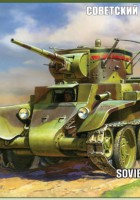
BT-7 Soviet Tank - Zvezda 3545

Zvezda

Ref3545
TypeMilitary WW2
Scale1/35
Topic

BT-7 Soviet Tank

A model of the brand Zvezda the kit: BT-7 Soviet Tank – Zvezda 3545.

The BT-7 light tank was developed in 1935 and was a further refinement of the BT-5. The BT-7 was a high-performance tank with reinforced armored protection in contrast and was used in the of Halkhin-Gol and during World War II.

Source: Zvezda

Continue reading

Views : 2055

C-54D SKYMASTER - Revell 04877

Revell

Ref04877
TypeAircraft
Scale1/48
Topic

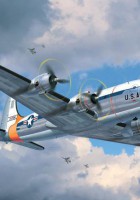
C-54D SKYMASTER

A model of the brand Revell the kit: C-54D SKYMASTER – Revell 04877.

– New Mould – Finely structured surfaces, recessed panel joints – Detailed cockpit with instrument panel – Detailed seats – Detailed radio room with equipment – Cargo hold door can be built in the open or closed position – Inner bulkheads – Complete set of interior seating – Rest cabin with bunks – Cargo hold floor with fine details – Separate landing flaps – Detailed interior fuselage walls – Detailed forward undercarriage – Separate ailerons – Detailed tail-unit – Detailed main under-carriage, 3 different wheel rims – Rotating propellers – Detailed twin radial engines with exhaust manifolds – Any antennae – Detailed nose area, 2 nose variants Authentic decal set for following versions: – Douglas C-54 Skymaster, USAF, 1949 – Douglas C-54 Skymaster, USAF, Airlift Berlin, Wiesbaden AB, Winter 1948 – 1949

The legendary C-54 was used for intercontinental transport operations and set numerous records. She was the first mass produced four-engine aircraft to make trans-atlantic crossings. The Douglas Aircraft Company began development of the DC-4 passenger aircraft in 1938. This was changed to become the C-54 long-range military transport aircraft after the United States entered the war in 1942. A total of 1,160 C-54 aircraft have been built. First flights across the Pacific to resupply troops fighting against the Japanese and repatriate the wounded began in 1942. Numerous modifications and special versions made the C-54 one of the most versatile of all military aircraft. Amongst other missions it also served as the President’s airplane. The C-54 achieved special recognition during the Berlin Airlift when it became known as the Candy Bomber . It was used to completely resupply the three Western Sectors of the city during 1948 -1949.

Source: C-54D SKYMASTER on Revell
Continue reading

Views : 1989

Nakajima B5N2 Kate - Airfix A04058

Airfix

RefA04058
TypeModel Kit
Scale1/72
Topic

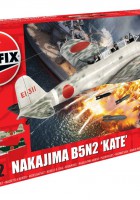
Nakajima B5N2 ‘Kate’

A model of the brand Airfix the kit : Grumman F4F-4 Wildcat Starter Set – Airfix A55214.

Scale: 1:72 Skill: 3 Flying Hours: 1 Number of Parts: 107

The Nakajima B5N2 ‘Kate’ was the most numerous Japanese torpedo bomber of the Second World War and while primarily operated as a torpedo bomber from carriers, it also saw service as a land based bomber. A single engine monoplane, it was defended by just one rearward firing machine gun, operated by the radio operator, and its relatively low speed left it vulnerable to enemy fighters, perfoming well at Pearl Harbour and going on to have success at the Battle of the Coral Sea and Midway.

Source: Nakajima B5N2 Set on Airfix

Continue reading

Views : 2569

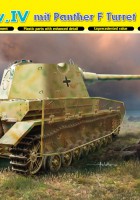
Pz.Kpfw.IV mit Panther F Turret - DML 6824

Dragon Models

Ref 6824
Type1/35 WWII Military
Scale1/35
Topic

Pz.Kpfw.IV mit Panther F Turret

A model of the brand Dragon Models the kit : Pz.Kpfw.IV mit Panther F Turret – DML 6824

This 1/35 scale plastic kit represents in plastic the fruition of that project’s ambition. The highly detailed kit is closely based on Dragon’s leading model of the Panzer IV, and of course it features an appropriately rendered Panther Ausf.F turret. In fact, to accommodate the new turret, the upper hull has been completely retooled with the correct details. The unique-looking tank also wears a set of detailed side skirts. While the design was destined to be confined to history as yet another paper panzer, this kit offers modelers the chance to build and enjoy something of an oddity!

Source: Dragon Models

Continue reading

Views : 3285

World of Warships - German Battleship Bismarck - ITALERI 46501

Italeri

Ref 46501
SerieWorld of Warships
Scale1/700
Topic

German Battleship Bismarck

THE BOX CONTAIN: 1 MODEL KIT – 1 LIQUID CEMENT – 1 SHIP GUIDE – 1 WALL POSTER (29,7x42cm) – WORLD of WARSHIPS DECALS – 3 INVITE CODES – 1 BONUS CODE

Based on the Bayern class of battleships from WWI, the Bismarck was the pinnacle of German heavy ship development- and probably the best known German ship of World War II. Laid down in 1936, Bismarck was launched in February 1939 and its outfitting proceeded quickly in the shadow of impending war. Even so, Bismarck missed the beginning of the war and the great offensive effort of the Kriegsmarine (KM) during the invasion of Norway. Commissioned in August 1940, Bismarck departed swiftly for sea trials which lasted until the end of the year. With Bismarck’s sister ship, Tirpitz, nearing completion, a grand sortie of all the KM heavy units was planned for 1941, with the goal of disrupting British convoys in the Atlantic an expansion on the previous Operation Berlin. However, it was quickly found that the Tirpitz would be delayed and other ships were unavailable. As a result, the Bismarck departed on 19 May, 1941, for its only combat sortie escorted only by a heavy cruiser, the Prinz Eugen.

Source: Italeri

Continue reading

Views : 3347

World of Tanks - Pz. Kpfw. V Panther - ITALERI 36506

Italeri

Ref 36506
SerieWorld of Tanks
Scale1/35
Topic

Pz. Kpfw. V Panther

THE BOX CONTAIN: 1 MODEL KIT – 1 LIQUID CEMENT – 1 TANK GUIDE – 1 POSTER (42×59,4cm) – WORLD oF TANKS DECALS – 3 INVITE CODES – 1 BONUS CODE

The Panther was produced as a reaction to the tanks encountered by German forces during Operation Barbarossa. Having considered Soviet tank designs to be obsolete, German tank crews were stunned when they came up against concepts like sloped armour on the T-34 and the sheer size and brutality of the KV-1. The Panther, designed as a kind of multi-purpose tank, took Soviet innovations and supersized them. Entering the battlefield from 1943 and weighing in at around 45 tonnes, this was a huge machine. It was technologically ambitious, seeking to combine armouring with speed and firepower. It mounted one of the best guns of the war – the dependable 7,5 cm Kw.K 42 L/70. However, in needing the tank on the field as quickly as possible, many shortcuts were taken in the manufacture and testing of the Panther. Reliability problems and mechanical failures became the bane of its crews. It was an over-engineered design that left no room for cutting corners. Roughly 6000 Panthers were made, but arrived too late to make a difference. It cannot be denied that if it had arrived earlier, and with all its high-tech features operational, the path of history would have deviated.

Source: Italeri

Continue reading

Views : 1765

SOVIET DIVE BOMBER PE-2 - Zvezda 4809

Zvezda

Ref4809
TypeModel kit
Scale1/48
Topic

SOVIET DIVE BOMBER PE-2

A model of the brand Zvezda the kit: SOVIET DIVE BOMBER PE-2 – Zvezda 4809.

Petlyakov Pe-2, nicknamed Peshka, was the most numerous Soviet bomber of World War 2 – from 1943 the Soviet Air Forces used more Pe-2s than all other bombers put together. Pe-2 participated in almost every campaign of the Red Army, being used for ground attack missions.

Read these instructions carefully, you will realize that this model will collect nice and beginners and a true professional. With a maximum of detail (set consists of 435 parts), you make out in minute detail the entire interior cockpit and arrow-radio operator, landing gear and engine compartment, which, if desired, you can set individual exhaust pipes of the engine.A nice bonus is one more feature: the rotor blades are not necessarily paste. They can be simply inserted into the spinner and the need to pull to transport. Do not limit your opportunities and gather with pleasure!

Source: Zvezda

Continue reading

Views : 2205

Curtiss XF15C-1

Curtiss XF15C-1

CountryUSA
TypeMixed-propulsion fighter prototype
PhotographerVladimir Yakubov
Topic

Album of 67 photos walk-around of a «Curtiss XF15C-1»

Photo gallery of a Curtiss XF15C-1, The Curtiss XF15C-1 was a mixed-propulsion fighter prototype of the 1940s. The first flight of the first prototype was on 27 February 1945, without the turbojet installed. When this was completed in April of the same year, the aircraft flew several mixed-power trials, however on May 8 it crashed on a landing approach. The second prototype flew for the first time on 9 July, again in 1945, and was soon followed by a third prototype. Both aircraft showed promise, however by October 1946 the Navy had lost interest in the mixed-power concept and cancelled further development.

Source: Curtiss XF15C-1 on Wikipedia

Continue reading

Views : 3593