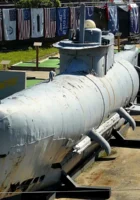
Seehund tysk dvärg ubåt

Seehund

LandBakterie
RollMidget ubåt
Produceras1944–1945
Byggd285

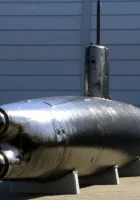
Den Seehund (tyska: "tätning"), även känd som typ XXVII, var en dvärgubåt tillverkad av Nazityskland under andra världskriget. Designad 1944 och drivs av tvåmannabesättningar, användes den av Kriegsmarine (tyska flottan) under krigets sista månader, sänkte nio handelsfartyg och skadade ytterligare tre, samtidigt som den förlorade 35 båtar, mestadels hänförliga till dåligt väder. Den franska flottan använde tre fångade båtar efter kriget fram till 1953.

Källkod: Seehund på Wikipedia

Fortsätt läsa

Visningar : 2266

Krupp Protze Kfz

TKrupp Kfz.81 Protze

LandBakterie
RollArtilleritraktor / Nyttolastbil
Produceras1934–1941
Byggd7000

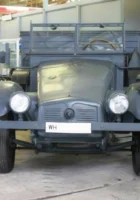
L 2 H 43 och L 2 H 143 "Krupp-Protze (krupp-protze)” (unofficial designation) was a six-wheeled 6×4 German truck and artillery tractor produced between 1934 and 1941 and heavily used in World War II. It was powered by a 4-cylinder, 55 hp or, from 1936, 60 hp Krupp M 304 petrol engine. Its main purpose was to tow artillery, especially the PaK 36, and transport motorized infantry. This vehicle was extensively used on the Eastern Front, during the North African campaign and in France and Sicily. The “Krupp-Protze” was of relatively advanced design. Its fuel consumption was relatively high (24 Litres / 100 km on road) in comparison to the comparable Opel Blitz 1.5 t truck (16.5 liters / 100 km, produced 1938 – 1942). Total production was about 7,000 units.

Källkod: Krupp Kfz.81 Protze på Wikipedia

Fortsätt läsa

Visningar : 4561

Typ A Midget ubåt

Type A Midget Submarine

LandJapans imperium
KlassKō-hyōteki-klass ubåt
PeriodVärldskriget
ByggdUnknow

Den Typ A Ko-hyoteki (甲標的甲型 Kō-hyōteki kō-gata, Target ‘A’, Type ‘A’) class was a class of Japanese midget submarines (Ko-hyoteki) used during World War II. They had hull numbers but no names. For simplicity, they are most often referred to by the hull number of the mother submarine. Thus, the midget carried by I-16-class submarine was known as I-16’s boat, or “I-16tou.” This class was followed by: Type B (甲標的乙型 Kō-hyōteki otsu-gata), Type C (甲標的丙型 Kō-hyōteki hei-gata), and Type D (甲標的丁型 Kō-hyōteki tei-gata), the last one better known as Kōryū

Källkod: Typ A Midget Ubåt på Wikipedia

Fortsätt läsa

Views : 2059

USS Joseph Kennedy

USS Joseph P. Kennedy

LandUsa
KlassJagare av Gearing-klass
Lanserade26 juli 1945
SmeknamnJoey P

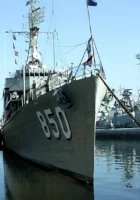
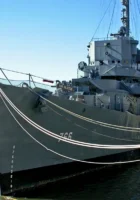
USS Joseph P. Kennedy Jr. (DD-850) är en före detta jagare av amerikansk flotta. Fartyget fick sitt namn efter löjtnant Joseph P. Kennedy Jr., en marinflygare, son till den tidigare ambassadören i Storbritannien, Joseph P. Kennedy Sr., och äldre bror till den blivande presidenten John F. Kennedy. Joseph P. Kennedy Jr. tjänstgjorde, med avbrott för modernisering, fram till 1973. Bland höjdpunkterna i hennes tjänstgöring är blockaden av Kuba under Kubakrisen och de flytande återhämtningsteamen för Gemini 6 och Gemini 7. Joseph P. Kennedy Jr. är utställd som ett museifartyg i Battleship Cove, Fall River, Massachusetts. Hon lades till i National Register of Historic Places 1976 och utsågs till ett nationellt historiskt landmärke 1989 som en av ett litet antal överlevande jagare av Gearing-klass.

Källkod: USS Joseph P. Kennedy on Wikipedia

Fortsätt läsa

Visningar : 1024

PT Båt PT-617

PT boat

LandUsa
KlassCannon-klass förstörare eskort
Lanserade20 februari 1944
IdentifikationDE-766

A PT-båt (förkortning för patrulltorpedbåt) var ett torpedbeväpnat snabbt attackfartyg (MTB) som användes av den amerikanska flottan under andra världskriget. Det var litet, snabbt och billigt att bygga, uppskattat för sin manövrerbarhet och hastighet men hindrades i början av kriget av ineffektiva torpeder, begränsad beväpning och relativt bräcklig konstruktion som begränsade några av varianterna till kustvatten.

Källkod: PT boat på Wikipedia

Fortsätt läsa

Visningar : 2420

USS Slater

USS Slater

LandUsa
KlassCannon-klass förstörare eskort
Lanserade20 februari 1944
IdentifikationDE-766

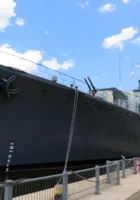
USS Slater (DE-766) is a Cannon-class destroyer escort that served in the United States Navy and later in the Hellenic (Greek) Navy. The ship was named for Frank O. Slater of Alabama, a sailor killed on the cruiser USS San Francisco during the Naval Battle of Guadalcanal. He was posthumously awarded the Navy Cross for gallantry in action and the Purple Heart. Following service during World War II, the ship was transferred to Greece and renamed Aetos. Decommissioned in 1991, the destroyer escort was returned to the United States. USS Slater is now a museum ship on the Hudson River in Albany, New York, the only one of its kind afloat in the United States. (USS Stewart (DE-238) is exhibited at Seawolf Park in Galveston, Texas, but located on dry land and USS Atherton (DE-169) is still in service in the Philippine Navy.) Slater was designated a National Historic Landmark on 2 March 2012

Källkod: USS Slater på Wikipedia

Fortsätt läsa

Views : 1103

Lynx spaningsfordon

Lynx reconnaissance vehicle

LandUsa
RollSpaningsfordon
PeriodUnknow
ByggdUnknow

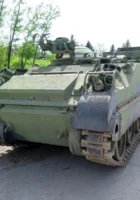
Den Lynx spaningsfordon (manufacturer’s name: M113½ Command and Reconnaissance Vehicle, abbr. M113 C&R) is a United States-built tracked reconnaissance armoured fighting vehicle, which was employed by the armed forces of the Netherlands and Canada. Dutch vehicles were exported in the 1990s to Bahrain[1] and Chile, according to SIPRI 35 and 8 vehicles respectively. The M113½ was developed in 1963 as a private venture by FMC Corp., the manufacturer of the M113. It competed with the M114 but the US Army chose the M114 for production. The design was then offered to foreign buyers and gained the name Lynx when purchased by Canada.

Källkod: Lynx spaningsfordon på Wikipedia

Fortsätt läsa

Visningar : 1783

Douglas X-3 Stilett

Douglas X-3 Stiletto

LandUsa
RollExperimentell
Första flygningen15 oktober 1952
Byggd1

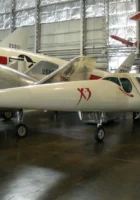
Den Douglas X-3 Stilett , var ett amerikanskt experimentellt jetflygplan från 1950-talet med en smal flygkropp och en lång avsmalnande nos, tillverkat av Douglas Aircraft Company. Dess primära uppdrag var att undersöka designegenskaperna hos ett flygplan som var lämpligt för ihållande överljudshastigheter, vilket inkluderade den första användningen av titan i viktiga flygplanskomponenter. Douglas konstruerade X-3 med målet att ha en maxhastighet på cirka 2 000 m.p.h, men den var dock kraftigt underdimensionerad för detta ändamål och kunde inte ens överstiga Mach 1 i planflykt. Även om forskningsflygplanet var en besvikelse, använde Lockheeds konstruktörer data från X-3-testerna för Lockheed F-104 Starfighter som använde en liknande trapetsformad vingdesign i ett framgångsrikt Mach 2-jaktplan.

Källkod: Douglas X-3 Stilettklack på Wikipedia

Fortsätt läsa

Views : 2941

Jagare HMCS Haida

HMCS Haida

LandKanada
Klass och typJagare av Tribal-klass
Lanserade25 augusti 1942
Ur drift22 februari 1964

HMCS Haida is a Tribal-class destroyer that served in the Royal Canadian Navy (RCN) from 1943 to 1963, participating in World War II and the Korean War. She was named for the Haida people. The only surviving Tribal-class destroyer out of 27 vessels constructed for the RCN, Royal Navy and Royal Australian Navy between 1937 and 1945, Haida sank more enemy surface tonnage than any other Canadian warship and as such is commonly referred to as the “Fightingest Ship in the Royal Canadian Navy”

Källkod: HMCS Haida på Wikipedia

Fortsätt läsa

Visningar : 1518

B-1B Lansiär

Rockwell B-1 Lancer

LandUsa
RollÖverljuds strategiskt tungt bombplan
Första flygningenden 23 december 1974
Byggd104

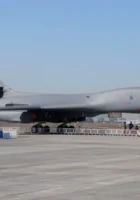
Den Rockwell B-1 Lansare is a supersonic variable-sweep wing, heavy bomber used by the United States Air Force. It is commonly called the “Bone” (from “B-One”). It is one of three strategic bombers in the U.S. Air Force fleet as of 2018, the other two being the B-2 Spirit and the B-52 Stratofortress. The B-1 was first envisioned in the 1960s as a platform that would combine the Mach 2 speed of the B-58 Hustler with the range and payload of the B-52, and would ultimately replace both bombers. After a long series of studies, Rockwell International (now part of Boeing) won the design contest for what emerged as the B-1A. This version had a top speed of Mach 2.2 at high altitude and the capability of flying for long distances at Mach 0.85 at very low altitudes. The combination of the high cost of the aircraft, the introduction of the AGM-86 cruise missile that flew the same basic profile, and early work on the stealth bomber all significantly affected the need for the B-1. This led to the program being canceled in 1977, after the B-1A prototypes had been built.

Källkod: Rockwell B-1 Lancer på Wikipedia

Fortsätt läsa

Views : 3009