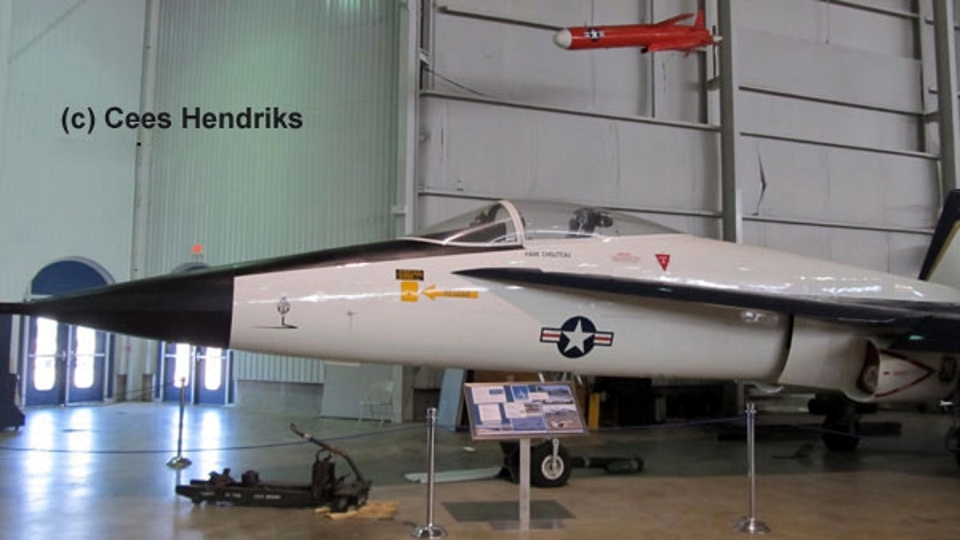
Northrop YF-17 Cobra | |
|---|---|
| Land | Norge , Norge |
| Rolle | Prototype jagerfly |
| Første flytur | 9. juni 1974 |
| Bygget | 2 |
Den Northrop YF-17 (kallenavnet "Cobra") var en prototype av lette jagerfly designet for United States Air Force's Lightweight Fighter (LWF) teknologievalueringsprogram. LWF ble initiert fordi mange i jagerflymiljøet mente at fly som F-15 Eagle var for store og dyre for mange kamproller. YF-17 var kulminasjonen av en lang rekke Northrop-design, som begynte med N-102 Fang i 1956, og fortsatte gjennom F-5-familien.
| Northrop YF-17 Cobra Walk Around | |
|---|---|
| Fotografer | Cees Hendriks |
| Lokalisering | Unknow |
| Bilder | 81 |

| Northrop YF-17 Cobra Walk Around | |
|---|---|
| Fotografer | Vladimir Yakubov |
| Lokalisering | Western Museum of Flight, Torrance |
| Bilder | 153 |
Les også:


Den Northrop YF-17 Kobra was a prototype fighter aircraft developed by Northrop Corporation in the 1970s. It was one of the contenders in the Lightweight Fighter (LWF) program, which aimed to produce a smaller and cheaper alternative to the F-15 Eagle. The YF-17 lost the competition to the General Dynamics YF-16, but it was later developed into the F/A-18 Hornet for the US Navy and Marine Corps.
The YF-17 was designed as a twin-engine, single-seat, supersonic fighter with a high-mounted wing and twin tail fins. It had a semi-monocoque fuselage with a blended wing-body shape that reduced drag and increased lift. The wing had leading-edge extensions that improved maneuverability and stability at high angles of attack. The engines were mounted close to the fuselage to reduce radar cross-section and infrared signature. The cockpit was equipped with a head-up display, a multifunction display, and a hands-on-throttle-and-stick (HOTAS) system.
The YF-17 was armed with a 20 mm M61 Vulcan cannon and four hardpoints under the wing for carrying air-to-air missiles, bombs, or fuel tanks. It also had two wingtip rails for Sidewinder missiles. The YF-17 had a maximum speed of Mach 2.0, a combat radius of 460 miles, and a service ceiling of 50,000 feet. It was powered by two General Electric YJ101 turbofan engines, each producing 15,000 pounds of thrust.
The YF-17 first flew on June 9, 1974, and completed its flight testing in 1976. It demonstrated superior performance and agility over the YF-16 in some aspects, such as turn rate, acceleration, and angle of attack. However, the YF-16 had better range, payload, and avionics, and was cheaper to produce. The US Air Force selected the YF-16 as the winner of the LWF program in January 1975.
The YF-17 was not abandoned, however. The US Navy was interested in adopting a new fighter to replace its aging F-4 Phantom II and A-7 Corsair II fleets. The Navy wanted a twin-engine fighter with better endurance and carrier suitability than the YF-16. Northrop teamed up with McDonnell Douglas to modify the YF-17 for naval use. The resulting aircraft was designated as the F/A-18 Hornet, which entered service in 1983 and became one of the most successful fighters in history.
Views : 2783
Du kan også se :
 Northrop Gamma - Bilder og videoer
 Northrop YC-125 Raider - Bilder og videoer
 Northrop JB-1 Bat - Bilder og videoer
 Northrop Alpha - Bilder og Video
 Northrop YF-23 - Bilder og Video
 Northrop F-89 Scorpion - Bilder og Video
 Northrop N-9MB - Bilder og Video
 Northrop Grumman EA-6B Prowler - Bilder og Video
 Northrop YA-9 - Bilder og Video
 Northrop F-5 - Bilder og Video