Morris Pantserwagen

Morris CS9

LandUk
RoleLichte gepantserde auto
Periode1936+
GebouwdOnbewust

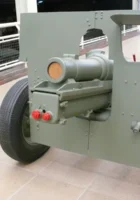
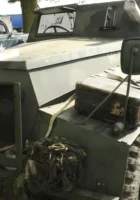
Het voertuig was gebaseerd op een Morris Commercial C9 4×2 15 long cwt (760 kg) truck chassis. On this chassis, a riveted hull was mounted with an open-topped two-man turret. The armament consisted of either Boys anti-tank rifle and Bren light machine gun or Vickers machine gun. The vehicle carried a No. 19 radio set. The prototype was tested in 1936. A further 99 cars were ordered and were delivered in 1938. Thirty-eight of these cars were used by the 12th Royal Lancers in the Battle of France, where all of them were destroyed or abandoned. Another 30 served with the 11th Hussars in the North African Campaign. It was found that, when fitted with desert tyres, the vehicle had good performance on soft sand. However, its armour and armament were insufficient. The vehicle was retired halfway through the North African Campaign.

Bron: Morris CS9 op Wikipedia

Lees verder

Bekeken : 933

ATF Dingo 2A2-A2.3

ATF Dingo

LandDuitsland
RoleInfanterie mobiliteitsvoertuig
In gebruik2000 – Heden
GebouwdOnbewust

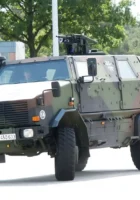
De ATF Dingo is a German heavily armored military MRAP infantry mobility vehicle based on a Unimog chassis with a V-hull design, produced by the company Krauss-Maffei Wegmann (KMW). The first prototype of the Dingo 1 was completed in 1995 and the first production Dingo 1 entered service in 2000 with the German Army. It is designed to withstand land mines, rifle fire, artillery fragments and NBC-threats. ATF stands for Allschutz-Transport-Fahrzeug, meaning all-protected transport vehicle in German. It is named after the Australian native dog, the dingo. The Dingo 2 entered service in late 2004 after undergoing trials from November 2003-May 2004. Currently KMW is developing the Dingo 2 GFF for the German Army with increased internal volume. Textron signed an exclusive deal to produce and market KMW’s Dingo in the United States. However, Textron chose its own more expensive and heavier M1117 Armored Security Vehicle for the MRAP competition, which did not receive a contract.

Bron: ATF Dingo op Wikipedia

Lees verder

Bekeken : 1286

Britse Vliegtuigen Jet Provost T.Mk.5A

BAC Jet Provost

LandUk
RoleMilitaire trainervliegtuigen
Eerste vlucht26 juni 1954
Gebouwd734

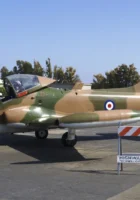
De BAC Jet Provost is een Brits straaltrainervliegtuig dat van 1955 tot 1993 in gebruik was bij de Royal Air Force (RAF). Het werd oorspronkelijk ontwikkeld door Hunting Percival van de eerdere zuigermotor aangedreven Percival Provost basistrainer, en later geproduceerd door de British Aircraft Corporation (BAC). Naast de vele RAF-orders werd de Jet Provost, soms met lichte bewapening, geëxporteerd naar vele luchtmachten wereldwijd. Het ontwerp werd ook verder ontwikkeld tot een zwaarder bewapende grondaanvalsvariant onder de naam BAC Strikemaster.

Bron: BAC Jet Provost op Wikipedia

Lees verder

Bekeken : 960

Sd.Kfz. 250 war

SD.Kfz. 250

LandDuitsland
TypeHalfsporige gepantserde personeelsdrager
In gebruik1941–1945
Gebouwd6600+

De SD.Kfz. 250 (German: Sonderkraftfahrzeug 250; ‘special motor vehicle’) was a light armoured half-track, very similar in appearance to the larger Hanomag-designed Sd.Kfz. 251, and built by the DEMAG firm, for use by Nazi Germany in World War II. Most variants were open-topped and had a single access door in the rear. The Sd. Kfz 250 was adopted in 1939 to supplement the standard half-track. Production delays meant that the first vehicle did not appear until mid-1941.

Bron: Sd.Kfz. 250 op Wikipedia

Lees verder

Bekeken : 3492

Schneider CA1

Schneider CA1

LandFrankrijk
TypeZware tank
In gebruik1916-1918 (Frankrijk) / 1921-1936 (Spanje)
Gebouwd400

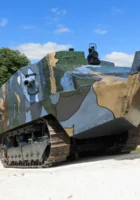
De Schneider CA 1 (originally named the Schneider CA) was the first French tank, developed during the First World War. The Schneider was inspired by the need to overcome the stalemate of trench warfare which on the Western Front prevailed during most of the Great War. It was designed specifically to open passages for the infantry through barbed wire and then to suppress German machine gun nests. After a first concept by Jacques Quellennec devised in November 1914, the type was developed from May 1915 onwards by engineer Eugène Brillié, paralleling British development of tanks the same year. Colonel Jean Baptiste Eugène Estienne in December 1915 began to urge for the formation of French armoured units, leading to an order in February 1916 for four hundred Schneider CA tanks, which were manufactured by SOMUA, a subsidiary of Schneider located in a suburb of Paris, between September 1916 and August 1918.

Bron: Schneider CA1 op Wkipedia

Lees verder

Aantal keren bekeken: 1877

Opel Olympia

Opel Olympia

LandDuitsland
TypeAuto
Productie1935–1970
GebouwdOnbewust

De Opel Olympia is a compact car produced by the German automaker Opel from 1935 to 1940, from 1947 to 1953 and again from 1967 to 1970. The 1935 Olympia was Germany’s first mass-produced car with an all-steel unitized body (monocoque). This revolutionary technology reduced the weight of the car by 180 kilograms (400 lb.) compared to its predecessor. Production of the unibody design required new production methods and materials. Spot welding, advanced types of steel, and a new production line layout were among the many advances introduced by the Olympia.

Bron: Opel Olympia op Wikipedia

Lees verder

Aantal keren bekeken: 1704

Bartini Beriev VVA-14

Bartini Beriev VVA-14

LandSovjet-Unie
TypeAmfibische ASW-vliegtuigen
Eerste vlucht4 september 1972
Gebouwd2

De Bartini Beriev VVA-14 Vertikaľno-Vzletayushchaya Amfibiya (verticaal opstijgend amfibisch vliegtuig) was een vleugel-in-grond-effect vliegtuig ontwikkeld in de Sovjet-Unie tijdens de vroege jaren 1970. Ontworpen om uit het water te kunnen opstijgen en met hoge snelheid over lange afstanden te kunnen vliegen, was het om echte vluchten op grote hoogte te maken, maar ook om efficiënt net boven het zeeoppervlak te vliegen, met behulp van aerodynamisch grondeffect. De VVA-14 werd ontworpen door de in Italië geboren ontwerper Robert Bartini als antwoord op een vermeende eis om Polaris-raketonderzeeërs van de Amerikaanse marine te vernietigen. Het laatste toestel werd in 1987 buiten gebruik gesteld.

Bron: Bartini Beriev VVA-14 op Wiki

Lees verder

Bekeken : 3493

Lun-klasse ekranoplan

Lun-klasse ekranoplan

LandSovjet-Unie
RoleAanval/Transport grondeffect voertuig
In gebruik 1987-eind jaren 1990
Gebouwd2

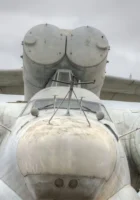
De Lun-klasse ekranoplan (also called Project 903) is a ground effect vehicle (GEV) designed by Rostislav Alexeyev in 1975 and used by the Soviet and Russian navies from 1987 until sometime in the late 1990s. It flew using lift generated by the ground effect acting on its large wings when within about four metres (13 ft) above the surface of the water. Although they might look similar to traditional aircraft, ekranoplans like the Lun are not classified as aircraft, seaplanes, hovercraft, or hydrofoils. Rather, crafts like the Lun-class ekranoplan are classified as maritime ships by the International Maritime Organization due to their use of the ground effect, in which the craft glides just above the surface of the water.

Bron: Lun-class ekranoplan op Wikipedia

Lees verder

Bekeken : 1802

3,7 inch houwitser

QF 3.7-inch howitzer

LandUk
RoleHet kanon van de berg
In gebruik1917–Heden
GebouwdOnbewust

Ordnance, QF 3,7-inch houwitser is een bergkanon, gebruikt door Britse en Gemenebestlegers in de Eerste en Tweede Wereldoorlog, en tussen de oorlogen.

Bron: QF 3,7-inch houwitser op Wikipedia

Lees verder

Bekeken: 1461