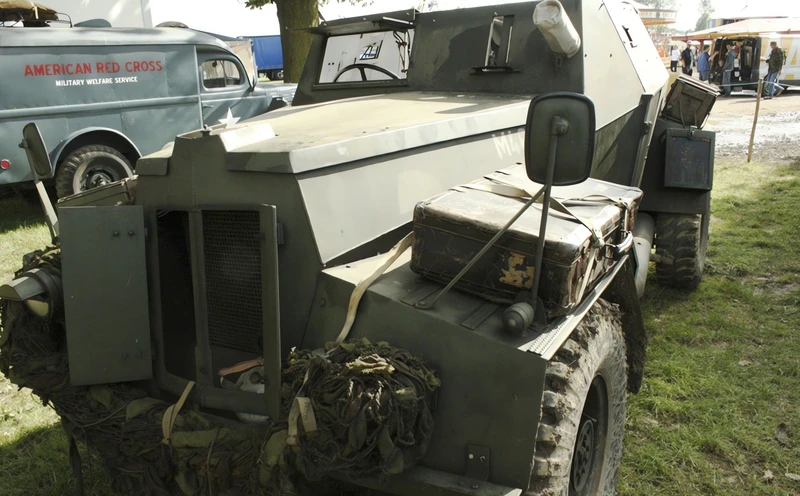
모리스 CS9 | |
|---|---|
| 국가 | 영국 |
| 역할 | 가벼운 장갑차 |
| 기간 | 1936+ |
| 내장 | Unknow |
차량은 모리스 Commercial C9 4×2 15 long cwt (760 kg) truck chassis. On this chassis, a riveted hull was mounted with an open-topped two-man turret. The armament consisted of either Boys anti-tank rifle and Bren light machine gun or Vickers machine gun. The vehicle carried a No. 19 radio set. The prototype was tested in 1936. A further 99 cars were ordered and were delivered in 1938. Thirty-eight of these cars were used by the 12th Royal Lancers in the Battle of France, where all of them were destroyed or abandoned. Another 30 served with the 11th Hussars in the North African Campaign. It was found that, when fitted with desert tyres, the vehicle had good performance on soft sand. However, its armour and armament were insufficient. The vehicle was retired halfway through the North African Campaign.
소스: 모리스 CS9 위키 백과에
| 모리스 장갑차 산책 | |
|---|---|
| 사진 작가 | Unknow |
| 로컬라이제이션 | Unknow |
| 사진 | 15 |


참고 항목:


General Characteristics (WWII Era)
The Morris CS9, later known as the Light Armoured Car, was an early World War II British reconnaissance vehicle. It was based on a commercial truck chassis, giving it good road speed but limited cross-country performance.
| Property | Value (Approximate) |
|---|---|
| 역할 | Light Armoured Car, Reconnaissance |
| 제조업체 | Morris Commercial Cars |
| 도입 | 1938 |
| 승무원 | 4 (Commander, Gunner, Driver, Radio Operator) |
| Combat Weight | 4.5 tonnes (4.5 tons) |
| Chassis Base | Morris Commercial C9 4×2 truck chassis |
Armament and Protection
- Main Armament: One Boys .55 inch Anti-Tank Rifle (AT Rifle).
- Secondary Armament: One Bren .303 inch Light Machine Gun (LMG) (mounted in the open-topped turret).
- Alternative Armament: Some variants were equipped with a Vickers machine gun instead of the Boys rifle and Bren gun combination.
- Armour Thickness: Very light, typically up to 7 mm (0.28 inches). This was insufficient against most contemporary anti-tank weapons and heavy machine gun fire.
- Service History: Used in the Battle of France (1940) and the early North African Campaign. It was quickly replaced by more capable designs like the Humber and Daimler armoured cars.
Powerplant and Mobility
- Engine: Morris 6-cylinder petrol engine.
- Power Output: 96 hp (72 kW).
- Drive: 4×2 (Rear-wheel drive). This contributed to its poor off-road mobility compared to 4×4 vehicles.
- Maximum Speed: 73 km/h (45 mph).
- Operational Range: Approximately 385 km (240 miles).
- Notable Fact: When fitted with large-section sand tires, it performed surprisingly well over soft sand in the Western Desert, but was still generally considered a short-lived, interim design.
조회수 : 1015