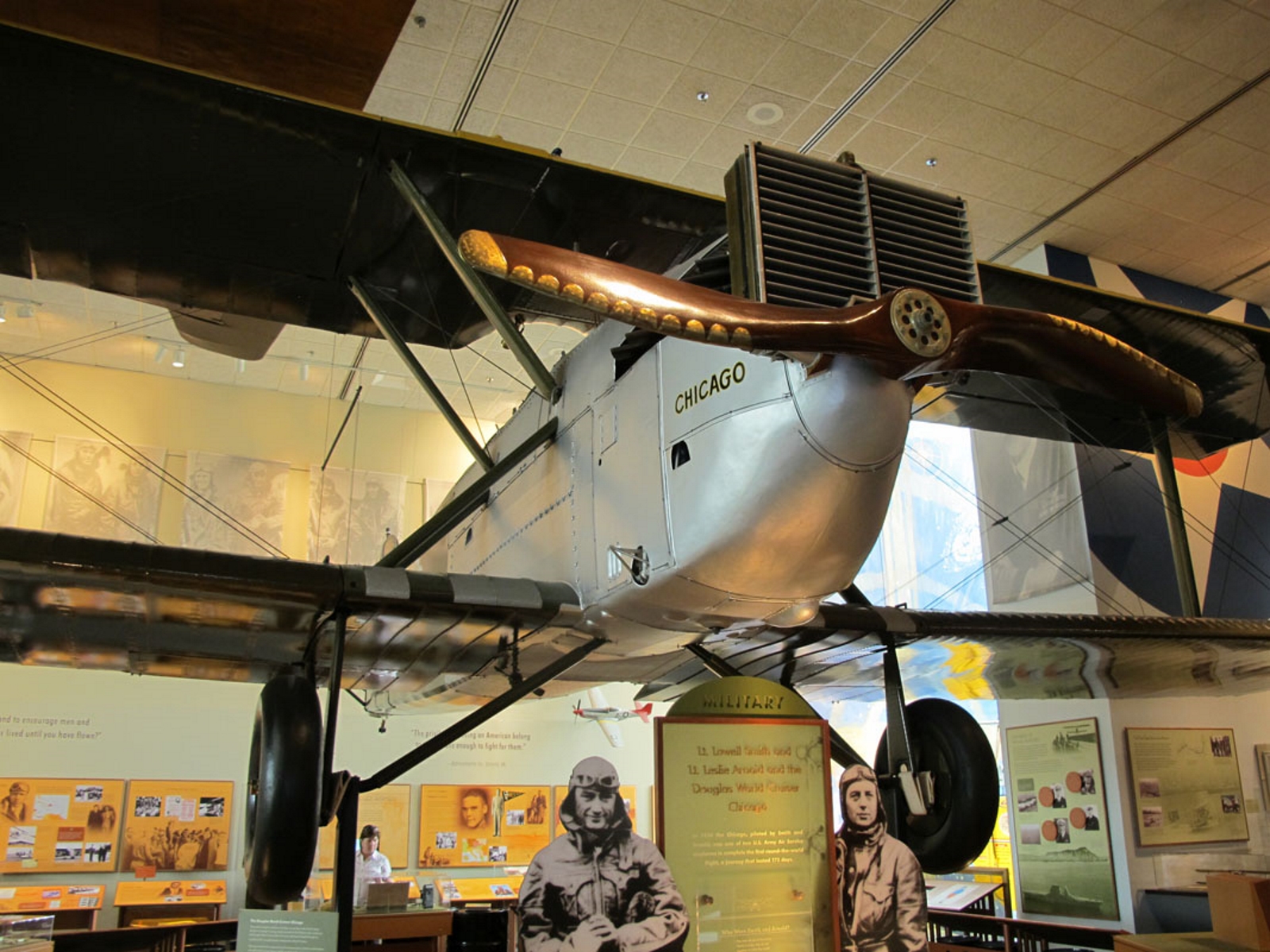
Douglas World Cruiser | |
|---|---|
| Paese | Usa |
| Ruolo | idrovolante |
| Primo volo | Novembre 1923 |
| Costruito | 5 |
Le Douglas Incrociatore del mondo (DWC) was developed to meet a requirement from the United States Army Air Service for an aircraft suitable for an attempt at the first flight around the world. The Douglas Aircraft Company responded with a modified variant of their DT torpedo bomber, the DWC. Five aircraft were ordered for the round-the-world flight, one for testing and training and four for the actual expedition. The success of the World Cruiser bolstered the international reputation of the Douglas Aircraft Company. The design of the DWC was later modified to create the O-5 observation aircraft, which was operated by the Army Air Service.
| Douglas World Cruiser "Chicago" a piedi | |
|---|---|
| Fotografo | Vladimir Jakubov |
| Localizzazione | National Air & Space Museum, Washington DC |
| Foto | 60 |

Vedi anche:


Le Douglas Incrociatore del mondo è stato un aereo storico che ha realizzato la prima circumnavigazione aerea del mondo nel 1924. Fu sviluppato dalla Douglas Aircraft Company come versione modificata del loro aerosilurante DT, che era stato utilizzato dalla US Navy. Il World Cruiser aveva una fusoliera in acciaio, un'ala e un timone più grandi e sei serbatoi di carburante che ne aumentavano l'autonomia e la resistenza. Potrebbe anche passare da ruote a galleggianti, a seconda del terreno e delle condizioni meteorologiche. L'US Army Air Service ordinò quattro incrociatori del mondo per la spedizione, denominati Seattle, Chicago, Boston e New Orleans. Erano pilotati da quattro ufficiali e accompagnati da quattro meccanici.
Il volo partì da Seattle il 6 aprile 1924 e seguì una rotta che attraversò 28 paesi e quattro continenti. Il volo ha affrontato molte sfide, come maltempo, problemi meccanici e autorità ostili. Uno dei World Cruisers, il Seattle, si schiantò in Alaska e un altro, il Boston, si perse nell'Oceano Atlantico. I restanti due World Cruiser, Chicago e New Orleans, completarono il viaggio il 28 settembre 1924, dopo aver volato per 175 giorni e aver percorso più di 26.000 miglia. Il Douglas World Cruiser è stato un risultato notevole che ha dimostrato la fattibilità e il potenziale dell'aviazione a lunga distanza.
Visualizzazioni : 1609
Puoi anche vedere:
 Douglas DC-3 – Foto e Video
 Douglas B-23 Dragon – Foto e Video
 McDonnell Douglas F/A-18 Hornet – Foto e video
 McDonnell Douglas KC-10 Extender – Foto e video
 Douglas A-4 Skyhawk – Foto e Video
 Douglas F4D Skyray – Foto e Video
 Douglas A-3 Skywarrior – Foto e Video
 Grumman HU-16 Albatross – Foto e Video
 Lisunov Li-2 - WalkAround
 Douglas A-26 Invader - Walkaround