AT-6D Texan

Nord America AT-6D Texan

PaeseUsa
RuoloVelivoli da addestramento avanzati monomotore
Primo volo1 aprile 1935
Costruito15495

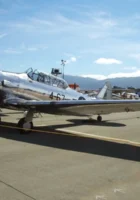
North American Aviation T-6 Texan is a single-engined advanced trainer aircraft used to train pilots of the United States Army Air Forces (USAAF), United States Navy, Royal Air Force and other air forces of the British Commonwealth during World War II and into the 1970s. Designed by North American Aviation, the T-6 is known by a variety of designations depending on the model and operating air force. The United States Army Air Corps (USAAC) and USAAF designated it as the AT-6, the United States Navy the SNJ, and British Commonwealth air forces, the Harvard, the name it is best known by outside of the US. After 1962, US forces designated it the T-6. It remains a popular warbird aircraft used for airshow demonstrations and static displays. It has also been used many times to simulate various Japanese aircraft including the Mitsubishi A6M Zero in movies depicting World War II in the Pacific.

fonte: North American AT-6D Texan su Wiki

Continua a leggere

Numero visioni : 3989

Douglas WB-66 Cacciatorpediniere

PaeseUsa
RuoloBombardiere leggero
Primo voloIl 28 giugno 1954
Numero costruito294

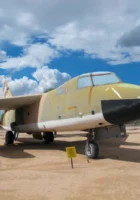
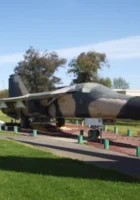
Galleria fotografica di un Douglas WB-66 Cacciatorpediniere, The Douglas B-66 Destroyer was a U.S. Air Force Tactical Air Command light bomber based on the United States Navy’s A-3 Skywarrior carrier-based heavy attack aircraft. It was intended to replace the Douglas A-26 Invader. An RB-66 photo-reconnaissance version was ordered simultaneously. The USAF B-66 retained the three-man crew from the US Navy A-3, but incorporated ejection seats that the US Navy variant lacked. WB-66D: Electronic weather reconnaissance variant with the crew compartment modified for two observers, 36 built with two later modified to X-21A.

fonte: Douglas WB-66 Destroyer su Wiki

Continua a leggere

Punti di vista: 3743

Wiesel 1 Fahrschule

Wiesel 1 Fahrschulek

PaeseGermania
digitareVeicolo da combattimento corazzato leggero trasportabile ad aria
FotografiaUlrich Wrede
IndividuareInconsapevole
DescrizioneAlbum di 34 foto a piedi di una «Wiesel 1 Fahrschule»

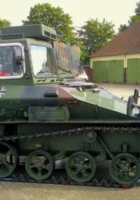
Galleria fotografica di un Wiesel 1 Fahrschule, The Wiesel Armoured Weapons Carrier (AWC) is a German light air-transportable armoured fighting vehicle, more specifically a lightly armoured weapons carrier. It is quite similar to historical scouting tankettes in size, form and function, and is the only true modern tankette in use in Western Europe. Variants in Service Wiesel 1 Aufklärung: reconnaissance Wiesel 1 ATM TOW: anti-tank vehicle fitted with TOW missiles Wiesel 1TOW: Uprated with BMS Wiesel 1 MK20: fire support version with a Rheinmetall MK 20 Rh202 20mm autocannon Wiesel 1 MK20 Variant 1: Uprated with new sight Wiesel 1 MK20 Variant 2: Uprated with BMS Remotely controlled Wiesel 1 equipped with ground-scanning radar as part of the Route Clearance System Prototypes and Studies Wiesel 1 ATM TOW Resupply: cargo carrier fitted with racks for TOW missiles Wiesel 1 BTM-208: fitted with a SAMM BTM-208 turret armed with .50-cal (12.7mm) M2HB and 7.62mm MG3 machine guns Wiesel 1 ATM HOT: anti-tank vehicle fitted with HOT missiles Wiesel 1 ATM HOT Variant 1: fitted with UTM-800 turret Wiesel 1 Radar: fitted with RATAC-S multi-purpose radar Wiesel 1 MK25: 25 mm armed version

fonte: Wiesel 1 Fahrschule su Wiki

Continua a leggere

Visualizzazioni : 3317

M923 Guntruck

M923 Guntruck

PaeseUsa
digitareCamion da carico

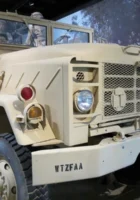
Galleria fotografica di un M923 Guntruck, This medium cargo truck of the 5 ton category, is representative of today’s generation of logistical vehicles of the U.S. Forces. It entered service in the early eighties. The M-923 has an extremely sturdy structure and excellent off-road features, which are necessary to secure the flow of material to the front line combat units. Based on this chassis many versions have been produced: wrecking trucks, tank trucks, mobile maintenance and communication trucks. The A-1 version is characteristic because of its large off-road tires which have earned it the nick-name “big-foot”. During its operational use, and in particular in the most recent military campaigns in which it was employed as Iraq and Afghanistan, the “Big Foot” has often been modified with the addition of “home made” protections to reduce the damages caused by the fire of light weapons. However, the personalization of the vehicles, made “on field” by the crews, were possible thanks to the excellent platform offered by-M-923 trucks.

fonte: M923 Guntruck su Wiki

Continua a leggere

Visualizzazioni : 3746

Guerriero 510

Veicolo corazzato cingolato Warrior

PaeseRegno unito
digitareVeicolo blindato

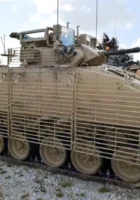
Galleria fotografica di un Veicolo corazzato cingolato Warrior, The Warrior tracked vehicle family is a series of British armoured vehicles, originally developed to replace the older FV430 series of armoured vehicles. The Warrior started life as the MCV-80 project that was first broached in the 1970s, GKN Sankey/Defence winning the production contract in 1980. GKN Defence was subsequently purchased by BAE Systems (via Alvis plc). A total of 789 FV510 and variants were manufactured for the British Army, and 254 of a modified version (Desert Warrior) were produced for the Kuwaiti Army.

fonte: Veicolo corazzato cingolato Warrior su Wiki

Continua a leggere

Visualizzazioni : 4932

SdKfz 302 Leichter Ladungstrager Golia

SdKfz 302 Leichter Ladungstrager Golia

PaeseGermania
digitareVeicolo da demolizione telecomandato
In servizio1942-1945
Costruito7564

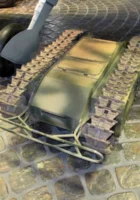
Galleria fotografica di un SdKfz 302 Leichter Ladungstrager Golia, The Goliath tracked mine – complete German name: Leichter Ladungsträger Goliath (Sd.Kfz. 302/303a/303b) – was a remote controlled German-engineered demolition vehicle, also known as the beetle tank to the Allies. Employed by the Wehrmacht during World War II. It carried 60 or 100 kilograms (130 or 220 lb) of high explosives, depending on the model, and was intended to be used for multiple purposes, such as destroying tanks, disrupting dense infantry formations, and demolition of buildings and bridges.

fonte: SdKfz 302 Leichter Ladungstrager Golia su Wiki

Continua a leggere

Visualizzazioni : 3808

Sdkfz 179 Bergepanther

Sdkfz 179 Bergepanther

PaeseGermania
digitareVeicolo blindato di recupero
FotografiaVladimir Jakubov
IndividuareMusee des Blindes
DescrizioneAlbum di 112 foto walk-around di un "Sdkfz 179 Bergepanther"

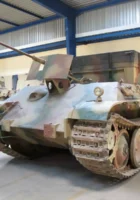
Galleria fotografica di un Sdkfz 179 Bergepanther, An armoured recovery vehicle (ARV) is an armoured vehicle used during combat for recovery or repair of battle-damaged and inoperable armoured fighting vehicles. The term “Armoured Repair and Recovery Vehicle” (ARRV) is also used. Bergepanther (SdKfz 179) – PzKpfw V Panther chassis 347 produced (1943 to 1945).

fonte: Sdkfz 179 Bergepanther su Wiki

Continua a leggere

Visualizzazioni : 6971

MT-55 Bridgelayer

MT-55 Bridgelayer

PaeseSlovacchia
digitarePonte blindato lanciato da veicoli
FotografiaCarey
IndividuareMuseo "Linea Stalin", Zaslavl, Bielorussia
DescrizioneAlbum di 77 foto walk-around di un «MT-55 Bridgelayer»

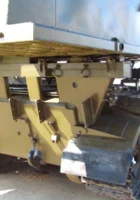
Galleria fotografica di un MT-55 Bridgelayer, The MT-55A (Slovak: Mostný tank) is an armoured vehicle-launched bridge (AVLB) tank, manufactured by ZTS Martin in Slovakia. The AVLB is based on a T-55A medium tank chassis, with the turret detached and replaced by a special bridge launching equipment. The MT-55A was produced for the armies of the Warsaw Pact (including the Soviet Army), as well as for export clients.

fonte: MT-55 Bridgelayer su Wiki

Continua a leggere

Punti di vista: 2146

Schiwmwagen

Schwimmwagen

PaeseGermania
digitareAuto anfibia
Descrizione

Album de 51 walk-around foto del Schwimmwagen

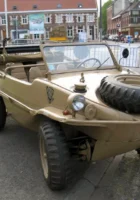
Le VW 166 Schwimmwagen è un'auto anfibia tedesca in uso durante la seconda guerra mondiale. La modalità 4X4 di questa auto fuoristrada leggera è attiva solo nella prima e nella parte inversa. La sua altezza da terra è piuttosto alta e beneficiando di differenziali tipo ciottoli autobloccanti questa macchina è un vero pass-all. Lo Schwimmwagen è utilizzato principalmente come veicolo di collegamento o ricognizione e come mezzo rapido per evacuare i feriti.

Un embout d’hélice relevable permet de facilement basculer en mode amphibie, la propulsion dans l’eau se faisant uniquement en marche avant. Avec plus de 15000 unités construites entre 1941 et 1944 la Schwimmwagen est surement un des véhicules amphibie les plus produits de tous les temps.

fonte: Schwimmwagen su Wikipedia

Continua a leggere

Visualizzazioni : 3193

General Dynamics FB-111A Aardvark

General Dynamics FB-111A Aardvark

PaeseUsa
digitareAerei supersonici
FotografiaVladimir Jakubov
IndividuareMuseo AFB del Castello
DescrizioneAlbum di 64 foto walk-around di un «General Dynamics FB-111A Aardvark»

Galleria fotografica di un General Dynamics FB-111A Aardvark, The General Dynamics F-111 Aardvark was a supersonic, medium-range interdictor and tactical attack aircraft that also filled the roles of strategic nuclear bomber, aerial reconnaissance, and electronic-warfare aircraft in its various versions. Developed in the 1960s by General Dynamics, it first entered service in 1967 with the United States Air Force. The Royal Australian Air Force (RAAF) also ordered the type and began operating F-111Cs in 1973.

fonte: General Dynamics FB-111A Aardvark su Wiki

Continua a leggere

Numero visioni : 4365