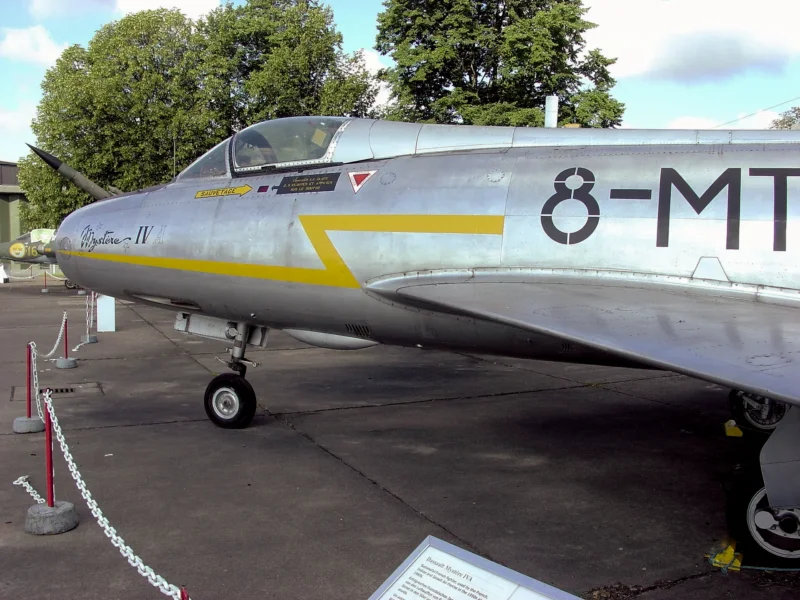
Dassault Mystere | |
|---|---|
| Land | Frankreich |
| Rolle | Jagdbomber |
| Erstflug | 23. Februar 1951 |
| Gebaut | 171 |
das Dassault MD.452 Mystére is a 1950s French fighter-bomber. After the success of the Ouragan, Dassault was working on a more advanced machine based on it, which would take to the air in early 1951 as the MD.452 Mystère I. The first prototype Mystère I was essentially an Ouragan with a 30-degree swept wing and modified tail surfaces. Two further prototypes followed, powered by the Rolls-Royce Tay 250 centrifugal-flow turbojet, an improved version of the Rolls-Royce Nene, built under license by Hispano-Suiza, and rated at 28.0 kN (6,300 lbf) thrust.
| Dassault Mystere Walk Around | |
|---|---|
| Fotograf | Meindert de Vreeze |
| Lokalisierung | Unbekannter |
| Fotos | 27 |

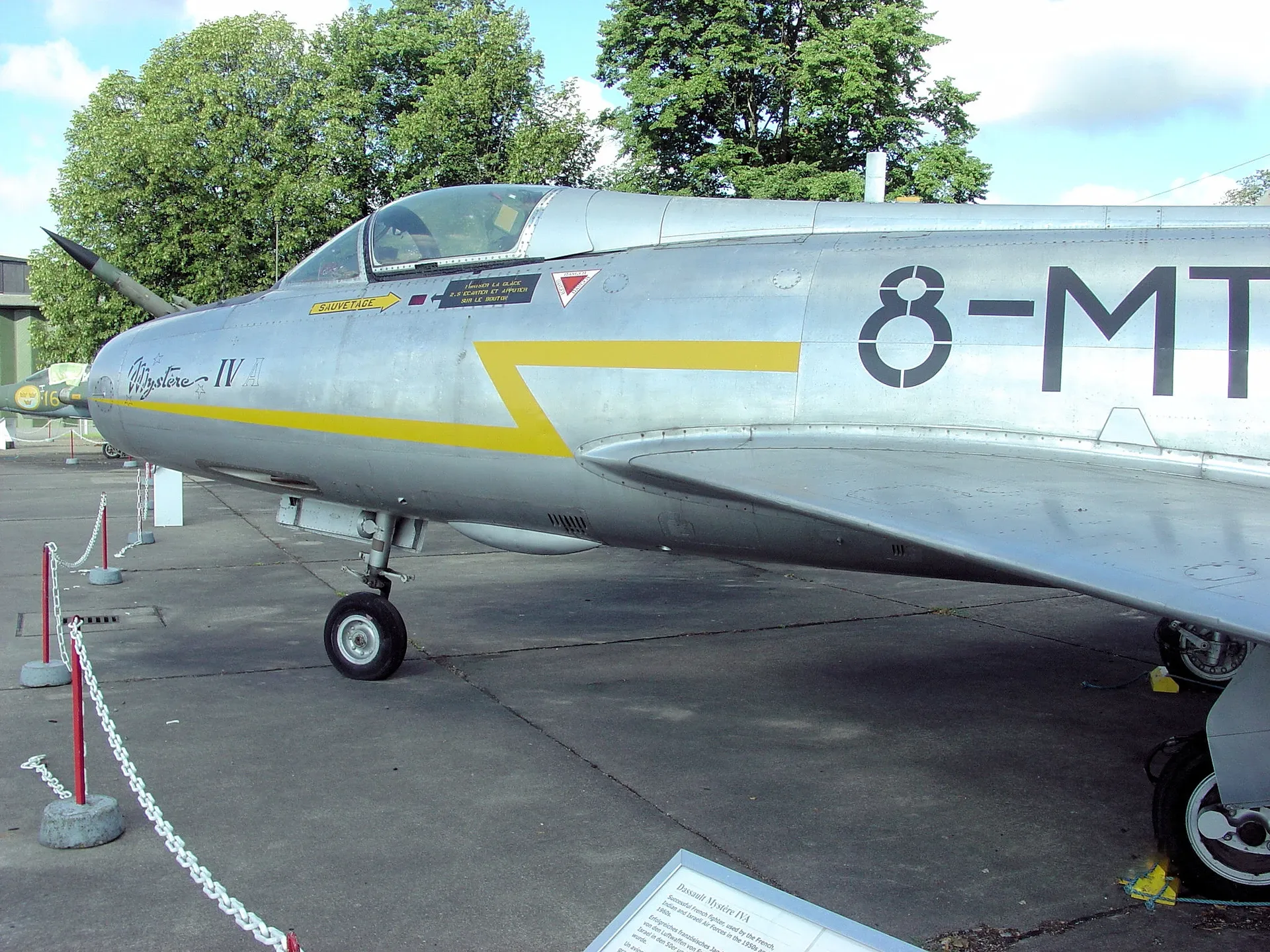
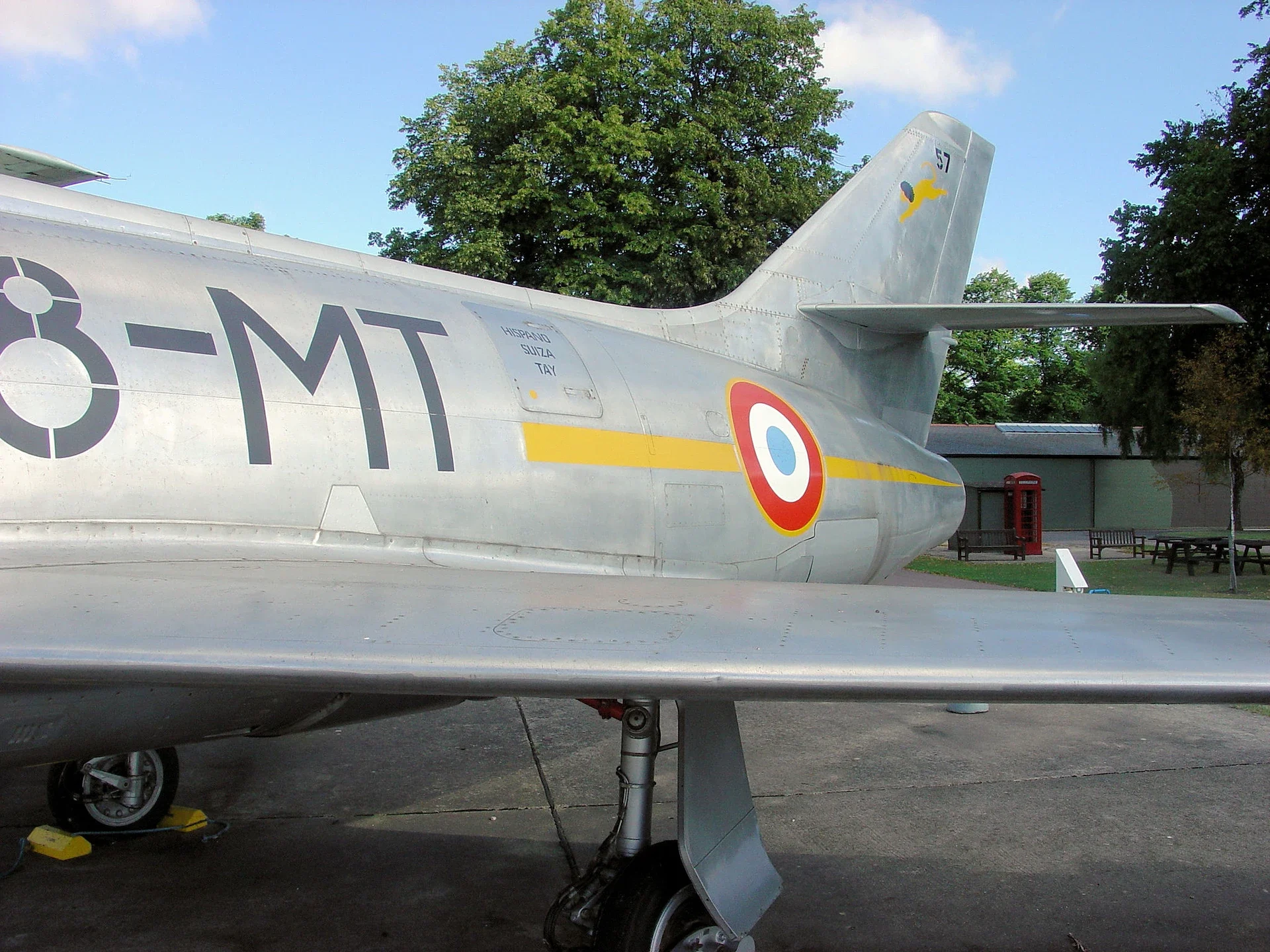
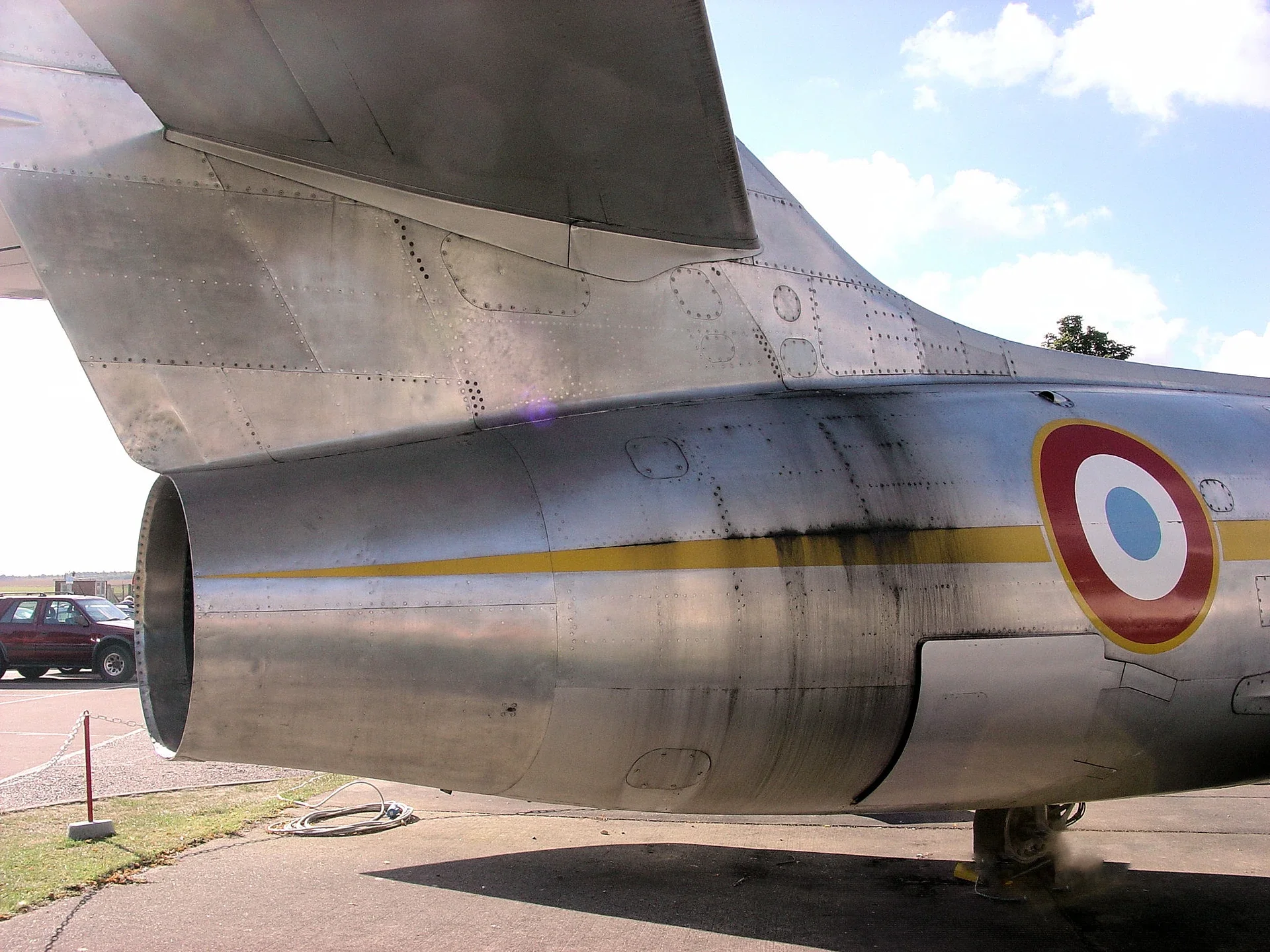
| Dassault Mystere IVA Walk Around | |
|---|---|
| Fotograf | Mark Hayward |
| Lokalisierung | Unbekannter |
| Fotos | 16 |
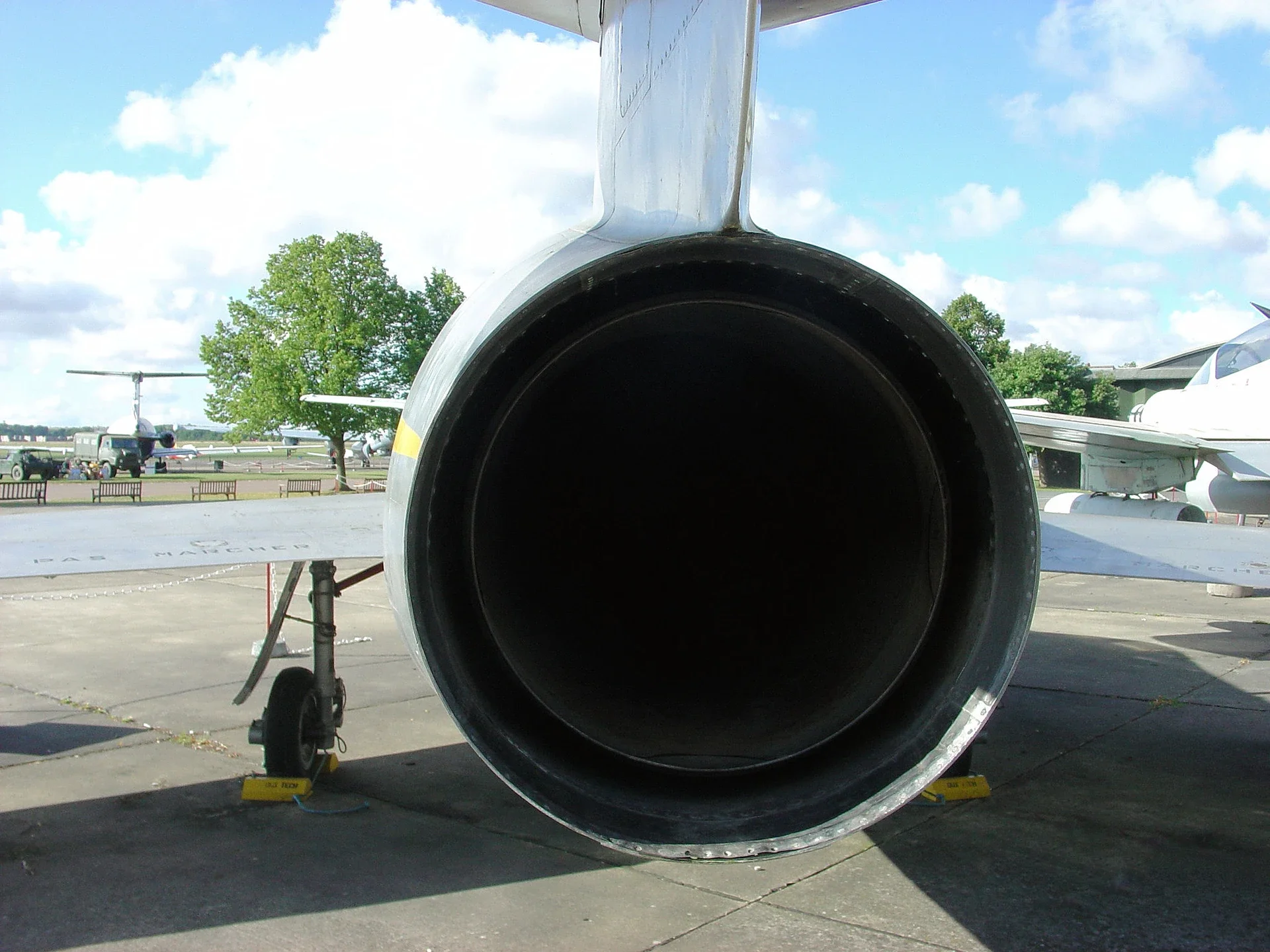
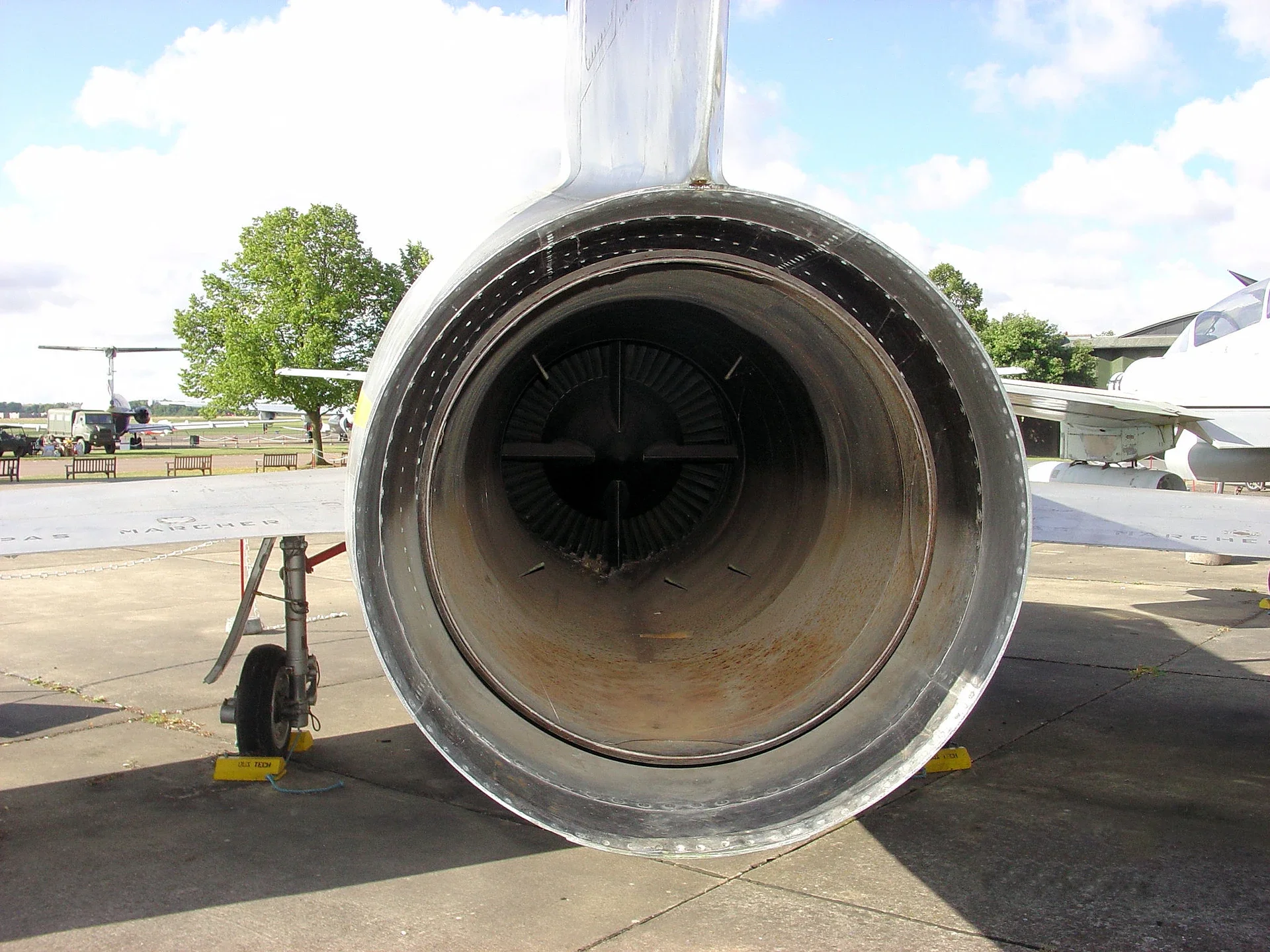
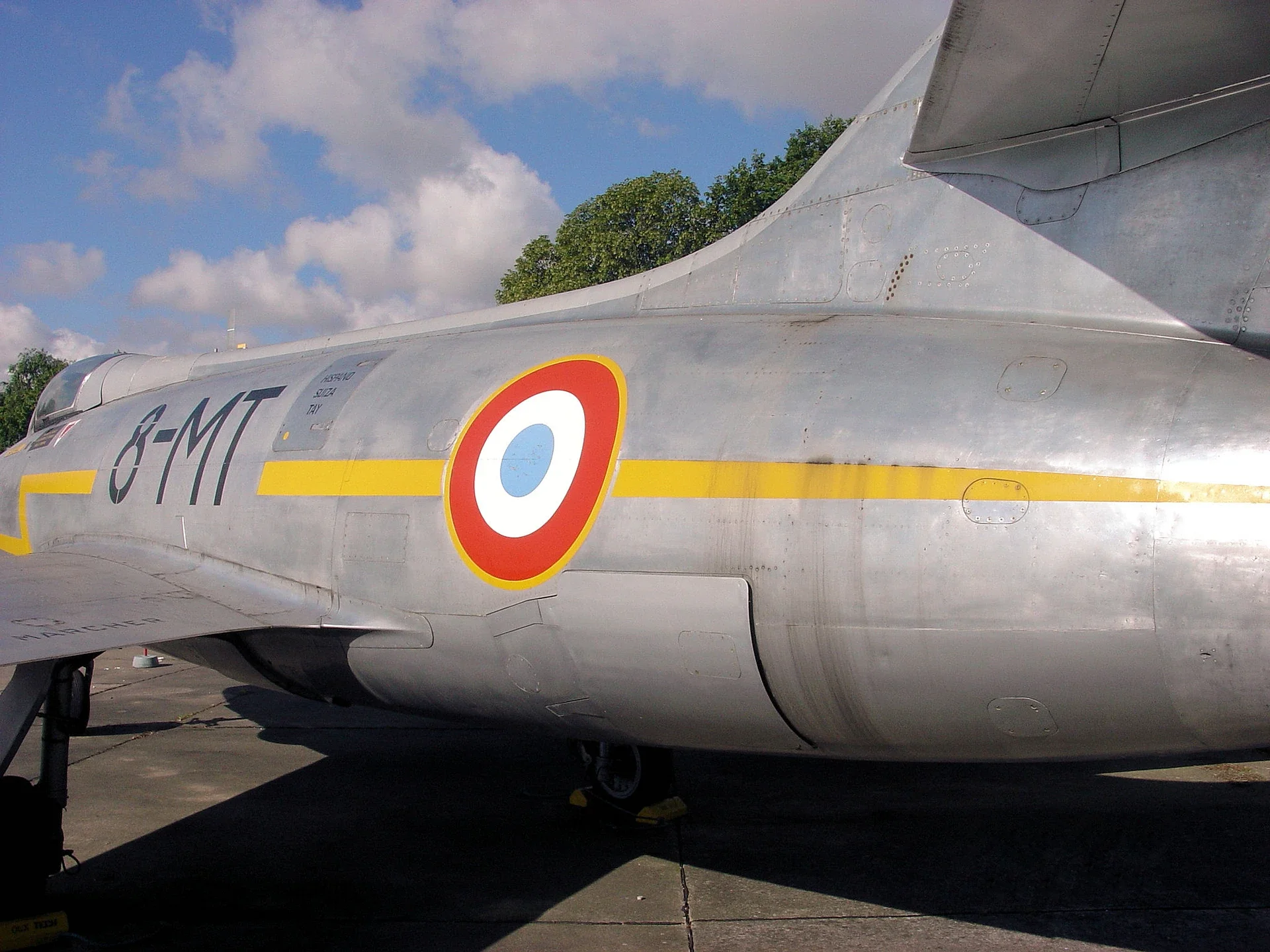
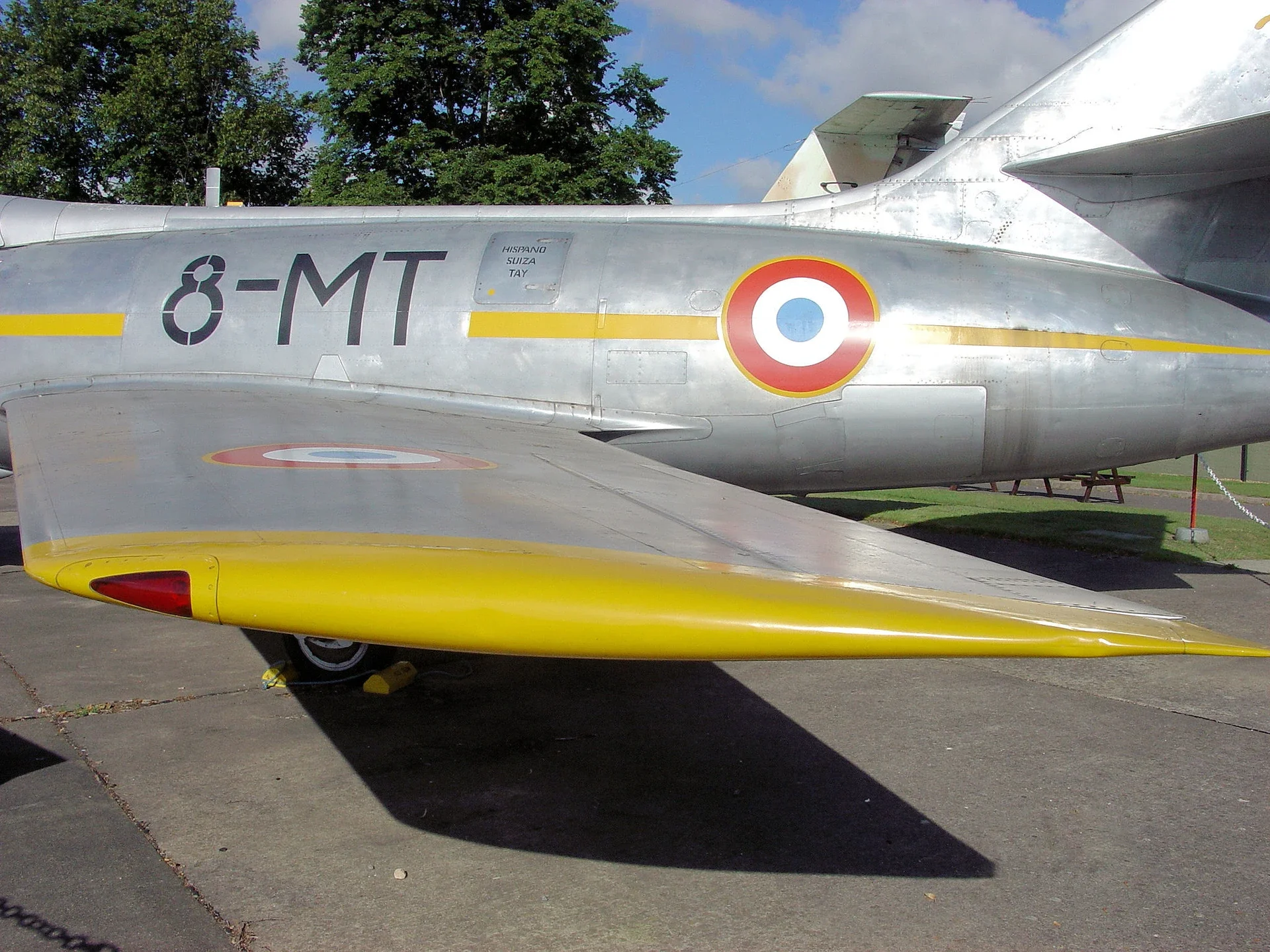
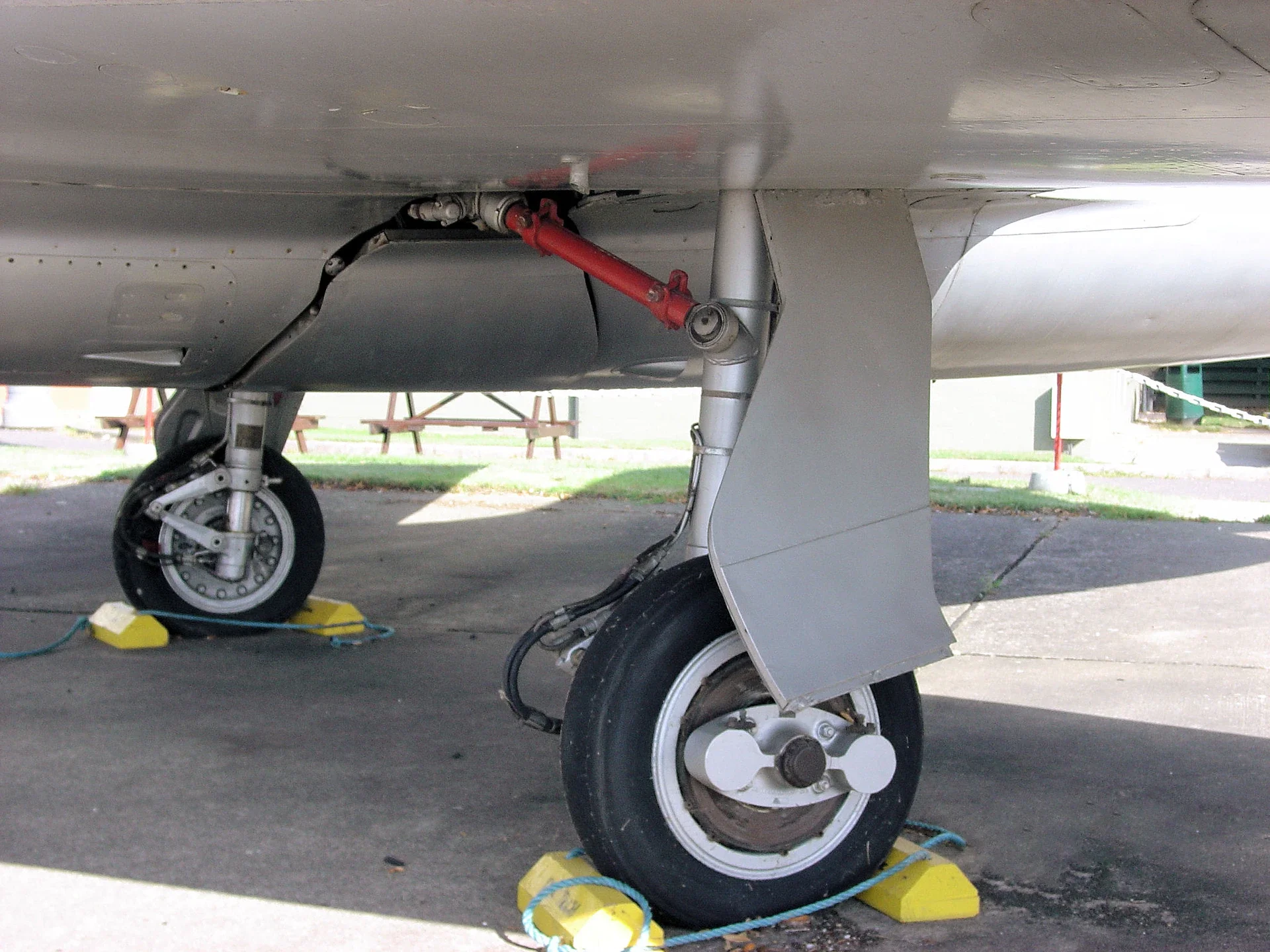
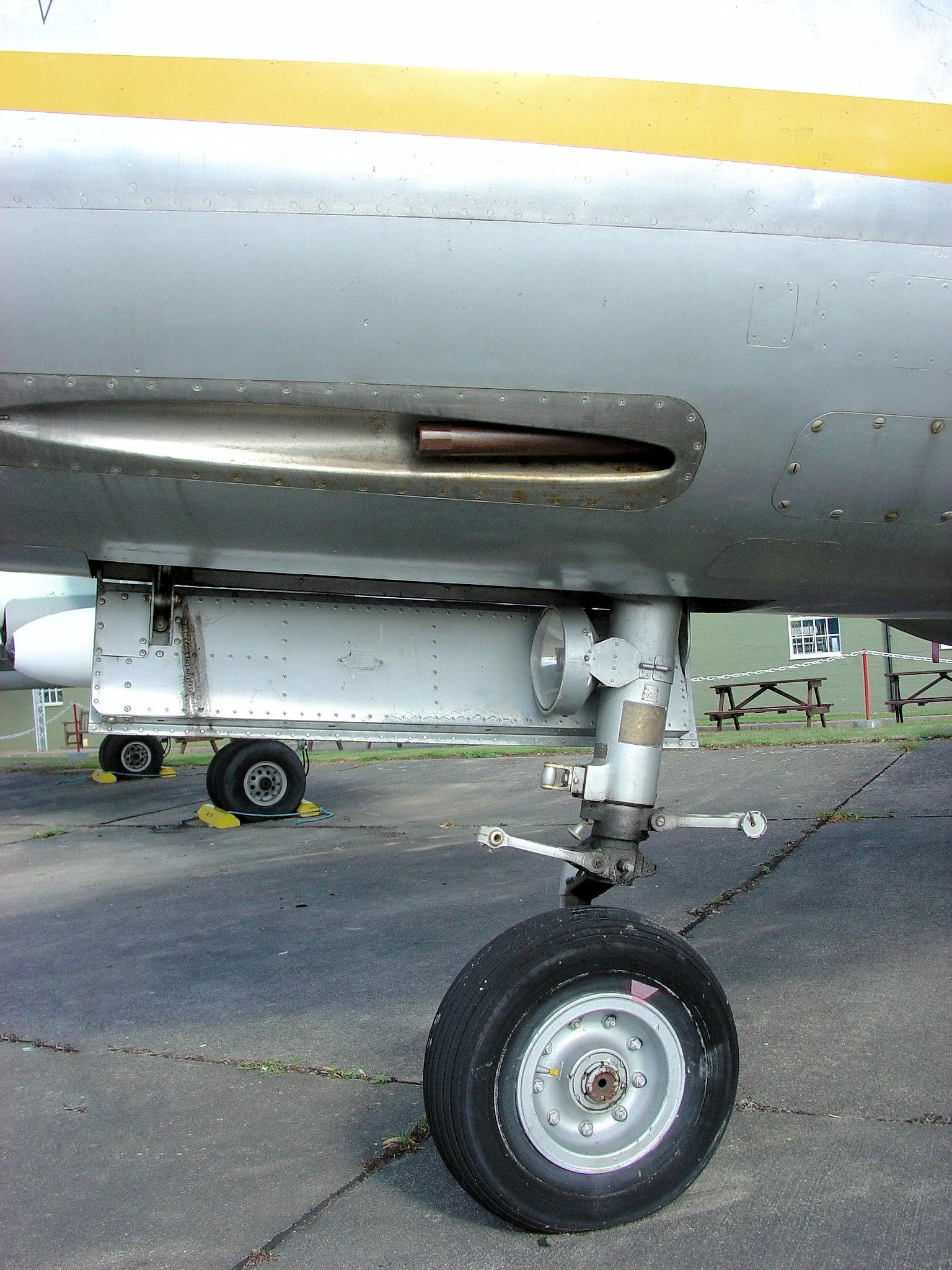
Siehe auch:


The Swept-Wing Pioneer of the French Jet Age
das Dassault Mystère (specifically its definitive mass-produced variant, the Mystère IV) was a highly successful, first-generation French fighter-bomber that symbolized the remarkable post-WWII rebirth of the French aviation industry. Designed by Marcel Dassault, it evolved directly from the earlier, straight-winged MD.450 Ouragan. By introducing a radical swept-wing geometry and incorporating powerful new turbojet engines, the Mystère shattered performance barriers, establishing France as a top-tier global exporter of high-performance military aircraft. For its time, it was an agile, rugged, and exceptionally steady dogfighter. While it initially struggled to reliably break the sound barrier in level flight without an afterburner, its incredible low-altitude handling, devastating internal cannon firepower, and robust ground-attack capabilities made it an indispensable frontline asset during the height of the Cold War.
| Attribute | Technical Specification (Mystère IV A Production Standard) |
|---|---|
| Rolle | Fighter-Bomber / Day Interceptor |
| Crew | 1 (Pilot) |
| Triebwerk | 1 × Hispano-Suiza Verdon 350 turbojet engine (approx. 7,716 lbs of static thrust) |
| Höchstgeschwindigkeit | 1,110 km/h (690 mph / Mach 0.91) at sea level | Capable of Mach 1+ in a steep dive |
| Combat Weight | Approx. 7,500 kg (16,535 lbs) | Max Takeoff Weight: 9,500 kg (20,944 lbs) |
| Service Ceiling | 15,000 meters (49,200 feet) |
| Einsatzbereich | ~915 km (570 miles) standard clean | Up to 1,300 km with underwing drop tanks |
| Primary Armament | 2 × 30mm DEFA revolver cannons (150 rounds per gun) mounted in the lower fuselage nose |
| Sekundärbewaffnung | 4 × underwing hardpoints capable of carrying up to 900 kg (2,000 lbs) of bombs, Matra rocket pods, or a retractable internal belly tray containing 55 × 68mm SNEB rockets |
| Production Total | 411 units of the Mystère IV A variant built between 1954 and 1958 |
Design Engineering: The Hispano Verdon and the Shift to Swept Wings
- Embracing the Swept-Wing Revolution: To overcome the severe aerodynamic drag limitations that plagued straight-winged aircraft as they approached the speed of sound, Dassault designed the Mystère IV with a sharp 38-degree wing sweepback. This dramatic geometric shift allowed air to flow more smoothly over the wings at high speeds, significantly delaying the onset of shockwaves and giving the pilot an exceptionally stable platform during high-speed, low-altitude attack runs.
- The Heart of French Muscle (Hispano-Suiza Verdon): The Mystère IV A was powered by the Verdon 350 turbojet, a highly advanced French development of the British Rolls-Royce Tay engine. Operating without an afterburner, it was one of the most powerful centrifugal-flow turbojets ever put into mass production. This engine offered immense dependability and excellent low-altitude throttle response, though its wide, bulbous compressor section forced the Mystère to maintain a fairly thick, barrel-like fuselage design.
- The Heavy Punch of the 30mm DEFA Cannons: Ditching the smaller .50 caliber machine guns common on American aircraft of the early 1950s, the Mystère introduced twin 30mm DEFA revolver cannons. These weapons fired devastating, high-explosive shells at a combined rate of nearly 2,400 rounds per minute. A single hit from a 30mm shell was often enough to completely tear off the wing of an enemy fighter or obliterate an armored ground vehicle.
- The Secret Belly Rocket Tray: For interception missions against enemy bomber formations, the Mystère IV featured a unique engineering surprise: a specialized, retractable tray built directly into the lower rear belly of the fuselage. At the push of a button, this tray dropped down into the airstream to unleash a salvo of 55 unguided 68mm SNEB rockets, allowing the pilot to blanket an entire patch of sky with high-explosive fragments before rapidly snapping the tray closed to minimize aerodynamic drag.
Operational History: The Suez Crisis and Dogfights Over the Middle East
- The Baptism of Fire in the Suez Crisis (1956): Operation Musketeer marked the combat debut of the Mystère IV A. French Air Force squadrons deployed to Cyprus flew dozens of ground-attack and escort missions, completely suppressing Egyptian air defense networks. During the conflict, French-piloted Mystères successfully intercepted and shot down Egyptian Soviet-built MiG-15 fighters, proving that Western engineering could go toe-to-toe with the Kremlin’s latest designs.
- Israel’s Ultimate Air-Superiority Shield: Israel became the premier export customer for the Mystère IV A, purchasing 61 units just in time to face a rapidly modernizing Arab coalition. Israeli pilots deeply respected the aircraft’s exceptional horizontal turning ability and rugged construction, utilizing it as their premier frontline air-superiority fighter throughout the late 1950s and early 1960s to hold off aggressive border incursions.
- The Six-Day War Masterclass (1967): By 1967, the Mystère was technically outdated, having been superseded in the air-to-air role by the supersonic Mirage III. However, during the opening hours of the Six-Day War (Operation Focus), Israeli Mystères performed flawlessly as heavy ground-attack trucks. Striking with absolute precision, they blasted Egyptian, Jordanian, and Syrian airfields, destroying hundreds of enemy aircraft on the tarmac and wiping out advancing enemy tank columns in the Sinai Desert.
- The Elite Patrouille de France and Long Retirement: The Mystère’s spectacular handling qualities and elegant lines made it the choice of the *Patrouille de France*—the French Air Force’s elite aerial demonstration team—which flew the jet from 1957 to 1961. The aircraft proved to be so mechanically reliable and structurally sound that the French military kept it in active service as an advanced operational weapon-trainer until 1982, marking a stunning nearly 30-year operational lifespan.
Aufrufe : 3044
Sie können auch sehen:
 Dassault MD 315 Flamant – Fotos & Videos
 Mirage 2000D – Fotos und Videos
 Dassault Mirage 4000 – Fotos und Videos
 Dassault Mirage F.1 – Fotos und Videos
 Dassault Super Mystere B.2 – Fotos & Video
 Dassault Etendard IV M – Fotos & Video
 Dassault Mirage III-O – Fotos & Video
 Dassault M.D.450 Ouragan – Fotos und Videos
 Dassault / Dornier Alpha Jet – WalkAround
 Dassault Rafale M – WalkAround