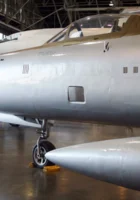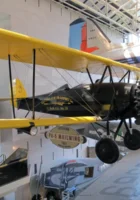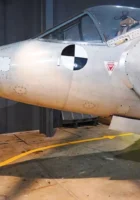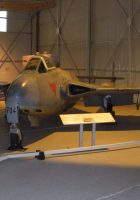
Pitcairn PA-5 Mailwing

Pitcairn PA-5 Mailwing

CountryUSA
RoleMail Carrier and Sport
First flight1927
Built106

The Pitcairn Mailwings were developed by Pitcairn to carry air mail for the U.S. Postal Service. Of simple and robust construction, they also had relatively benign flying characteristics. They were constructed using chrome-moly steel tube and square-section spruce spars with spruce and plywood built-up ribs. The fuselage was faired using wooden formers and covered with fabric. The tail sections were built up from steel tube and fabric-covered. The Pitcairn Mailwing had a ground-adjustable fin and in-flight adjustable tailplane, features not often seen in other aircraft.

Source: Pitcairn PA-5 Mailwing on Wikipedia

Continue reading

Views : 1229

Hawker P.1127

Hawker Siddeley P.1127

CountryUK
TypeExperimental V/STOL aircraft
First flight19 November 1960 (P.1127) – 7 March 1964 (Kestrel)
Built6 P.1127s – 9 Kestrels

The Hawker P.1127 and the Hawker Siddeley Kestrel FGA.1 are the experimental and development aircraft that led to the Hawker Siddeley Harrier, the first vertical and/or short take-off and landing (V/STOL) jet fighter-bomber. P.1127 development began in 1957, taking advantage of the Bristol Engine Company’s choice to invest in the creation of the Pegasus vectored-thrust engine. Testing began in July 1960 and by the end of the year the aircraft had achieved both vertical take-off and horizontal flight.

Source: Hawker Siddeley P.1127 on Wiki

Continue reading

Views : 2491

de Haviland DH112 Venom

de Havilland DH112 Venom

CountryUK
TypeSingle-engined jet
PhotographRandy Ray
LocateRoyal Air Force Museum Cosford, UK
DescriptionAlbum of 20 photos walk-around of «de Havilland DH112 Venom»

Photo gallery of a de Havilland DH112 Venom, The de Havilland DH 112 Venom was a British postwar single-engined jet aircraft developed from the de Havilland Vampire. It served with the Royal Air Force as a single-seat fighter-bomber and two-seat night fighter. The Venom was an interim between the first generation of British jet fighters – straight-wing aircraft powered by centrifugal flow engines such as the Gloster Meteor and the Vampire and later swept wing, axial flow-engined designs such as the Hawker Hunter and de Havilland Sea Vixen. The Venom was successfully exported, and saw service with Iraq, New Zealand, Sweden, Switzerland and Venezuela. The Sea Venom was a navalised version for carrier operation.

Source: de Havilland DH112 Venom on Wiki

Continue reading

Views : 1380

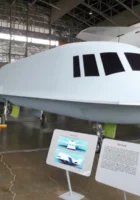
Northrop Tacit Blue

Northrop Tacit Blue

CountryUSA
RoleStealth demonstrator
First flightFebruary 5, 1982
Built1

The Northrop Tacit Blue was a technology demonstrator aircraft created to demonstrate that a low-observable stealth surveillance aircraft with a low probability of intercept radar and other sensors could operate close to the forward line of battle with a high degree of survivability.

Source: Northrop Tacit Blue on Wikipedia

Continue reading

Views : 3036

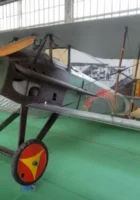
Spad XIII C.1

SPAD S.XIII

CountryFrance
RoleBiplane fighter
First flight4 April 1917
Built8472

The SPAD S.XIII was a French biplane fighter aircraft of the First World War, developed by Société Pour L’Aviation et ses Dérivés (SPAD) from the earlier and highly successful SPAD S.VII. During early 1917, the French designer Louis Béchereau, spurred by the approaching obsolescence of the S.VII, decided to develop two new fighter aircraft, the S.XII and the S.XIII, both utilizing a powerful new geared version of the successful Hispano-Suiza 8A engine. The cannon armament of the S.XII was unpopular with most pilots, but the S.XIII proved to be one of the most capable fighters of the war, as well as one of the most-produced, with 8,472 built and orders for around 10,000 more cancelled at the Armistice

Source: SPAD S.XIII on Wikipedia
Continue reading

Views : 4191

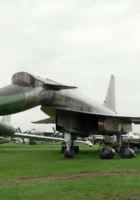
Sukhoi T-4

Sukhoi T-4

CountrySoviet Union
RoleBomber – Reconnaissance
First flight22 August 1972
Built4

The Sukhoi T-4, or “Aircraft 100”, or “Project 100”, or “Sotka” was a Soviet high-speed reconnaissance, anti-ship and strategic bomber aircraft that did not proceed beyond the prototype stage. It is sometimes called the Su-100.

Source: Sukhoi T-4 on Wikipedia

Continue reading

Views : 2981

CG-4A Waco

Waco CG-4

CountryUSA
RoleMilitary glider
First flight1942
Built13900+

The Waco CG-4A was the most widely used American troop/cargo military glider of World War II. It was designated the CG-4A by the United States Army Air Forces, and named Hadrian (after the Roman emperor) in British military service. Designed by the Waco Aircraft Company, flight testing began in May 1942, and eventually more than 13,900 CG-4As were delivered.

Source: Waco CG-4 on Wikipedia

Continue reading

Views : 2598

Lockheed F-117 Nighthawk sky

Lockheed F-117 Nighthawk

CountryUSA
RoleStealth attack aircraft
First flight18 June 1981
Built64

The Lockheed F-117 Nighthawk is an American single-seat, twin-engine stealth attack aircraft that was developed by Lockheed’s secretive Skunk Works division and operated by the United States Air Force (USAF). The F-117 was based on the Have Blue technology demonstrator. The Nighthawk was the first operational aircraft to be designed around stealth technology. Its maiden flight took place in 1981, and the aircraft achieved initial operating capability status in 1983. The Nighthawk was shrouded in secrecy until it was revealed to the public in 1988. Of the 64 F-117s built, 59 were production versions, with the other five being prototypes.

Source: Lockheed F-117 Nighthawk on Wikipedia

Continue reading

Views : 3886

GAF Pika

GAF Pika

CountryAustralia
RoleTarget drone
First flight28 August 1952
Built517

The GAF Jindivik is a radio-controlled target drone produced by the Australian Government Aircraft Factories (GAF). The name is from an Aboriginal Australian word meaning “the hunted one”. Two manually-controlled prototypes, were built as the GAF Pika (Project as a proof of concept to test the aerodynamics, engine and radio control systems, serialled A92-1/2, ‘B-1/2’. The radio-controlled Jindivik was initially designated the Project B and received serials in the A93 series. Pika is an Aboriginal Australian word meaning flier

Source: GAF Pika on Wikipedia

Continue reading

Views : 1827