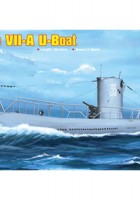
DKM Navy Type VII-A U-Boat - HOBBY BOSS 83503

Hobby Boss

Topic

DKM Navy Type VII-A U-Boat

Scale1/350
Ref

83503

Une maquette de la marque HobbyBoss le kit : «DKM Navy Type VII-A U-Boat – HOBBY BOSS 83503».

These boats, designed in 1933-1934, were the first of a new generation of German attack U-boats known, as Type VII, they were popular with their crews and very agile on the surface. They also had a much more powerful striking power than the smaller Type II’s. They had 5 torpedo tubes (4 at the bow) and would carry 11 torpedoes onboard or 22 TMA (=33 TMB) mines. They also had the effective 88mm fast-firing deck gun with about 160 rounds of ammunition. Type VIIB was an improvement on this design with substantially increased range. All but two (U-29 and U-30, both scuttled in Kupfermühlen Bay on May 4, 1945) Type VIIA U-boats were sunk during World War Two.

Source: Type VII-A U-Boat sur Hobby Boss

Continue reading

Views : 1304

Hawker Typhoon Starter Set - Airfix A50079

Airfix

RefA50079
TypeMaquette
Scale1/72
Topic

Hawker Typhoon Starter Set

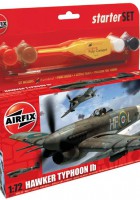
A kit from the brand Airfix the kit : Hawker Typhoon Starter Set – Airfix A50079.

The Typhoon was a British single-seat fighter bomber that entered into service in 1941 and was an intended replacement for the Hawker Hurricane in the ‘interceptor role’.

Source: Hawker Typhoon sur Airfix

Continue reading

Views : 1383

Supermarine Spitfire MKIXc - Airfix A02065

Airfix

RefA02065
TypeMaquette
Scale1/72
Topic

Supermarine Spitfire MKIXc

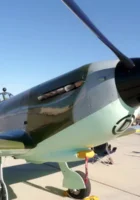
A kit from the brand Airfix the model : Supermarine Spitfire MKIXc – Airfix A02065.

In 1941 the Luftwaffe introduced the Fw190 providing a formidable foe to the RAF’s fighters. The Mk IX was a significant improvement on the Mk V. It had a top speed of 409 mph at 28,000 feet, an increase of 40 miles per hour. Its service ceiling rose from 36,200 feet to 43,000 feet.

Source: Supermarine Spitfire MKIXcl sur Airfix

Continue reading

Views : 1410

Supermarine Spitfire - DVD

Topics Entertainment

LangueAnglais
SujetSupermarine Spitfire
FormatColor, DVD, NTSC
PériodeSeconde guerre mondiale
ASINB004QPHBDO

Synopsis : Studio: Topics Entertainment Release Date: 05/31/2011 Run time: 60 minutes. Great WW-II History about the Spitfire. If you are a history buff about World War Two espically about air power this is a must have.

Continue reading

Views : 931

Spitfire MK IX

Spitfire Mk.IX

CountryUK
RoleFighter / Photo-reconnaissance
First flightSeptember 1941
Built8996

The British Supermarine Spitfire was facing several challenges by mid-1942. The debut of the formidable Focke-Wulf Fw 190 in late 1941 had caused problems for RAF fighter squadrons flying the latest Spitfire Mk Vb. Rolls-Royce engineers were already working on a new version of the Merlin incorporating a two-stage supercharger; the combination of the improved Merlin and the Spitfire Mk VC airframe in a “stop-gap” design allowed the RAF to combat the Fw 190 on equal terms. In a second stream of development Supermarine was working on an improved, reinforced, Spitfire airframe which incorporated several new features and was designed for the Merlin 60 and 70 series engines. This new airframe later formed the basis for the Rolls-Royce Griffon powered Spitfires.

Mk IX (type 361): BS456 UZ-Z of 306(Polish) Toruński Squadron, RAF Northolt, November 1942. A Spitfire IX converted from a Mk VC airframe. A teardrop shaped blister for a Coffman cartridge starter can be seen just behind the propeller. This aircraft carries a 30-gallon “slipper” drop tank under the fuselage. In the early months of 1942, with the clear superiority of the Focke Wulf Fw 190 over the Spitfire VB, there was much pressure to get Spitfires into production using the new two-stage supercharged Merlin 61 engine. In September 1941 the Spitfire Mk III prototype N3297 had been converted by Rolls-Royce at their Hucknall plant to take a Merlin 60, which had been specifically designed for use in the Wellington Mk VI high altitude bomber.

Source: Spitfire on Wikipedia

Continue reading

Views : 11757

Squadron Signal 1071 Savoia Marchetti S.79

Squadron Signal

SérieAircraft In Action
Sujet

Savoia Marchetti S.79

Réf71

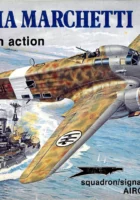
Une documentation signée Squadron Signal le livre «Savoia Marchetti S.79 – Squadron Signal 71» .

The Savoia-Marchetti SM.79 Sparviero (Italian for “Sparrowhawk”) was a three-engined Italian medium bomber with a wood and metal structure. Originally designed as a fast passenger aircraft, this low-wing monoplane, in the years 1937–39, set 26 world records that qualified it for some time as the fastest medium bomber in the world.

It first saw action during the Spanish Civil War and flew on all fronts in which Italy was involved during World War II. It became famous and achieved many successes as a torpedo bomber in the Mediterranean theater. The SM.79 was an outstanding aircraft and was certainly the best known Italian aeroplane of World War II. It was easily recognizable due to its distinctive fuselage dorsal “hump”, and was well liked by its crews who nicknamed it Gobbo Maledetto (“damned hunchback”). It was the most widely produced Italian bomber of World War II, with some 1,300 built, remaining in Italian service until 1952.

Source: SM-79 sur Wikipedia

Continue reading

Views : 2173

Savoia Marchetti SM-79

Savoia Marchetti SM-79

CountryItaly
Role

Bomber

First flight28 September 1934
Built1240

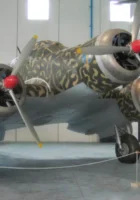
The Savoia-Marchetti SM.79 Sparviero (Italian for sparrowhawk) was a three-engined Italian medium bomber with a wood-and-metal structure. Originally designed as a fast passenger aircraft, between 1937 and 1939 this low-wing monoplane set 26 world records, qualifying it for some time as the fastest medium bomber in the world. It first saw action during the Spanish Civil War and flew on all fronts in which Italy was involved during World War II.

Source: Savoia Marchetti SM-79 on Wikipedia

Continue reading

Views : 6603

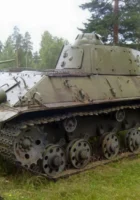
Light Tanks T-27, T-38, BT, T-26, T-40, T-50, T-60, T-70 - Mikhail Beryatinskiy

Ian Allan Publishing

Author

Mikhail Beryatinskiy

LangAnglais
Topic

Light Tanks

Pages96 pages
ISBN-13978-0711031630

Book description : There are few battles in the sometimes bloody history of the expansion of the United States in North American during the Indian Wars that are more famous than Little Bighorn. The romantic view of Custer’s last stand against marauding hordes of Indians has achieved iconic status but the reality was somewhat different, as recent research has shown. The Battle of Little Bighorn was the culmination of a process of attrition between the Native Americans and European settlers. On 25 June 1876 this clash of cultures was settled by force of arms as the 7th Cavalry under Custer came upon a huge Indian camp by the Little Bighorn River. The resulting battle was the stuff of legends, but legends based on misconception and hearsay – no members of the 7th Cavalry survived to tell their tale and the Indians recorded their triumph in pictographs and oral memory, long undeciphered by historians…

Editorial Reviews : This 96 page softcover volume is even more comprehensive than the title suggests, covering the tanks in the title and additionally the Russian Renault; T-18/MS-1; Vickers E; Christie Original; T-17; T-37; PPG; T-30; and T-80. For the BT section there is coverage of the BT-2, 3, 5, 7, 7M/8. In the text are lots of manufacturing, acceptance and in service numbers, and good descriptions of the development and service history. …

Continue reading

Views : 944

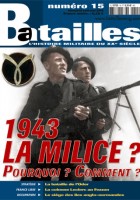
1943 La milice, pourquoi ? comment ? - Batailles 15

Histoire & Collections

SérieBatailles
Sujet1943 La milice
Période

Seconde guerre mondiale

Réf15

Une revue signée Histoire et Collections la revue «1943 La milice, pourquoi ? comment ? – Batailles 15».

  • Révolution Nationale : La milice française de février à août 1943
  • Troupes d’élite : Les parachutistes hongrois
  • France libre : La colonne Leclerc à la conquête du Fezzan
  • Face à l’Armée Rouge : La bataille de l’Oder
  • Stratégie : Objectif : Budapest
  • Occupation : L’occupation allemande dans les îles anglo-normandes
  • Chute du Reich : La bataille de Küstrin
  • Front de l’Est : La défense allemande sur l’Oder

Source: Histoire & Collections

Continue reading

Views : 1176