M4A1 ShermanM4A1 Sherman

M4A1 Sherman

CountryUSA
Role

Medium tank

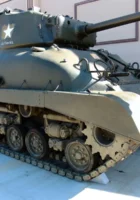
Photo gallery of a M4A1 Sherman, The M4 Sherman, formally Medium Tank, M4, was the primary tank used by the United States during World War II. Thousands were also distributed to the Allies, including the British Commonwealth and the Soviet Union, via lend-lease. In the United Kingdom, the M4 was named after Union General William Tecumseh Sherman, following the British practice of naming their American-built tanks after famous American Civil War generals. Subsequently, the British name found its way into common use in the U.S. The Sherman evolved from the Grant and Lee medium tanks, which had an unusual side-sponson mounted 75 mm gun. It retained much of the previous mechanical design, but added the first American main 75 mm gun mounted on a fully traversing turret, with a gyrostabilizer enabling the crew to fire with reasonable accuracy while the tank was on the move. The designers stressed mechanical reliability, ease of production and maintenance, durability, standardization of parts and ammunition in a limited number of variants, and moderate size and weight. These factors made the Sherman superior in some regards to the earlier German light and medium tanks of 1939-41. The Sherman ended up being produced in large numbers and formed the backbone of most Allied offensives, starting in late 1942.

Source: M4A1 on Wikipedia

Continue reading

Views : 11529

Italian PUMA 4×4 AFV - Trumpeter 05525

Trumpeter

Ref 05525
TopicModels
Scale1/35
Sujet

Italian PUMA 4×4 AFV

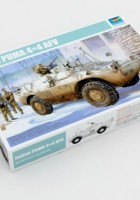
A model of the brand Trumpeter the kit: Italian PUMA 4×4 AFV – Trumpeter 05525.

Features : The kit consists of over 410 parts -multi-slide moulded upper hull -the kit w/refined detail -Rubber tyres w/fine detail -Included Photo-etched parts

The Puma Armoured Fighting Vehicles are a family of light wheeled armoured vehicles developed in a 4×4 and 6×6 configuration by the Consorzio Iveco Fiat – Oto Melara based in Rome. The Puma were developed for the Italian Army to complement the fleet of Centauro Tank Destroyer. Iveco Fiat were awarded a contract by the Italian Army for the development of Puma platforms carrying missiles, a mortar carrier, an ambulance and a command post vehicle. At the end of 1999, the Italian Army ordered 580 Puma vehicles, 250 of the 6×6 configuration, and 330 4×4 vehicles. First vehicles were completed in mid-2003. The Puma was first deployed operationally in Southern Iraq in early 2005.

Source: Italian PUMA 4×4 AFV on Trumpeter

Continue reading

Views : 1227

P.1000 Ratte Le Léviathan terrestre - Revue TnT 32

Trucks and Tanks Magazine

Publisher Caraktère
TitleP.1000 Ratte The Land Leviathan
Réf32
Topics

P.1000 Ratte,Jeep Willys,Panzer III,Bagration...

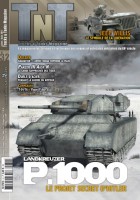
S.1000 Ratte : Le Léviathan terrestre – The Jeep Willys : Le symbole de la Victoire – Panzer III Ausf. n : La garde rapprochée des Tiger – File: Bagration : L’Armée Rouge reprend la main – Steel duels : Les combats de chars pendant la guerre du Kippour – camouflage : LT vz. 35 sous les couleurs étrangères – comparative In: T-34/76 vs. Ausf Panzer IV. g
Source: Trucks and Tanks Magazine
Continue reading

Views : 1399

NEW VANGUARD 33

Osprey Publishing

Réf33
SérieNew Vanguard
ISBN9781855329119
AuteurSteven J Zaloga
IllustrateurJim Laurier

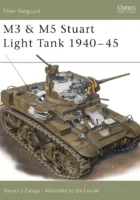
Un livre signé Osprey Publishing le livre «M3 & M5 Stuart Light Tank 1940–45 – NEW VANGUARD 33» .

The M3 and M5 family of light tanks were the culmination of American tank development of the 1930s. By the time of the outbreak of the World War II, they were approaching obsolescence, as tank forces in Europe were shifting from light to medium tanks as the main element of their armored forces. First entering combat in the autumn of 1941 in the Western Desert with the British Army, the Stuart quickly proved its inadequacies. The M3 and M5 light tanks proved more suitable in the Pacific theater than in Europe, and fought successfully in many of the major battles including Guadalcanal, Tarawa and Peleliu. This title narrates this distinctive and unusual fighting vehicle’s history.

Source: osprey

Continue reading

Views : 1239

The Photo Journal of the Second World War No.28 - ALLIED-AXIS 28

Ampersand Publishing

Ref

Allied-Axis 28

Author
Topic

SdKfz 6 5-ton halftrack

A documentation signed Ampersand Publishing the book «The Photo Journal of the Second World War No.28 – ALLIED-AXIS 28» .

Table of Contents:

  • SdKfz 6 5-ton halftrack prime mover
  • 3-inch antitank gun M5
  • U.S. T1/M6 Heavy Tank
  • Sprengladungsträger (SdKfz 301) Ausf. A and B
  • Covenanter Heavy Cruiser Tank

Continue reading

Views : 949

M47 Patton

M47 Patton

CountryUSA
RoleMain Battle Tank
In service1952–early 1960s
Built8576

The M47 Patton was an American main battle tank, a development of the M46 Patton mounting an updated turret, and was in turn further developed as the M48 Patton. It was the second American tank to be named after General George S. Patton, commander of the U.S. Third Army during World War II and one of the earliest American advocates of tanks in battle. The M47 was the U.S. Army’s and Marine Corps’ primary tank, intended to replace the M46 Patton and M4 Sherman medium tanks. The M47 was widely used by U.S. Cold War allies, both SEATO and NATO countries, and was the only Patton series tank that never saw combat while in US service.

Source: M47 Patton on Wikipedia

Continue reading

Views : 6182

B-35 Mosquito

B-35 de Havilland Mosquito

CountryUK
Type

Combat aircraft

First flight25 November 1940
Built7781

Photo gallery of a B-35 – de Havilland Mosquito, The de Havilland DH.98 Mosquito was a British multi-role combat aircraft, with a two-man crew, that served during the Second World War and the postwar era. The B.35 was powered by Merlin 113 and 114As. Some were converted to TT.35s (Target Tugs) and others were used as PR.35s (photo-reconnaissance). The B Mk XVI had a maximum speed of 408 mph (656 km/h), a cruising speed of 245 mph (394 km/h), ceiling of 37,000 ft (11,280 m), a range of 1,485 nm (2,390 km), and a climb rate of 2,800 ft per minute (853 m). The type could carry 4,000 lb (1,810 kg) of bombs. The B.35 had a maximum speed of 422 mph (679 km/h), a cruising speed of 276 mph (444 km/h), ceiling of 42,000 ft (12,800 m), a range of 1,750 nm (2,820 km), and a climb rate of 2,700 ft per minute (823 m)

Source:B-35 on Wikipedia

Continue reading

Views : 14459