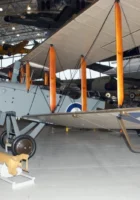
de Havilland DH.9

Airco DH.9

PaísReino unido
PapelBombardeiro
Primeiro vooJulho de 1917
Construído4091

O Ar condicionado DH.9 (from de Havilland 9) – also known after 1920 as the de Havilland DH.9 – was a British single-engined biplane bomber developed and deployed during the First World War. The DH.9 was a development of Airco’s earlier successful DH.4, with which it shared many components. These were mated to an all-new fuselage and the BHP/Galloway Adriatic engine, which promised increased performance. Anticipating its usefulness, the type was ordered in very large numbers for Britain’s Royal Flying Corps (RFC).

Fonte: Airco DH.9 na Wikipedia

Continue lendo

Visualizações : 1408

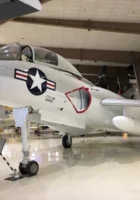
F7U-3M Cutlass

Vought F7U Cutlass

PaísEua
PapelCaça multifunção naval
Primeiro voo29 de setembro de 1948
Construído320

O Vought F7U Cutlass foi um caça-aviões baseado em porta-aviões da Marinha dos Estados Unidos e bombardeiro de caças do início da era da Guerra Fria. Era uma aeronave sem cauda baseada em dados aerodinâmicos e planos capturados da empresa alemã Arado no final da Segunda Guerra Mundial, embora os designers da Vought negassem qualquer ligação com a pesquisa alemã na época. A F7U foi a última aeronave projetada por Rex Beisel, que foi responsável pelo primeiro caça já projetado especificamente para a Marinha dos EUA, o Curtiss TS-1 de 1922.

Fonte: Vought F7U Cutlass na Wikipédia

Continue lendo

Visualizações : 2589

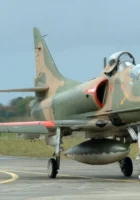
TA-4SU Skyhawk

ST Aerospace A-4SU Super Skyhawk

PaísCingapura
PapelCaça-bombardeiro, treinador a jato avançado
Primeiro voo19 de setembro de 1986
Construído150

O ST Aeroespacial A-4SU Super Skyhawk é um grande projeto de atualização da aeronave de ataque Douglas A-4S Skyhawk realizado pela Singapore Aircraft Industries (SAI, agora ST Aerospace) na década de 1980. Foi usado exclusivamente pela Força Aérea da República de Cingapura (RSAF), servindo no papel de caça-bombardeiro de 1989 até a aposentadoria do serviço de linha de frente em 2005. Desde meados de 1999, o A-4SU assumiu o papel adicional de ser a aeronave de treinamento avançado a jato (AJT) designada para o programa de treinamento / destacamento AJT da RSAF em Cazaux, França.

Fonte: ST Aerospace A-4SU Super Skyhawk na Wikipédia

Continue lendo

Visualizações : 1009

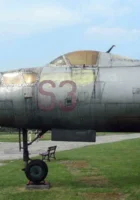
Iliushin Il-28

Ilyushin Il-28

PaísUnião Soviética
PapelBombardeiro médio
Primeiro voo8 de julho de 1948
Construído6635

O Ilyushin Il-28 (Russo: Ильц́цин Ил-28; Nome de reportagem da OTAN: Beagle) é um bombardeiro a jato do período pós-guerra imediato que foi originalmente fabricado para as Forças Aéreas Soviéticas. Foi a primeira aeronave desse tipo da União Soviética a entrar em produção em larga escala. Também foi construído na China como o Harbin H-5. A produção total na URSS foi de 6.316 aeronaves, e mais de 319 H-5 foram construídas. Apenas 187 exemplos da variante de treinamento HJ-5 foram fabricados. Na década de 1990, centenas permaneceram em serviço com várias forças aéreas mais de 50 anos após a primeira vez que o Il-28 apareceu. Os únicos H-5 em serviço atualmente são aproximadamente 80 aeronaves que operam com a Força Aérea Popular coreana. O Il-28 tem o nome de relatório USAF/DoD "Tipo 27" e o nome de relatório da OTAN "Beagle", enquanto a variante do treinador Il-28U tem o nome de relatório USAF/DoD "Tipo 30" e o nome de relatório da OTAN Mascot.

Fonte: Ilyushin Il-28 na Wikipédia

Continue lendo

Views : 2490

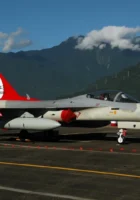
F-CK-1 Ching Kuo

AIDC F-CK-1 Ching-kuo

PaísTaiwan
PapelAviões
Primeiro voo28 de maio de 1989
Construído131

O AIDC F-CK-1 Ching-Kuo (chinês: 經國號戰機; pinyin: Jīngguó Hào Zhànjī), comumente conhecido como o Caça de Defesa Indígena (IDF), é um avião de combate multifuncional nomeado após Chiang Ching-kuo, o falecido presidente da República da China. A aeronave fez seu primeiro voo em 1989. Foi entregue à Força Aérea da República da China em janeiro de 1994 e entrou em serviço em 1997. Todas as 130 aeronaves de produção foram fabricadas até 1999.

Fonte: AIDC F-CK-1 Ching-kuo na Wikipédia

Continue lendo

Views : 1896

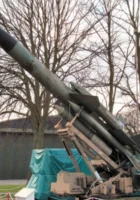
Cão de Caça de Bristol

Cão de Caça de Bristol

PaísReino unido
PapelMíssil terra-ar
Em serviço1958 – 1991
Construído783

O Cão de Caça de Bristol is a British ramjet powered surface-to-air missile developed during the 1950s. It served as the UK’s main air defence weapon into the 1990s and was in large-scale service with the Royal Air Force (RAF) and the forces of four other countries. Part of sweeping changes to the UK’s defence posture, the Bloodhound was intended to protect the RAF’s V bomber bases to preserve the deterrent force, attacking bombers that made it past the Lightning interceptor force. Bloodhound Mk. I entered service in December 1958, the first British guided weapon to enter full operational service. This was part of Stage 1 upgrades to the defensive systems, in the later Stage 2, both Bloodhound and the fighters would be replaced by a longer-range missile code named Blue Envoy. When this was ultimately cancelled in 1957, parts of its design were worked into Bloodhound Mk. II, roughly doubling the range of the missile. The Mk. I began to be replaced by the Mk. II starting in 1964.

Fonte: Bristol Bloodhound na Wikipédia

Continue lendo

Visualizações : 1654

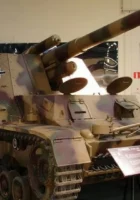
Jagdpanzer Hummel

Hummel

PaísAlemanha nazista
PapelArtilharia autopropulsada
Em serviço1943–1945
Construído714

Hummel (German: “bumblebee”) was a self-propelled gun based on the Geschützwagen III/IV chassis and armed with a 15 cm howitzer. It was used by the German Wehrmacht during the Second World War from early 1943 until the end of the war. The full name was Panzerfeldhaubitze 18M auf Geschützwagen III/IV (Sf) Hummel, Sd.Kfz. 165. On February 27, 1944, Hitler ordered the name Hummel to be dropped as it was deemed inappropriate for a fighting vehicle.

Fonte: Hummel na Wikipédia

Continue lendo

Views : 2489

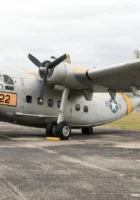
Northrop YC-125B Raider

Northrop YC-125 Raider

PaísEua
PapelAeronaves de transporte
Primeiro voo1 de agosto de 1949
Construído23

O Northrop YC-125 Raider was a 1940s American three-engined STOL utility transport built by Northrop Corporation, Hawthorne, California. Deliveries of the YC-125 to the USAF began in 1950. These aircraft did not serve long as they were underpowered and they were soon sent to Sheppard Air Force Base, Texas and relegated to be ground instructional trainers until retired in 1955 and declared surplus. Most of the surplus aircraft were purchased by Frank Ambrose and sold to bush operators in South and Central America.

Fonte: Northrop YC-125 Raider na Wikipédia

Continue lendo

Visualizações : 1306

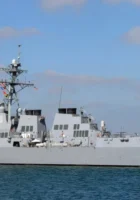
USS Preble

USS Preble (DDG-88)

PaísEua
Classe e tipoDestroier da classe Arleigh Burke
Lançado1 de Junho de 2001
Porto de origemBase Conjunta Pearl Harbor Hickam

USS Preble (DDG-88) is an Arleigh Burke-class destroyer in the United States Navy. She is the sixth U.S. Navy ship named in honor of Commodore Edward Preble, who served in the American Revolutionary War and was one of the early leaders of the Navy. USS Preble is the 38th destroyer of her class. She was the 17th ship of this class to be built at Ingalls Shipbuilding in Pascagoula, Mississippi, and construction began on 22 June 2000. She was launched on 1 June 2001 and was christened on 9 June 2001. On 9 November 2002, she was commissioned during a ceremony at the Commonwealth Pier/World Trade Center in Boston, Massachusetts. At her commissioning ceremony USS Preble was docked bow to bow with USS Constitution, the command of her namesake. The ceremony included a symbolic welcoming aboard of the spirit of Commodore Preble signaled by the ringing of chimes. Among the speakers at the commissioning were U.S. Senator Edward Kennedy, U.S. Representative Stephen Lynch, then Chief of Naval Operations Admiral Vernon E. Clark USN (Ret.) and journalist and sailor Walter Cronkite.

Fonte: USS Preble na Wikipédia
Continue lendo

Visualizações : 1104

Sd.Kfz.11 Meia Pista de 3 Toneladas

Sd.Kfz. 11

PaísAlemanha nazista
PapelMeia pista leve
Produzido1938–45
Construído9000+

O Sd.Kfz. 11 (Sonderkraftfahrzeug – special motorized vehicle) was a German half-track that saw widespread use in World War II. Its main role was as a prime mover for medium towed guns ranging from the 3.7 cm FlaK 43 anti-aircraft gun up to the 10.5 cm leFH 18 field howitzer. It could carry eight troops in addition to towing a gun or trailer. The basic engineering for all the German half-tracks was developed during the Weimar-era by the Reichswehr’s Military Automotive Department, but final design and testing was farmed out to commercial firms with the understanding that production would be shared with multiple companies. Borgward was chosen to develop the second smallest of the German half-tracks and built a series of prototypes between 1934 and 1937. However development was taken over in 1938 by Hanomag who designed the main production version, H kl 6.

Fonte: Sd.Kfz. 11 na Wikipédia
Continue lendo

Views : 2489