Wydawnictwo Militaria 293

Wydawnictwo Militaria

Ref

Wydawnictwo Militaria 293

Auteur
Temat

Sturmtiger – Maus

Podpisana dokumentacja Wydawnictwo Militaria książka "Sturmtiger - Maus - Wydawnictwo 293" .

Sturmtiger, którego oryginalna nazwa to 38cm RW61 auf Sturmmser Tiger – niemiecki ciężki pistolet szturmowy produkowany w latach 1943-1944.

Źródła: Wikipedia

Czytaj dalej

Liczba wyświetleń : 1024

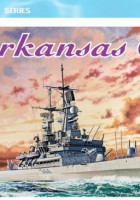
U.S.S. Arkansas CGN-41 - Cyber-Hobby 7124

Cyber-Hobby

Ref 7124
Temat1/700 Warships
Skali1/700
Temat

U.S.S. Arkansas CGN-41

Model marki Cyber-Hobby zestaw: U.S.S. Arkansas CGN-41 – Cyber-Hobby 7124.

Funkcje: -Waterline or full-hull version can be assembled -One-piece slide-molded upper hull w/undercut details realistically represented -Sponsons are represented on lower hull by slide-mold technology -True-to-scale propellers reproduced -Rudder reproduced like the real one -Masts, radar and antenna parts are represented by photo-etched parts w/realistic details -Intricate bridge is made from 3-directional slide-mold technology -Mk-141 Harpoon missile launchers accurately produced w/fine detail -Additional stowage boxes included -Radar dishes possess well-defined detail -Armored box launchers for Tomahawk missile -Two twin Mk26 missile launchers in great detail -Open-topped upper-mount 5-inch Mk-45 lightweight guns -Extremely fine detailed parts like whalers -Life rafts w/crisp details -Extra-fine detail on superstructure walls like hose and ladder patterns delicately reproduced

Źródła: U.S.S. Arkansas CGN-41 na Cybber-Hobby

Czytaj dalej

Odsłony: 782

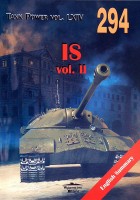
Wydawnictwo Militaria 294 - IS vol. II

Wydawnictwo Militaria

Ref

Wydawnictwo Militaria 294

Autor
Temat

Czołgi IS – Józef Stalin

Podpisana dokumentacja Wydawnictwo Militaria książka "Czołgi IS – Józef Stalin – Wydawnictwo 294".

La série des chars Josef Stalin soviétiques a son origine dans le développement du prototype KV-13, qui devait allier la protection d’un char lourd avec la mobilité d’un char moyen. Ce programme avait donné lieu à un char de 31,7 tonnes, armé d’un canon de 76,2 mm, caractérisé surtout par un emploi généralisé d’éléments coulés pour la caisse et la tourelle. Il combinait le moteur et la suspension des chars KV avec les chenilles du Char T-34, la caisse était blindée à 120 mm et la tourelle à 85 mm, mais les 600 ch du moteur lui permettait d’atteindre 55 km/h. Cependant il présentait de nombreuses imperfections et défauts de jeunesse, une accélération insuffisante, ce qui fut résolu dès juillet en adoptant la boîte dessinée pour le KV-1s, et de fréquents déraillements de chenilles qui furent réglés par l’emploi d’un nouveau modèle apparu sur les deux nouveaux exemplaires produits en décembre, qui apportaient de nombreuses autres améliorations, dont des tourelles redessinées.

Źródła: Wikipedia

Czytaj dalej

Liczba wyświetleń : 854

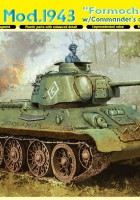
T34/76 Mod.1943 "Formochka" w/Commander's Cupola - DML 6603

Modele smoków

Ref6603
Temat1/35 Wojsko
Skali1/35
TematT34/76 Mod.1943 “Formochka” w/Commander’s Cupola

Model marki Modele smoków zestaw: T34/76 Mod.1943 "Formochka" z kopułą dowódcy – DML 6603

Funkcje: -Newly tooled T34/76 w/Commander’s cupola -“Stamped” turret in accurate detail -Turret hatches w/fine details can be positioned open/closed ; -Two types of periscopes provided as options -Turret bottom w/cutting marks -3-directional slide-molded cupola w/interior detail -Turret interior detail – gun w/breech assembly -Upper-hull glacis plate w/detail -One-piece lower hull offers easy assembly -Bolted connecting plate for mantlet -Trunnions w/weld detail -Mantlet has cutting-seam detail -Engine-deck rear plate and engine-cover plate have full detail -Slide-molded gun barrel included -Realistically represented road wheels – two outer road wheels w/rubber tires and three inner all-steel road wheels -Multi-combination running gear w/two road wheels patterns -Sprocket is finely reproduced -Detailed suspension system -Suspension arms realistically recreated -Two types of storage box provided -Optional photo-etched parts for engine-cover grills available -Engine deck louvers finely represented by photo-etched parts -500mm variant of T34 Magic Tracks w/refined detail

Źródła: T34/76 Mod.1943 on Dragon Models

Czytaj dalej

Liczba wyświetleń : 1469

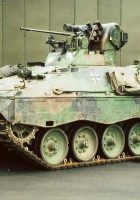
Marder 1A2

Marder 1A3

KrajuNiemcy
Roli

Pojazd bojowy piechoty

W eksploatacjiod 1971 do chwili obecnej
Zbudowany2136

The Marder (German for “marten”) is a German infantry fighting vehicle operated by the German Army as the main weapon of the Panzergrenadiere (mechanized infantry) from the 1970s through the present day. Developed as part of the rebuilding of Germany’s armoured fighting vehicle industry, the Marder has proven to be a successful and solid infantry fighting vehicle design. While it does include a few unique features, such as the fully remote machine gun on the rear deck, it is overall a simple and conventional machine with rear exit hatch and side gun ports for mounted infantry to fire through. The Marder is currently being replaced by its successor, the Puma. The Marder 1A3 jest obecnie najpopularniejszą wersją tego systemu i jest w służbie niemieckiej Bundeswehry, Marder 1A4 różni się od 1A3 tylko dzięki zastosowaniu radioodbiornika zdolnego do kryptografii. Najnowsza wersja Mardera to Marder 1A5 z zaawansowaną ochroną przeciwminową. Tylko niewielka liczba tego wariantu jest w użyciu.

Źródła: Marder na Wiki

Czytaj dalej

Views : 5378

Wydawnictwo Militaria 234 - Roosevelt's Tanks

Wydawnictwo Militaria

Ref

Wydawnictwo Militaria 234

Autor
Temat

Czołgi Roosevelta

Książka podpisana Wydawnictwo Militaria magazyn "Czołgi Roosevelta – Wydawnictwo 234".

Niniejsza publikacja opisuje wzory kamuflażu i system znakowania pojazdów pancernych amerykańskich jednostek zmotoryzowanych, kawalerii i piechoty, stosowanych w latach 1940-1945.

Czytaj dalej

Liczba wyświetleń: 740

Pz.Kpfw.IV Ausf.B mit Gelandepflug - DML 6764

Model smoka

Ref6764
Temat1/35 Wojsko
Skali1/35
Temat

Pz.Kpfw.IV Ausf.B mit Gelandepflug

Model marki Model smoka zestaw: Pz.Kpfw.IV Ausf.B mit Gelandepflug – DML 6764

Ten plastikowy zestaw w skali 1/35 składa się prosto z pudełka na celny Panzer IV Ausf.B, używając dokładnych komponentów z poprzedniej wersji tego wariantu. Oczywiście pług śnieżny jest zupełnie nowym elementem tego konkretnego zestawu i wynika z nowych narzędzi. Pług można łatwo zamontować z przodu standardowego zbiornika. Ilustracja z pudełka autorstwa Rona Volstada z pewnością zainspiruje modelarzy do stworzenia oszałamiającej dioramy tego "opancerzonego pługa śnieżnego" w akcji na zaśnieżonym froncie wschodnim. Linki do ścieżek wykorzystują Magic Tracks, które są bardzo proste w montażu. Modelarze będą czerpać wiele radości z inwestycji w ten nowy, ekscytujący niemiecki czołg wyposażony w pług!

Źródła: Pz.Kpfw.IV Ausf.B mit Gelandepflug on Dragon Models

Czytaj dalej

Liczba wyświetleń : 1106

Wydawnictwo-Militaria-226-PzKpfw-I

Wydawnictwo Militaria

Ref

Wydawnictwo Militaria 226

Autor
Temat

PzKpfw I

Podpisana dokumentacja Wydawnictwo Militaria le livre «PzKpfw I – Wydawnictwo 226» .

Tthe Panzer I – niemiecki czołg lekki, zaprojektowany w latach 30., używany podczas wojny hiszpańskiej i na początku II wojny światowej. Był to pierwszy pancerny, który powstał, gdy Niemcy, zgodnie z traktatem wersalskim, zabroniły studiowania lub budowy pojazdów opancerzonych, tak że pierwsze oznaczenie miało na celu zacieranie torów, było dobrze nieszkodliwe, Landwirtschaftlicher Schlepper, lub ciągnik rolniczy, ale później otrzymał bardziej oficjalny Panzerkampfwagen I (opancerzony pojazd bojowy). Jest również znany jako Sonderkraftfahrzeug 101 (skrót od SdKfz 101) dosłownie specjalny pojazd silnikowy.

Il était principalement destiné à servir comme véhicule d’instruction, peu coûteux car légèrement armé et blindé, pour formaliser les nouvelles doctrines de la blitzkrieg, mais les retards sur les modèles suivants contraignirent les allemands à l’utiliser au combat. Il constitua ainsi les gros des panzerdivisions, lors des campagnes de Pologne et de France, mais fut rapidement retiré des premières lignes et converti à d’autres usages, principalement comme tracteur pour des canons sur roues. Son équipage se composait d’un conducteur et d’un commandant qui était également tireur. Il possédait deux mitrailleuses de calibres 7,92 mm. La faible épaisseur de son blindage n’était efficace que contre l’infanterie légère. Pour un poids de près de 5 tonnes, le moteur de 100 chevaux était nettement insuffisant et sa consommation de près de 120l les 100km trop importante. En dépit de ses faibles performances de combat, l’expérience du “Panzer I” s’avéra précieuse lorsqu’il fallut développer des chars plus puissants et la plupart des équipages de “Panzers” furent formés sur ce char.

Źródła: Wikipedia
Czytaj dalej

Liczba wyświetleń : 673

Wydawnictwo Militaria 144 - Panzerjaeger I

Wydawnictwo Militaria

Ref

Wydawnictwo Militaria 144

Autor
Temat

Panzerjäger I

Podpisana dokumentacja Wydawnictwo Militaria le livre «Panzerjäger I – Wydawnictwo Militaria 144» .

Le Panzerjäger I (chasseur de chars en allemand) fut le premier des chasseurs de chars conçus par l’Allemagne au cours de la Seconde Guerre mondiale. Il était conçu en 1940 sur un châssis converti de Panzerkampfwagen I Ausf. B et était armé du canon antichar Skoda 4.7cm PaK L/43. Le Panzerjäger s’avéra être une solution peu coûteuse et relativement efficace pour contrer les chars soviétiques et permit de prolonger l’utilisation des chars Panzer I devenus désuets. Comme pour la majorité des chasseurs de chars, l’équipage était très vulnérable, sa seule protection étant fournie par le bouclier frontal du canon ; le canon avait en outre un faible rotation latérale. En tout, 202 chars Panzer I furent convertis, 132 par Alkett et 70 par Skoda. Les conversions opérées par Skoda sont reconnaissables au bouclier du canon qui présente sept faces alors que les modèles d’Alkett n’en présentent que cinq. La dénomination formelle du Panzerjäger était 4.7cm PaK(t) (Sf) auf Panzerkampfwagen I. Le (t) indique l’origine tchécoslovaque (Tschechoslowakisch) du canon et les lettre (Sf) pour Selbstfahrlafette (terme allemand pour “châssis autopropulsé”).

Źródła: Wikipedia

Czytaj dalej

Liczba wyświetleń : 890

Wydawnictwo Militaria 200

Wydawnictwo Militaria

Ref

Wydawnictwo Militaria 200

Autor
Temat

Charków 1942

Podpisana dokumentacja Wydawnictwo Militaria książka "Charków 1942 – Wydawnictwo Militaria 200".

Historia: Druga bitwa pod CharkówWilhelm Keitel – kontratak sił Osi na Armię Czerwoną w dniach 12-28 maja 1942 na froncie wschodnim podczas II wojny światowej. Jego celem było wyeliminowanie przyczółka na Dońcu, który był jednym z poligonów manewrowych Sowietów. Po zimowym kontrataku, który zdołał odepchnąć wojska niemieckie od Moskwy, ale także doprowadził do wyczerpania rezerw Armii Czerwonej, ofensywa charkowska była kolejną sowiecką próbą odzyskania inicjatywy strategicznej, nawet jeśli nie gwarantowała elementu zaskoczenia.

12 maja 1942 r. wojska radzieckie pod dowództwem feldmarszałka Siemiona Tymoszenko rozpoczęły ofensywę przeciwko niemieckiej 6 Armii po przełomie dokonanym podczas zimowego kontrataku. Po początkowych obiecujących sygnałach ofensywa została zatrzymana przez niemiecki kontratak. Poważne błędy kilku oficerów sowieckiego Sztabu Generalnego i samego Stalina, niedoszacowanie dokładnie niemieckiego potencjału i przecenianie własnych sił, doprowadziły do sukcesu niemieckiego kontrataku topniejącego "w szczypce" wokół natarcia wojsk radzieckich.

Źródła: Wikipedia

Czytaj dalej

Liczba wyświetleń: 1000