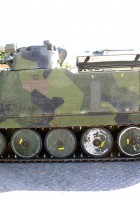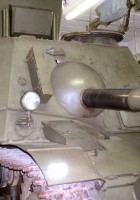
Pansarvärnskanonvagn m/43

Pvkv m/43

KrajuSzwecja
TypuNiszczyciel czołgów
ZdjęcieThord Wedman
Temat

Album 44 zdjęcia czołgu Pvkv m/43

Tank destroyer m / 43 (Pvkv m / 43) was a Swedish combat vehicles that were manufactured in 1947-48. The carriages were built on the same chassis as Strv m / 42 with the superstructure of a lvkanon m / 36. They were originally built to open up but Armétygförvaltningen upgraded them in the 1950s with the roof. 1963 was fitted wagons with sexcylidriga Scania engines from decommissioned Strv m / 41 and m / 40. The carriages were used until the late 1970s. The gearbox was a Volvo VL 420 or Landsverk S-8082.

Źródła: Pvkv m/43 na Wikipedii

Czytaj dalej

Views : 3371

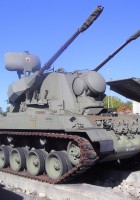
Pz68 Flakpanzer

Pz68 Flakpanzer

KrajuSzwajcaria
TypuFlakpanzer
ZdjęcieGunther Neumahr
Temat

Album 18 zdjęcia czołgu Pz68 Flakpanzer

The Panzer 68 was a Swiss main battle tank developed by the Eidgenoessische Konstruktionswerkstaette in Thun in the late 1960s. Fliegerabwehrpanzer 68 : Anti-aircraft Tank 68 – variant fitted with Flakpanzer Gepard turret, mounting two Oerlikon 35mm anti-aircraft guns, on Panzer 68 hull widened by 180 millimetres (7 in); two tanks modified and tested in 1979-1980, not placed into production

Źródła: Pz68 Flakpanzer na Wikipedii

Czytaj dalej

Liczba wyświetleń : 2442

PTS-M Gąsienicowy transport amfibii

PTS-M Gąsienicowy transport amfibii

KrajuRadzieckiego
TypuŚledzony transport amfibii
Produkcjipoczątek 1965 r.
Styl ciałaWodoodporny kadłub

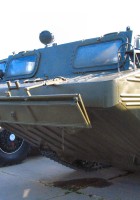
Tthe Pkt is a Soviet tracked amphibious transport. PTS stands for Plavayushchij Transportyer – Sryednyj or medium amphibious transport vehicle. Its industrial index was Ob’yekt 65. Introduced in 1965, it is large, with a substantial payload of 10 tons, two to four times the capacity of the BAV 485, and better cross-country performance, at the cost of greater somewhat higher purchase costs because it is tracked. The most common model is the improved PTS-M that is powered by a 350 hp diesel engine. It has a boxy, open watertight hull, with six road wheels per side, front drive sprocket, rear idler sprocket, and no return rollers. Like the BAV 485, and unlike the DUKW, it has a rear loading ramp. The crew is seated at the front, leaving the rear of the vehicle open for a vehicle, which can be driven (or backed) in, rather than lifted over the side. To aid in facilitating this, the engine is under the floor. Propulsion in water is by means of twin propellers, in tunnels to protect them from damage during land operations.

Źródła: PTS-M Tracked Amphibious Transport na Wikipedii

Czytaj dalej

Liczba wyświetleń : 2551

Holenderski PRTL

Holenderski PRTL

KrajuHolenderski
RoliPrzeciwlotniczy czołg armatni

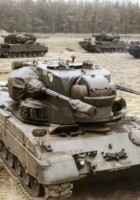
Flugabwehrkanonenpanzer Gepard ("przeciwlotniczy czołg armatni Cheetah", lepiej znany jako Flakpanzer Gepard) to autonomiczne, zdolne do pracy w każdych warunkach pogodowych niemieckie samobieżne działo przeciwlotnicze (SPAAG). Został opracowany w 1960 roku i wprowadzony w 1970 roku i został kilkakrotnie ulepszony o najnowszą elektronikę. Stanowiła ona kamień węgielny obrony powietrznej armii niemieckiej (Bundeswehry) i szeregu innych państw NATO. W Niemczech Gepard został wycofany pod koniec 2010 roku i zastąpiony przez "SysFla", mobilny i stacjonarny system obrony powietrznej wykorzystujący pocisk LFK NG i nowy system uzbrojenia MANTIS. Mobilna platforma SysFla będzie prawdopodobnie oparta na GTK Boxer.

Wariant holenderski : Search radar: X band, 15 km range Tracking radar: X/Ka band, 13 km range The Dutch version was officially called the PRTL (PantserRupsTegenLuchtdoelen translating to “ArmourTrackAgainstAirtargets”), pronounced as “pruttel” (meaning ‘to sputter’) by the soldiers. The Dutch series version was made public through a photograph of a vehicle from a C-Company, the first to be equipped with the new weapon. Traditionally all Dutch vehicles in a company have names beginning with the company designation letter and this vehicle happened to have the individual name Cheetah painted in bold type on its turret. Inevitably the international press assumed “Cheetah” was the Dutch name for their Gepard version and this mistake found its way into most armour publications on the subject. In 2000 the Dutch military authorities, tired of constantly having to explain all this and considering “pruttle” was hardly a martial name anyway, conformed themselves to common error and made “Cheetah” the official designation, when the system was upgraded.

Źródła: Holenderski PRTL na Wikipedii

Czytaj dalej

Liczba wyświetleń : 4843

RM-70 MLRS

RM-70 MLRS

KrajuNiemcy Wschodnie
TypuWielokrotna wyrzutnia rakiet
ZdjęcieRobert De Craeck
Temat

Album 151 zdjęcia czołgu RM-70 MLRS

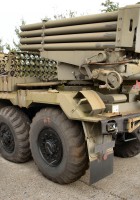
The RM-70 (raketomet vzor 1970) multiple rocket launcher is a Czechoslovakian army version and the heavier variant of the BM-21 Grad multiple rocket launcher, providing enhanced performance over its parent area-saturation artillery system that was introduced in 1971 (but the NATO designation is M1972). RM-70 was developed in Czechoslovakia as a successor for the RM-51, achieving initial operational capability with its Army in 1972. The launcher was being produced in Dubnica nad Váhom (Slovakia). Originally, it was sold to East Germany. After the Soviet Union collapse and the split of Czechoslovakia into the Czech Republic and Slovak Republic, it was sold to several states in Africa, America, Asia and Europe.

Źródła: RM-70 MLRS na Wikipedii

Czytaj dalej

Liczba wyświetleń : 3567

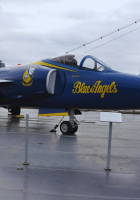
Grumman F-11 Tygrys

Grumman F-11A Tygrys

KrajuStany Zjednoczone Ameryki
TypuNaddźwiękowy myśliwiec
Pierwszy lot30 lipca 1954
Zbudowany200

Galeria zdjęć Grumman F-11A Tygrys, The Grumman F11F/F-11 Tiger was the first supersonic, single-seat carrier-based United States Navy fighter aircraft in operation during the 1950s and 1960s. Originally designated the F11F Tiger in April 1955 under the pre-1962 Navy designation system, it was redesignated as F-11 Tiger under the 1962 United States Tri-Service aircraft designation system. The F11F/F-11 was used by the Blue Angels flight team from 1957–1969. Grumman Aircraft Corporation made 200 Tigers, with the last aircraft being delivered to the U.S. Navy on 23 January 1959.

Źródła: Grumman F-11A Tiger na Wikipedii

Czytaj dalej

Liczba wyświetleń : 3332

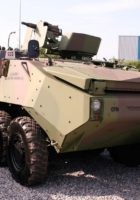
Mowag Piranha

Piranha 10×10

KrajuSzwajcaria
RoliOpancerzony pojazd bojowy
Produkowaneod 1972 do chwili obecnej
ZbudowanyNiewiedzy

The MOWAG Piranha is a family of armoured fighting vehicles designed by the Swiss company MOWAG (since April 2010 the name has changed to General Dynamics European Land Systems – Mowag GmbH). Five generations of vehicles have been produced, manufactured by Mowag or under licence by other companies, and variants are in service with military forces throughout the world. Piranhas are available in 4×4, 6×6, 8×8, and 10×10 wheel versions. There are several variants within these versions, giving different degrees of armour protection and several kinds of turret, for use in a variety of roles. Piranha derivatives have been assigned roles as troop transports, command vehicles, fire support vehicles, tank trainers, and police vehicles.

Źródła: Piranha 10×10 na Wikipedii

Czytaj dalej

Liczba wyświetleń : 2587

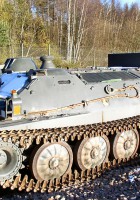
Pansarbandvagn 401

Pansarbandvagn 401

KrajuSzwecja
TypuUniwersalny pojazd opancerzony
ZdjęcieThord Wedman
Temat

Album 182 zdjęcia czołgu Pansarbandvagn 401

The MT-LB (Russian: Многоцелевой Тягач Легкий Бронированный, Mnogotselevoy Tyagach Logkiy Bronirovannyi / light multi-purpose armoured towing vehicle) is a Soviet multi-purpose fully amphibious auxiliary armoured tracked vehicle, which was first introduced in the late 1960s. Initially, the vehicle was known as the M 1970 in the west. Swedish MT-LB converted into Pbv 401 Pbv 401 (pansarbandvagn) – modified former East-German vehicle with 7.62 mm machine guns Ksp 95 and Ksp 58. Stripbv 4011 (stridsledningbandvagn) – battalion-level command post. Bgbv 4012 (bärgningsbandvagn) – Swedish designator for the MTP-LB. Rlpbv 4014/T (radiolänkbandvagn) – signals vehicle. Stripbv 4021 (stridsledningbandvagn) – company-level command post. Sjvpbv 4024 (sjukvårdspansarbandvagn) – Military ambulance. Lvrbpbv 4016 (luftvärnsrobotbandvagn) – unconfirmed designator for vehicles, equipped with RBS 70. Pvrbbv 452 (pansarvärnrobotbandvagn) – with RBS 56 BILL 1 Anti-tank guided weapon.

Źródła: Pansarbandvagn 401 na Wikipedii

Czytaj dalej

Wyświetleń: 3568

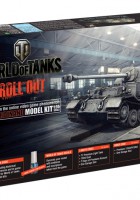
FERDYNAND ITALERI 36501

Italeri

Ref 36501
Serie(a)World of Tanks
Skali1/35
Temat

FERDINAND

THE BOX CONTAIN: 1 MODEL KIT – 1 LIQUID CEMENT – 1 TANK GUIDE – WORLD oF TANKS DECALS – 3 INVITE CODES – 1 BONUS CODE

Official German designation: Sturmgeschutz (StuG) 8.8cm Pak43/2 (Ferdinand/Elefant) The StuG 8.8cm was based on the unsuccessful Porsche Tiger chassis fitted with a heavily armoured superstructure in the front and a mounted 8,8cm Pak 43/2 L/71 gun. A total of 90 vehicles were produced; they first saw combat in the Battle of Kursk (Operation Citadel). It was built in 1943 under the name Ferdinand, after its designer Ferdinand Porsche, but was soon renamed. After the Battle of Kursk, the remaining 48 vehicles were pulled out of service and given an overhaul. This included a ball-mount machine gun in the front along with a commander’s cupola. The name Elefant was soon decided upon. The vehicle was received with mixed feelings. It provided good protection with its thick armour but was severely unreliable in its mechanics due to the use of non-standard parts. Nevertheless, the Ferdinand/Elefant might well have been the most successful tank destroyer employed during the war, with a kills to losses ratio of approximately 10:1.

Źródła: Italeri

Czytaj dalej

Liczba wyświetleń : 1697

PBV 302

Pansarbandvagn 302 Ogłoszenia

KrajuSzwecja
TypuTransporter opancerzony
ZdjęcieThord Wedman
Temat

Album 155 zdjęcia czołgu Pansarbandvagn 302 Ogłoszenia

Pansarbandvagn 302 (Pbv 302) to szwedzki transporter opancerzony o wysokiej mobilności, który został opracowany w celu spełnienia wymagań operacyjnych szwedzkiej armii. Został zaprojektowany i wyprodukowany przez Hägglund i Söner w Örnsköldsvik (obecnie Hägglunds Vehicle AB). Projekt został oddany do użytku w 1961 roku jako zamiennik Pbv 301. Produkcja trwała od 1966 do 1971 roku. Pojazd został zmodernizowany i nadal w ograniczonej służbie, mimo że seria CV 90 jest obecnie standardowym bojowym wozem piechoty w Szwecji, używanym zarówno w kraju, jak i przez szwedzkie siły za granicą.

Źródła: Pansarbandvagn 302 na Wikipedii

Czytaj dalej

Liczba wyświetleń : 4633