Lysne WC57

Lysne WC-57

LandNorge , Norge
Type4×4 lett lastebil>
FotografiYuri Pasholok
Beskrivelse

Album av 144 bilder walk-around av en «Dodge WC-57»

Bildegalleri av en Lysne WC-57, The Dodge WC series was a range of light military trucks produced by Dodge and Fargo during World War II. The series included weapon carriers, telephone installation trucks, ambulances, reconnaissance vehicles, mobile workshops and command cars. They were replaced after the war by the Dodge M-series vehicles. WC was a Dodge model code: W for 1941 and C for half-ton rating. The C code was retained for the ¾ ton and 1½ ton 6×6 Dodges.

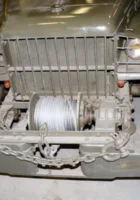
WC57 Truck, Command Reconnaissance, 3/4 tonn, 4×4 m/Winch Dodge (G502) var identisk med WC56, men utstyrt med en Braden MU2 5000 lb / 2 268 kg kapasitet vinsj på den fremre støtfangeren. 6010 bygget.

Kilde: Dodge WC-57 på Wikipedia

Fortsett å lese

Views : 5035

Mig-19PF

Mig-19PF – Shenyang J-6A

LandKina
TypeFighter
FotografiVladimir Yakubov
Emnet

Album av 165 bilder walk-around av en «Mig-19PF - Shenyang J-6A»

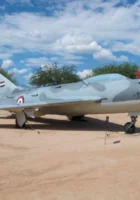
Bildegalleri av en Mig-19PF – Shenyang J-6A, The Shenyang J-6 (Chinese: 歼-6; designated F-6 for export versions; NATO Code: Farmer) was the Chinese-built version of the Soviet MiG-19 ‘Farmer’ fighter aircraft. Although the MiG-19 had a comparatively short life in Soviet service, the Chinese came to value its agility, turning performance, and powerful cannon armament, and produced it for their own use between 1958 and 1981. While the basic Soviet-designed MiG-19 has been retired from all nations, the Shenyang J-6 still flies for nine of its original 15 operators, however, in a very limited capacity. The J-6 airframe contributed to the Chinese ground attack version, the Q-5, which still flies for numerous nations. The J-6 was considered “disposable” and was intended to be operated for only 100 flight hours (or approximately 100 sorties) before being overhauled. The Pakistan Air Force was often able to extend this to 130 hours with diligent maintenance.

Kilde: Mig-19PF – Shenyang J-6A på Wikipedia

Fortsett å lese

Views : 3697

Verden av tanker - T-34/85

Italeri

Ref 36509
SerieVerden av tanker
Skala1/35
Emnet

T-34/85

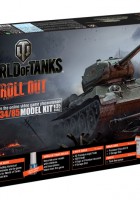
THE BOX CONTAIN: 1 MODEL KIT – 1 LIQUID CEMENT – 1 TANK GUIDE – 1 POSTER (42×59,4cm) – WORLD oF TANKS DECALS – 3 INVITE CODES – 1 BONUS CODE

Arguably the best medium tank of World War II, the T-34-85 was a crucial factor in the outcome of the conflict. Over 35,000 were produced, meaning that it also came to represent, from a Soviet standpoint, the supremacy of socialist industry over capitalism. It was the antithesis of German over-engineering. Designers favoured simple solutions that used fewer resources. It was therefore available in greater numbers – a telling factor as Axis forces were pushed out of the Soviet Union and back to Berlin. The T-34-85 was an up-gunned version of the T-34 tank which carried a 76mm gun that was insufficient at dealing with tanks like the Tiger and Panther. A new turret allowed the installation of an 85mm gun that was capable of penetrating German armour with greater ease. This tank also represented the first proper mass production of a sloped-hull design which meant that the armour could afford to be thinner while still providing the same effective protection. Coupled with sloping on the turret, the survivability of the tank compared to the original T-34 design was much better.

Kilde: Italeri

Fortsett å lese

Visninger : 2315

Stryker ICV

Stryker ICV

LandNorge , Norge
RolleInfanteri carrier kjøretøy

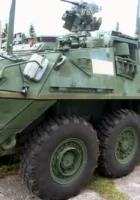
Bildegalleri av en Stryker ICV, The M1126 Infantry Carrier Vehicle (ICV) is an armoured personnel carrier and part of the Stryker family of vehicles (derived from the Canadian LAV III/Swiss MOWAG Piranha IIIH 8×8) used by the United States Army. The Infantry Carrier Vehicle provides protected transport and, during dismounted assault, supporting fire for the infantry squad. The Stryker is a full-time four-wheel drive, selectively eight-wheel drive, armoured vehicle weighing approximately 19t which carries an infantry squad with their equipment. On paved roads the vehicle can attain speeds of 62 mph without a governor and 37 mph with a governor. The basic infantry carrier vehicle (ICV) provides armored protection for the two-man crew and a squad of nine soldiers.

Kilde: Stryker ICV på Wikipedia

Fortsett å lese

Visninger : 4819

MiG-15UTI

Mikoyan-Gurevich MiG-15bis

LandSovjetunionen
RolleFighter
Første flytur30. desember 1947
Bygget12000+

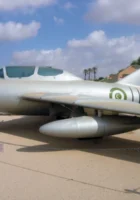
Den Mikoyan-Gurevich MiG-15 (Russian: Микоян и Гуревич МиГ-15; NATO reporting name: “Fagot”) was a jet fighter aircraft developed by Mikoyan-Gurevich OKB for the Soviet Union. The MiG-15 was one of the first successful jet fighters to incorporate swept wings to achieve high transonic speeds. In combat over Korea, it outclassed straight-winged jet day fighters which were largely relegated to ground attack roles, and was quickly countered by the similar American swept-wing F-86 Sabre. The MiG-15 is often mentioned, along with the North American F-86 Sabre, as the best fighter aircraft of the Korean War, and among the best fighter aircraft of all time. When refined into the more advanced MiG-17, the basic design would again surprise the West when it proved effective against supersonic fighters such as the F-105 Thunderchief and McDonnell Douglas F-4 Phantom II in the Vietnam War of the 1960s. The MiG-15 is believed to have been one of the most widely produced jet aircraft ever made; in excess of 12,000 were manufactured. Licensed foreign production may have raised the production total to over 18,000. The MiG-15 remains in service with the North Korean Air Force as an advanced trainer.

Kilde: MiG-15bis på Wikipedia

Fortsett å lese

Views : 9825

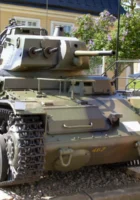
Strv M40

Strv M40

LandSverige
TypeStridsvogn
FotografiThord Wedman
Emnet

Album av 51 bilder walk-around av en «Strv M40»

Bildegalleri av en Strv M40, Tank w / 40 (Strv m / 40) was a Swedish tank, constructed by Landsverk during the early 1940s. On the Tank w / 39 developed battle tank was designated from the start L-60-S III. It got Army designation Strv m / 40, a little later, when m / 40 K (Karlstad) was added to the designated m / 40L (Land Administration). Total ordered 100 pieces from Landsverk delivered in 1943 and 80 pc from Karlstad delivered in 1945.

Kilde: Strv M40 på Wikipedia

Fortsett å lese

Views : 3092

Nordamerikansk FJ-3 Fury

Nordamerikansk FJ-3 Fury

LandUSA
RolleJagerfly
Første flytur27 December 1951
Bygget741

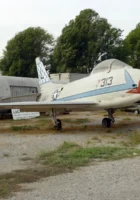
Bildegalleri av en Nordamerikansk FJ-3 Fury, The North American FJ-2/-3 Fury were a series of swept-wing carrier-capable fighters for the United States Navy and Marine Corps. The FJ-2 resulted from an effort to navalize the United States Air Force’s F-86 Sabre. These aircraft featured folding wings, and a longer nose landing strut designed to increase angle of attack upon launch and to accommodate a longer oleo to absorb the shock of hard landings on an aircraft carrier deck. Although sharing a U.S. Navy designation with its distant predecessor, the straight-winged North American FJ-1 Fury, the FJ-2/-3 were completely different aircraft. (The later FJ-4 Fury was again, a complete structural redesign of the FJ-3). The FJ-2 was one of the aircraft used to evaluate the first steam catapult on a US Navy aircraft-carrier.

Kilde: North American FJ-3 Fury on Wikipedia

Fortsett å lese

Views : 3313

Messerschmitt Me-262A

Messerschmitt Meg 262

LandTyskland
RolleJagerfly
Første flytur18. april 1941
Bygget filming1430

Bildegalleri av en Messerschmitt meg 262A, The Messerschmitt Me 262 Schwalbe / Sturmvogel (English: “Swallow”/ “Storm Bird”) of Nazi Germany was the world’s first operational jet-powered fighter aircraft. Design work started before World War II began, but engine problems and top-level interference kept the aircraft from operational status with the Luftwaffe until mid-1944. The Me 262 was faster, and more heavily-armed than any Allied fighter, including the British jet-powered Gloster Meteor. One of the most advanced aviation designs in operational use during World War II, the Me 262 was used in a variety of roles, including light bomber, reconnaissance, and even experimental night fighter versions.

Kilde: Messerschmitt Me 262 på Wikipedia

Fortsett å lese

Views : 15077

Stridsvagn 103

Stridsvagn 103

LandSverige
TypeAmfibisk Hovedkamptank
I tjeneste1960–1997
Bygget290

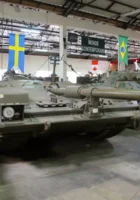
Den Stridsvagn 103 (Stridsvagn 103), also known as the S-Tank, was a Swedish post-war main battle tank. It was known for its unconventional design: it was turretless with a fixed gun traversed by engaging the tracks and elevated by adjusting the hull suspension. While turretless armoured fighting vehicles are usually classified as assault guns or tank destroyers, despite its unique gun laying process the Strv 103 is considered a tank because its designated combat role matched those of other tanks within contemporary Swedish doctrine. It is the only main battle tank and the only tank of any kind since the World War II era to dispense with a turret. The Strv 103 was designed and manufactured in Sweden. It was developed in the 1950s and was the first main battle tank to use a turbine engine. The result was a very low-profile design with an emphasis on defence and heightened crew protection level. Strv 103s formed a major portion of the Swedish armoured forces from the 1960s to part of the 1990s, but have since been removed from service in favour of the Stridsvagn 122.

Kilde: Stridsvagn 74 på Wikipedia

Fortsett å lese

Views : 8721

Strv 74

Stridsvagn 74

LandSverige
TypeHovedkamptank
FotografiThord Wedman
Emnet

Album av 95 bilder walk-around av en «Stridsvagn 74»

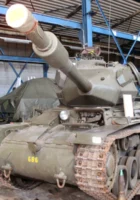
Bildegalleri av en Stridsvagn 74, Stridsvagn 74 (strv 74) was a Swedish tank in use with the Swedish Army from 1958 to 1984. It was a modification of the older stridsvagn m/42 which was phased out of service in the 1950s. Instead of scrapping the vehicles altogether, the chassis were used to build a new tank which could be used as a supplement to the newly bought stridsvagn 101. The turret of strv 74 was completely new, with a 75 mm high-velocity gun based on an old anti-aircraft gun, engines and transmission were modified or changed from the strv m/42, broader tracks and a separate electrical engine for the turret rotation was introduced while retaining the manual control as a backup.

Kilde: Stridsvagn 74 på Wikipedia

Fortsett å lese

Views : 3438