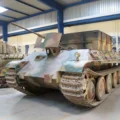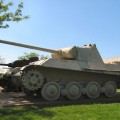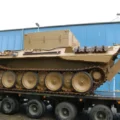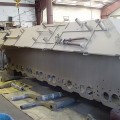
Panther tank | |
|---|---|
| 국가 | 나치 독일 |
| 역할 | 중형 전차 |
| 서비스 중 | 1943–1945 |
| 내장 | 6000+ |
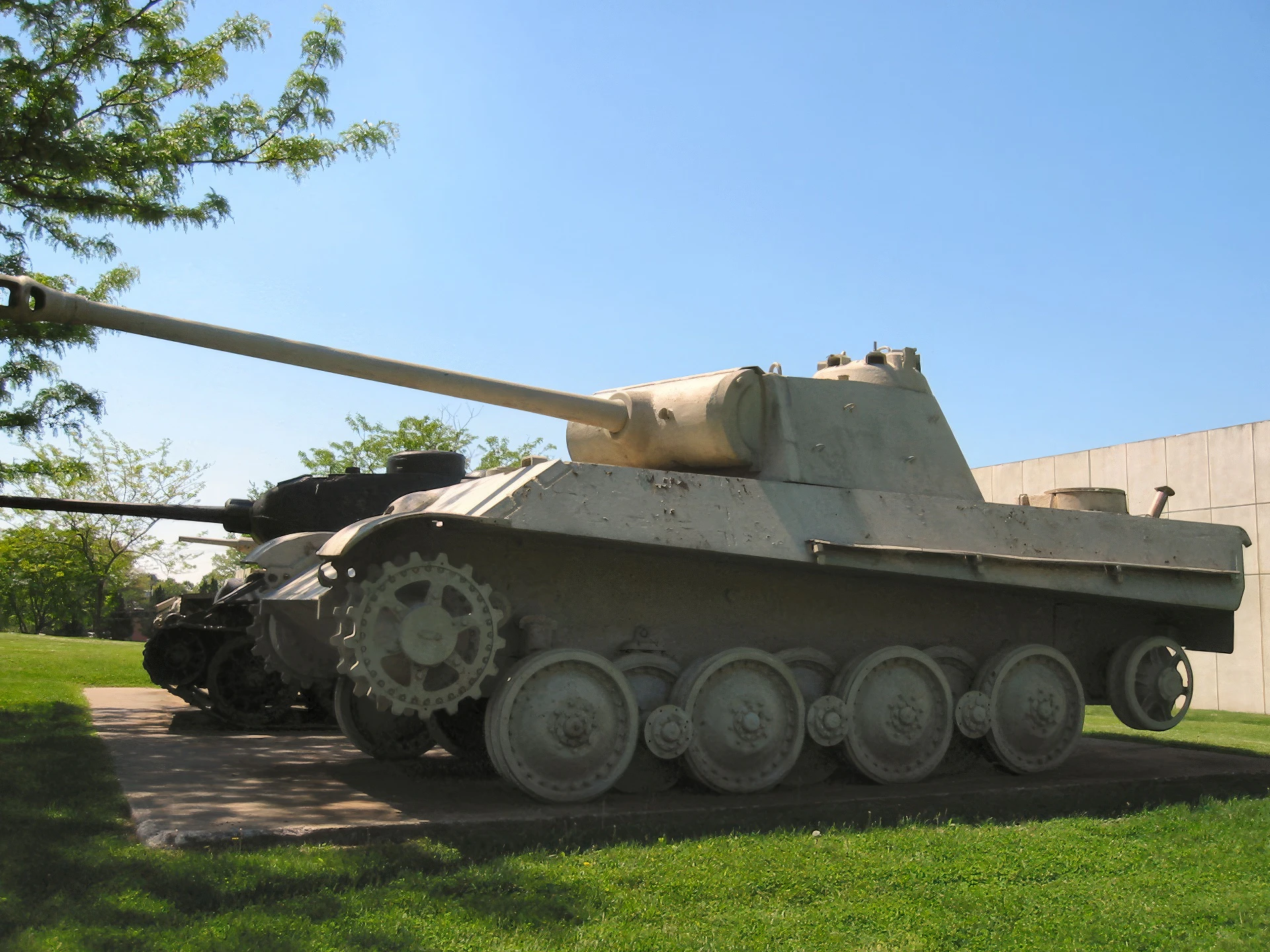
Tthe 팬더 는 1943년 중반부터 1945년 전쟁이 끝날 때까지 유럽의 동서양전선에 제2차 세계대전 당시 배치된 독일 중형 전차이다. 그것은 Sd.Kfz. 171의 병기 재고 지정을 가지고 있었다. 그것은 1944 년 2 월 27 일까지 Panzerkampfwagen V Panther로 지정되었으며, 히틀러는 로마 숫자 "V"를 삭제하도록 명령했습니다. 현대 영어 보고서는 때때로 그것을 "Mark V"라고 부릅니다.
소스: 위키백과에 팬더
| Panther | |
|---|---|
| 사진 작가 | Unknow |
| 로컬라이제이션 | Unknow |
| 사진 | 40 |

Panther 28

Panther 29

Panther 30

Panther 31

Panther 32

Panther 33

Panther 34

Panther 35

Panther 36
잠깐, 당신을 위해 팬더를 검색 ...

| PzKpfw V Panther Walk Around | |
|---|---|
| 사진 작가 | 존 헥 |
| 로컬라이제이션 | 자크 리틀필드 컬렉션 |
| 사진 | 44 |
참고 항목:


This German ordnance designation refers to the Panzerkampfwagen V Panther, often simply called the Panther tank. It was a medium tank developed by Nazi Germany and used on the Eastern and Western Fronts of World War II from mid-1943 until the end of the war in May 1945.
The Panther is widely regarded by historians as one of the best German tanks of the war, and an influential design due to its sloped armor, powerful main gun, and good mobility.
Sd.Kfz. 171: The Panther Medium Tank
| 특징 | Specification (General/Typical) |
|---|---|
| Full Name | Panzerkampfwagen V Panther (Pz.Kpfw. V) |
| 형식 | 중형 전차 |
| 서비스 중 | 1943–1945 (Nazi Germany) |
| 승무원 | 5 (Commander, Gunner, Loader, Driver, Radio Operator/Hull Machine Gunner) |
| Weight (Mass) | Approx. 44.8 tonnes (49.4 short tons) |
| Length (Gun forward) | 8.66 m to 8.86 m (depending on variant) |
| 너비 | 3.27 m to 3.42 m |
| 높이 | 2.99 m |
| 주무장 | 1 x 7.5 cm KwK 42 L/70 tank gun |
| 보조 무장 | 2 x 7.92 mm MG 34 machine guns |
| 엔진 | Maybach HL230 P30 V12 petrol engine |
| Engine Power | 700 PS (690 hp, 515 kW) |
| Max Speed (Road) | 46 km/h to 55 km/h (depending on model/conditions) |
| 작동 범위 | Approx. 200 km (Road) / 100 km (Cross-country) |
Key Design Features
- Sloped Armor: The Panther’s most notable feature, inspired by the Soviet T-34, was its heavily sloped frontal armor (up to 80 mm at 55 degrees on the glacis plate, equivalent to a much thicker vertical plate). This significantly increased its protection against enemy fire.
- Powerful Gun: The 7.5 cm KwK 42 L/70 was a high-velocity gun that could penetrate the armor of nearly any Allied tank it faced.
- Interleaved Road Wheels: The use of large, overlapping, interleaved road wheels provided excellent weight distribution and a very smooth ride, crucial for cross-country performance. However, this design was also complex and time-consuming to maintain and repair, particularly in muddy or icy conditions.
Major Variants
- Ausf. D: The initial production model, first seeing combat at the Battle of Kursk in 1943. It suffered from numerous mechanical issues initially.
- Ausf. A: Corrected many of the mechanical faults of the Ausf. D, featured a new, better-protected cast commander’s cupola, and often included a hull machine gun ball mount.
- Ausf. G: The most common and final major production variant. It featured changes to the hull side armor (thicker and simpler), the removal of the driver’s vision port (relying solely on a periscope), and further mechanical refinements.
Views : 10462