Sherman M4A2 vol 1 - Armor Photogallery 011

Modello Centrum Publishing

Ref

Armor PhotoGallery 011

Autore
Oggetto

Sherman M4A2 vol 1

Un libro firmato FotoGallery armatura la rivista «Sherman M4A2 vol 1 – Armor Photogallery 011».

storia: Le Medium Tank M4 est le char américain moyen produit en plus grande quantité pendant la Seconde Guerre mondiale. Près de cinquante mille exemplaires (toutes versions confondues) furent produits. Son surnom de « Sherman », lui est attribué par les Britanniques, quand ils reçoivent leurs premiers exemplaires dans le cadre de la loi de prêt-bail, continuant leur tradition de nommer les chars d’origine américaine d’après le nom d’un général nordiste de la guerre de Sécession célèbre de ce pays. L’US Army adopte par la suite ce surnom, et le Medium Tank M4 est dès lors appelé « M4 Sherman ». Les Soviétiques surnomment les leurs « Emcha ».

fonte: Wikipedia

Continua a leggere

Visualizzazioni : 2196

Fotogallery armatura 04 - SdKfz234

Modello Centrum Publishing

Ref

Armor PhotoGallery 004

Autore
Oggetto

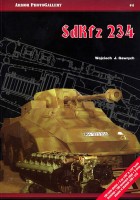
SDKFZ.234

Un libro firmato FotoGallery armatura la rivista «Sdkfz.234 – Armor Photogallery 004».

Le terme de Schwerer Panzerspähwagen (véhicule de reconnaissance blindé lourd) désignait l’ensemble des véhicules à 6 ou 8 roues utilisés par la Wehrmacht au cours de la Seconde Guerre mondiale. Ils jouèrent le rôle important de reconnaissance, en avant des divisions panzer, afin d’estimer les forces ennemies à combattre. Version améliorée des 232, la principale différence visible est ses gardes-boues en une seule pièce (2 pour les versions précédentes).

fonte: SdKfz 234 su Wikipedia

Continua a leggere

Visualizzazioni : 2045

Der Mittlere Schützenpanzerwagen - Waffen Arsenal Special 32

Arsenale del Waffen

Ref

Speciale Waffen Arsenal 32

Autore
Oggetto

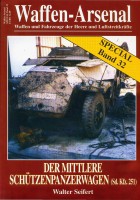
Der Mittlere Schützenpanzerwagen

Une documentation signée Arsenale del Waffen la rivista "Der Mittlere Schützenpanzerwagen – Waffen Arsenal Special 32".

Le Sonderkraftfahrzeug 251 (SdKfz 251) (littéralement : véhicule de combat spécial) était un véhicule blindé allemand semi-chenillé de combat construit durant la Seconde Guerre mondiale, qui fut produit tout au long du conflit. Sa classification dans la Heer correspond à Schützenpanzer (Véhicule de combat d’infanterie). Il était essentiellement destiné à équiper les Panzerdivisions et les unités de Panzergrenadieren et partageait de nombreux éléments mécaniques avec le SdKfz 7.

fonte: Wikipedia

Continua a leggere

Visualizzazioni : 1352

FM-1 Wildcat - WalkAround

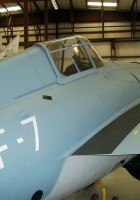
FM-1 Wildcat

PaeseUsa
Prima moscaIl 2 settembre 1947
Costruito7885

Le Grumman F4F Wildcat was an American carrier-based fighter aircraft that began service with both the United States Navy and the British Royal Navy (as the Martlet) in 1940. First used in combat by the British in Europe, the Wildcat was the only effective fighter available to the United States Navy and Marine Corps in the Pacific Theater during the early part of World War II in 1941 and 1942; the disappointing Brewster Buffalo was withdrawn in favor of the Wildcat and replaced as units became available. With a top speed of 318 mph (512 km/h), the Wildcat was outperformed by the faster and more nimble 331 mph (533 km/h) Mitsubishi A6M Zero, but its ruggedness, coupled with tactics such as the Thach Weave, resulted in an air combat kill-to-loss ratio of 5.9:1 in 1942 and 6.9:1 for the entire war. GM produced the FM-1, identical to the F4F-4, but reduced the number of guns to four, and added wing racks for two 250 lb (110 kg) bombs or six rockets. Production later switched to the improved FM-2 (based on Grumman’s XF4F-8 prototype) optimized for small-carrier operations, with a more powerful engine (the 1,350 hp (1,010 kW) Wright R-1820-56), and a taller tail to cope with the torque.

fonte: FM-1 Wildcat su Wiki

Continua a leggere

Visualizzazioni : 4944

B-25J Mitchell - WalkAround

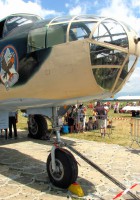
B-25J Mitchell

PaeseUsa
digitare

Bombardiere medio

Argomento

Album di 27 foto walk-around di un "B-25J Mitchell"

Galleria fotografica di un B-25J Mitchell, The B-25 Mitchell nordamericano Il è stato un bombardiere medio bimotore prodotto dalla North American Aviation. Fu usato da molte forze aeree alleate, in ogni teatro della seconda guerra mondiale, così come da molte altre forze aeree dopo la fine della guerra, e vide il servizio per quattro decenni.

fonte: Wikipedia

Continua a leggere

Visualizzazioni : 3360

Messerschmitt Me 163B - WalkAround

Messerschmitt Me 163B

PaeseGermania
Ruolo

Caccia a razzo

Primo volo1° settembre 1941
Costruito370

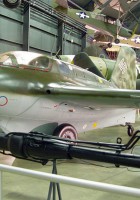
Le Messerschmitt Me 163 Komet Era un caccia tedesco a razzo. Progettato da Alexander Lippisch, è l'unico aereo da caccia a razzo ad essere mai stato operativo e il primo aereo pilotato di qualsiasi tipo a superare i 1000 km/h (621 mph) nel volo di livello. Il suo design è stato rivoluzionario e le sue prestazioni senza precedenti. Il pilota collaudatore tedesco Heini Dittmar all'inizio di luglio 1944 raggiunse i 1.130 km/h (700 mph), un record non ufficiale di velocità aerea di volo senza pari per quasi un decennio. Furono costruiti oltre 300 aerei, ma il Komet si dimostrò inefficace nel suo ruolo dedicato come intercettore ed era responsabile della distruzione di soli nove-diciotto aerei alleati contro dieci perdite. Oltre alle perdite di combattimento, molti piloti sono stati uccisi durante i test e l'addestramento

fonte: Messerschmitt Me 163 Komet su Wikipedia

Continua a leggere

Visualizzazioni : 3379

Kleines Kettenkraftrad - Arsenal Waffen 148

Arsenale del Waffen

Ref

Arsenale Waffen 148

Autore
Oggetto

Kleines Kettenkraftrad

Une documentation signée Arsenale del Waffen la rivista "Kleines Kettenkraftrad – Waffen Arsenal 148".

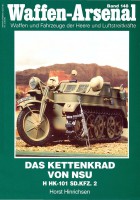
L'SdKfz 2, meglio conosciuto come Kleines Kettenkraftrad HK 101 ou Kettenkrad est un “Sonderkraftfahrzeug” (SdKfz) ce qui signifie véhicule spécial à moteur. Il s’agit d’un modèle d’autochenille. Produit de 1940 à 1948, il ne transporte que 2 hommes, mais atteint 70 km/h et se comporte très bien sur tout type de terrain. C’était au départ un petit tracteur pour troupes aéroportées. Ce véhicule a été conçu pour être livré par des avions Junkers Ju 52, mais pas par parachute. Le véhicule avait l’avantage d’être le seul petit tracteur d’artillerie, assez petit pour tenir dans la soute du Ju 52. Il a été utilisé comme transport de troupe, mais aussi pour d’autres missions, notamment le déroulage de câbles téléphoniques ou le tractage de pièces d’artillerie légères. Il pesait à vide 1235 kg.

fonte: Wikipedia

Continua a leggere

Numero visioni : 1072

186 - Carri armati del Corpo dei Marines degli Stati Uniti della seconda guerra mondiale

Osprey Publishing

Ref

New Vanguard 186

Isbn9781849085601
Autore
IllustratorRichard Chasemore

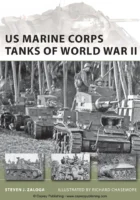
During World War II, the US Marine Corps formed six tank battalions that battled through the harsh conditions of the Pacific Theatre. Using the same basic tanks as the US Army, notably the M3 and M5A1 light tanks and the M4 Sherman medium tank, the marines made both technical and tactical innovations to make them more effective in the fight against the Japanese. Deep wading equipment, flamethrower tanks, and even wooden armor all became part of the Marine arsenal. This book examines the tactics and technology that made the US Marine Corps tank service unique in the annals of warfare.

fonte: falco pescatore

Continua a leggere

Visualizzazioni : 1342

Renault R35

Renault R35

PaeseFrancia
digitare

Carro armato di fanteria leggera

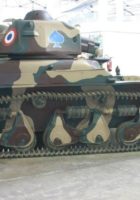
Galleria fotografica di un serbatoio Renault R35, The Renault R35, an abbreviation of Char léger Modèle 1935 R or R 35, was a French light infantry tank of the Second World War. Designed from 1933 and produced from 1936, the type was intended as a light infantry support tank, equipping autonomous tank battalions, that would be allocated to individual infantry divisions to assist them in executing offensive operations. To this end it was relatively well-armoured but slow and lacking a good antitank-capacity, fitted with a short 37 mm gun. At the outbreak of the war, the antitank-role was more emphasized leading to the development and eventual production from April 1940 of a subtype with a more powerful longer gun, the Renault R40. It was planned to shift new production capacity to the manufacture of other, faster, types, but due to the defeat of France the R35/40 remained the most numerous French tank of the war, about 1685 vehicles having been produced in June 1940. At that moment it had also been exported to Poland, Romania, Turkey and Yugoslavia. For the remainder of the war Germany and its allies would use captured vehicles, some of them rebuilt into tank destroyers.

fonte: Renault R35 su Wiki

Continua a leggere

Visualizzazioni: 7315

Das waffen arsenal 085 - Heinkel He 162

Arsenale del Waffen

Ref

Waffen Arsenal 085

Auteur
Oggetto

Der VolksJäger He 162

Une documentation signée Arsenale del Waffen la revue «Der VolksJäger He 162 – Waffen Arsenal 085» .

Le Heinkel Egli 162 Volksjäger ou Salamander est un avion de chasse intercepteur de la Seconde Guerre mondiale.

fonte: Egli 162 sur Wikipedia

Continua a leggere

Visualizzazioni : 1529