M50 Ontos

M50 Ontos

PaísE.e.u.u
TipoAntitanque blindado ligero
En servicio1956–69
Producido297+

el Ontos, officially the Rifle, Multiple 106 mm, Self-propelled, M50, was a U.S. light armored tracked anti-tank vehicle developed in the 1950s, a fast tank killer for airborne forces. It mounted six M40 106 mm recoilless rifles as its main armament, which could be fired in rapid succession against single targets to guarantee a kill. It was produced in limited numbers for the U.S. Marines after the U.S. Army lost interest in the project. The Marines consistently reported excellent results when they used the Ontos for direct fire support against infantry in numerous battles and operations during the Vietnam War. The American stock of Ontos was largely expended towards the end of the conflict and the Ontos was removed from service in 1969.

Fuente: M50 Ons en Wikipedia

Continuar leyendo

Views : 8915

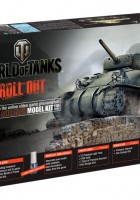
Mundo de tanques - M4 SHERMAN - ITALERI 36503

Italeri

Ref 36503
SerieMundo de tanques
Escala1/35
Tema

M4 SHERMAN

THE BOX CONTAIN: 1 MODEL KIT – 1 LIQUID CEMENT – 1 TANK GUIDE – WORLD oF TANKS DECALS – 3 INVITE CODES – 1 BONUS CODE

The M4 Sherman medium tank was the primary tank used by the United States during World War II. It was the first and most basic production version of the Sherman line and also the most commonly-produced U.S. tank of WWII. It essentially formed the backbone of U.S armoured forces at that time. As many as 49,234 vehicles were produced. The Sherman evolved from the M3 Medium Tank, retaining a lot from this previous design. However, the M4’s design introduced a fully-traversable turret in combination with a 75mm gun. To facilitate production, the Sherman tank family was modified into a perplexing array of variants – from the basic M4 through to the famous “Easy Eight”. Shermans first saw combat with British forces in North Africa in late 1942, against the Panzer III and Panzer IV. They would then go on to be used on all fronts until the war’s end. The tank was easy to produce en masse and quite reliable. A lack of firepower and narrow tracks, which often caused it to get stuck on muddy terrain, were its main weaknesses.

Fuente: Italeri

Continuar leyendo

Vistas : 1399

YEA-3A Skywarrior

Douglas A-3 Skywarrior

País E.e.u.u
Tipo Bombardero estratégico
Primer vuelo 28 de octubre de 1952
Construido 282
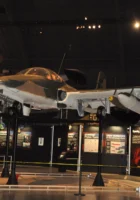
Galería de fotos de un Douglas A-3 Skywarrior, The Douglas A-3 Skywarrior was designed as a strategic bomber for the United States Navy and was among the longest serving carrier-based aircraft in history. It entered service in the mid-1950s and was retired in 1991. Throughout its service, it was the heaviest operational aircraft to operate from aircraft carriers, earning its nickname, “The Whale.” Its primary function for much of its later service life was as an electronic warfare platform, tactical air reconnaissance platform, and high capacity aerial refueling tanker.
Fuente: Douglas A-3 Skywarrior en Wikipedia
Continuar leyendo

Vistas : 6512

Barra de fuego Yak-28

Barra de fuego Yak-28

PaísUnión Soviética
TipoAviones de combate
Primer vuelo5 de marzo de 1958
Construido1180

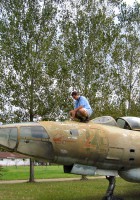
Galería de fotos de un Barra de fuego Yak-28, The Yakovlev Yak-28 was a swept wing, turbojet-powered combat aircraft used by the Soviet Union. Produced initially as a tactical bomber, it was also manufactured in reconnaissance, electronic warfare, interceptor, and trainer versions, known by the NATO reporting names Brewer, Firebar, and Maestro respectively. Based on the Yak-129 prototype first flown on 5 March 1958, it began to enter service in 1960.

Fuente: Barra de fuego Yak-28 en Wikipedia

Continuar leyendo

Views : 10288

Cessna Libélula

Cessna Libélula

PaísE.e.u.u
TipoAviones ligeros de ataque terrestre
Primer vueloOctubre de 1964
Construido577

el Cessna A-37 Libélula, o Super Tweet, es un avión de ataque ligero estadounidense desarrollado a partir del entrenador básico T-37 Tweet en las décadas de 1960 y 1970 por Cessna de Wichita, Kansas. La A-37 fue introducida durante la guerra de Vietnam y permaneció en servicio en tiempos de paz después.

Fuente: Cessna Dragonfly en Wikipedia

Continuar leyendo

Vistas : 3006

Nm 116

Nm 116

PaísNoruega
TipoTanque ligero
FotógrafoErik Torp
Tema

Álbum de 31 fotos de un Nm noruego 116

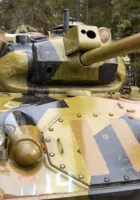
Galería de fotos de un Nm 116, In 1972, the Norwegian Army decided to retain 54 of their 123 M24 light tanks as reconnaissance vehicles after they were substantially rebuilt under the designation NM-116. It was calculated that the NM-116 rebuilding program cost only about a third as much as contemporary light tanks. This program was managed by the firm Thune-Eureka. The American firm NAPCO developed an improved power-pack based around the 6V53T diesel engine used in the M113 armored personnel carrier mated to an Allison MT-653 transmission. The original 75 mm Gun M6 L/39 was replaced with a French D-925 90 mm low pressure gun, with a co-axial 0.50-inch (12.7 mm) M2 heavy machine gun. The bow gunner position was eliminated in favor of ammunition stowage. A new fire-control system was installed, complete with a Simrad LV3 laser rangefinder. Norwegian firms also converted eight M24 light tanks into light armored recovery vehicles to support the NM-116. The NM-116 were retired from service in 1993.

Fuente: Wikipedia

Continuar leyendo

Vistas : 3440

Panzerwrecks vol 4

Panzerwrecks

IdiomaInglés
AsuntoJagdpanther de s.Pz.Jg.Abt.559 en los Países Bajos
Páginas96 páginas
ISBN-13978-0-9555940-0-7

-7 page feature showing a Jagdpanther of s.Pz.Jg.Abt.559 in the Netherlands -Amazing coverage of Sd.Kfz.234/2s and Sd.Kfz.234 2cm Schwebelafette surrendering in May 1945 -Stunning Bergepanzer III and Hummel, both with disc camouflage -Pz.Kpfw.IV Ausf.D Triebgas training vehicle -3 pages of Ersatz M-10 Panther -18 page feature showing Sd.Kfz.234/4s, m.SPWs, KFz.13 with extra armour surrendering -Sd.Kfz.234 with Luchs turret – 2 images -10 page feature about the Henschel factory and the Tiger IIs found there by US forces

Features: Jagdpanther of s.H.Pz.Jg.Abt.559 Pz.Aufkl.Abt.20 surrenders at Pilsen 4.7cm Pak(t) auf R35 walkaround Stabskp./Korps Pz.A.A.FHH surrenders A trip to the Tiger factory ISBN: 978-0-9555940-0-7 Date: July 2007. Reprinted 2009, 2014 No of Photos: 116 No of Pages: 96 Size: 280x210mm (L)

Fuente: Panzerwrecks

Continuar leyendo

Vistas : 1320

MTLB

MT-LBV

PaísUnión Soviética
TipoPortaaviones blindado
En servicioFinales de la década de 1960 – presente

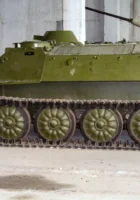
el MT-LB (En ruso: Многоḥелевой Тягах Легкий Бронированный, Mnogotselevoy Tyagach Logkiy Bronirovannyi / vehículo ligero de remolque blindado multiusos) es un vehículo blindado blindado auxiliar soviético multiusos totalmente anfibio, que se introdujo por primera vez a finales de la década de 1960. Inicialmente, el vehículo era conocido como M 1970 en el oeste.

Fuente: Wikipedia

Continuar leyendo

Views : 5689

Kampfpanzer 70

MBT-70 Experimental

PaísAlemania/Estados Unidos
TipoTanque de batalla principal
Peso50t
Equipo3
Construido14

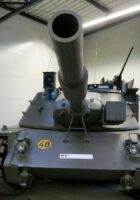
Galería de fotos de un MBT-70 Experimental, The MBT-70 (German: KPz 70) was a 1960s German-U.S. joint project to develop a new main battle tank, which was to be equipped with a number of advanced features. It utilized a newly developed hydropneumatic “kneeling” suspension and housed the entire crew in the large turret. The MBT-70 was armed with a 152mm XM150 gun/launcher, which could use conventional ammunition and the Shillelagh missile for long range combat. By 1969 the project was well over budget and Germany withdrew from the effort, developing a new main battle tank on their own instead (the Leopard 2). In the US the development continued for a short time, until in 1971 when Congress cancelled the program. The MBT-70 is the failed predecessor of the Leopard 2 and the M1 Abrams, the current main battle tanks of both countries.

Fuente: Wikipedia

Continuar leyendo

Vistas : 4233

Maqueta de Mark V

Marcos V

PaísUk
TipoTanque pesado

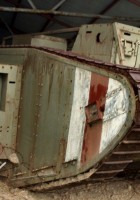
Galería de fotos de un Marcos V Mockup, The Mark V was a British heavy tank project from the First World War. After having made plans for the continued development of the Mark I into the Mark IV, the Tank Supply Committee (the institute planning and controlling British tank production) in December 1916 ordered the design of two new types: the Mark V and the Mark VI. The Mark V should embody the most advanced features that could still be incorporated into the Mark I hull. The Mark VI should abandon the old hull entirely, reflecting only some general principles of the older tank.

Fuente: Wikipedia

Continuar leyendo

Vistas : 2119