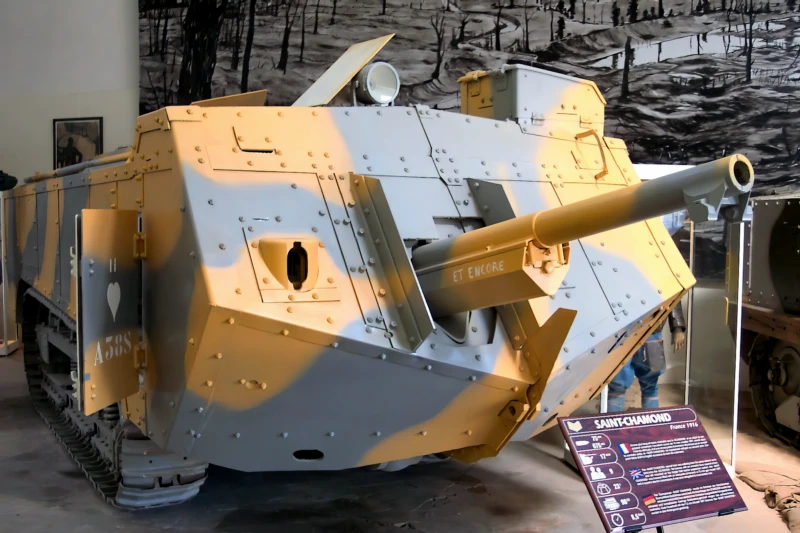
Sankt Chamond | |
|---|---|
| Land | Frankrig |
| Type | Mellemstor tank |
| Masse | 23 tons |
Den Saint-Chamond var den anden franske tunge kampvogn under Første Verdenskrig, med 400 fremstillet fra april 1917 til juli 1918. Selvom det ikke er en kampvogn efter den nuværende definition, er den generelt accepteret og beskrevet som sådan i beretninger om tidlig kampvognsudvikling. Saint-Chamond blev født af den kommercielle rivalisering med producenterne af Schneider CA1-kampvognen, og var et underdrevet og fundamentalt utilstrækkeligt design. Dens største svaghed var Holts "larve"-spor. De var alt for korte i forhold til køretøjets længde og tunge vægt (23 tons). Senere modeller forsøgte imidlertid at rette op på nogle af kampvognens oprindelige fejl ved at installere bredere og stærkere bæltesko, tykkere frontalpanser og den mere effektive 75 mm Mle 1897 feltkanon. I alt blev der bygget 400 Saint-Chamond kampvogne, herunder 48 ubevæbnede Caisson kampvogne. Saint-Chamond kampvognene forblev engageret i forskellige kampe indtil sensommeren 1918, og blev senere mere effektive, da kampene var flyttet ud af skyttegravene og ud på åbent terræn. Til sidst var det imidlertid planen, at Saint-Chamond-kampvognene skulle erstattes af importerede britiske tunge kampvogne.
Kilde: Saint Chamond på Wkipedia
| Saint Chamond – WalkAround | |
|---|---|
| Fotograf | Unknow |
| Lokalisering | Unknow |
| Billeder | 68 |


| Saint Chamond – WalkAround | |
|---|---|
| Fotograf | Unknow |
| Lokalisering | Unknow |
| Billeder | 47 |
Overview and Context
The Saint-Chamond was the second French heavy assault tank to enter service during World War I, with approximately 400 units produced between 1917 and 1918. Born out of industrial rivalry with the manufacturers of the first French tank (the Schneider CA1), it was an ambitious but deeply flawed design.
Its primary goal was to bring the firepower of a potent artillery piece, the French 75 mm field gun, directly against enemy trenches and fortifications.
Design og specifikationer
- Shape and Hull: It had a long, boxy superstructure with significant overhangs at both the front and rear of the vehicle, extending well beyond the relatively short, narrow tracks. This gave it a massive, ungainly silhouette.
- Hovedbevæbning: A long-barreled 75 mm gun (either the Saint-Chamond L12C TR or the standard Mle 1897 field gun in later versions) was rigidly mounted in the front of the hull, offering only a very limited traverse.
- Secondary Armament: Four 8 mm Hotchkiss machine guns, one mounted in each side (front, rear, left, right).
- Propulsion: The tank used a complex and innovative petrol-electric transmission system (Crochat-Colardeau). A 90 hp Panhard engine drove a generator, which in turn powered two electric motors linked separately to each track. This allowed for smooth steering but was heavy and prone to overheating and mechanical issues.
- Mandskab: The tank typically required a large crew of eight to nine men.
- Armor: Initially thin, with maximum armor plating of around 11.5 mm on the front and 8.5 mm on the sides. Later models increased side armor to 17 mm and added a spaced layer to the front to resist German armor-piercing bullets.
Combat Performance and Flaws
Despite its powerful main gun, the Saint-Chamond was plagued by critical operational deficiencies:
- Trench Crossing: The overly long hull combined with the relatively short track length and heavy forward weight caused the tank’s nose to violently dig into the ground or get irrevocably stuck in trenches and shell craters, making it notoriously poor for traversing the scarred terrain of the Western Front.
- Underpowered: The 90 hp engine was inadequate for the tank’s operational weight of around 23 metric tons, severely limiting its cross-country speed and agility (top speed was only about 8-12 km/h).
- Vulnerable: Its thin side armor left the crew vulnerable to heavy machine gun fire, a major issue that was only partially addressed in late-production models.
The Saint-Chamond remained in service until late 1918, mostly performing as a selvkørende pistol or being converted into unarmed supply/recovery vehicles, as it was eventually superseded by the more reliable and tactically superior Renault FT light tank and imported British heavy tanks.
Set antal gange : 4350
Du kan også se:
 Schneider CA1 – Billeder og videoer
 M14/41 tank – Billeder og videoer
 Batignolles-Chatillon Char 25T – Billeder & Videoer
 EE-T1 Osório – Billeder og videoer
 Light Tank Mk VI - Billeder og videoer
 Churchill tank - Billeder & Video
 Tiran 4 – Billeder og video
 M47 Patton – WalkAround
 T-38 - WalkAround
 Komet - Gå rundt