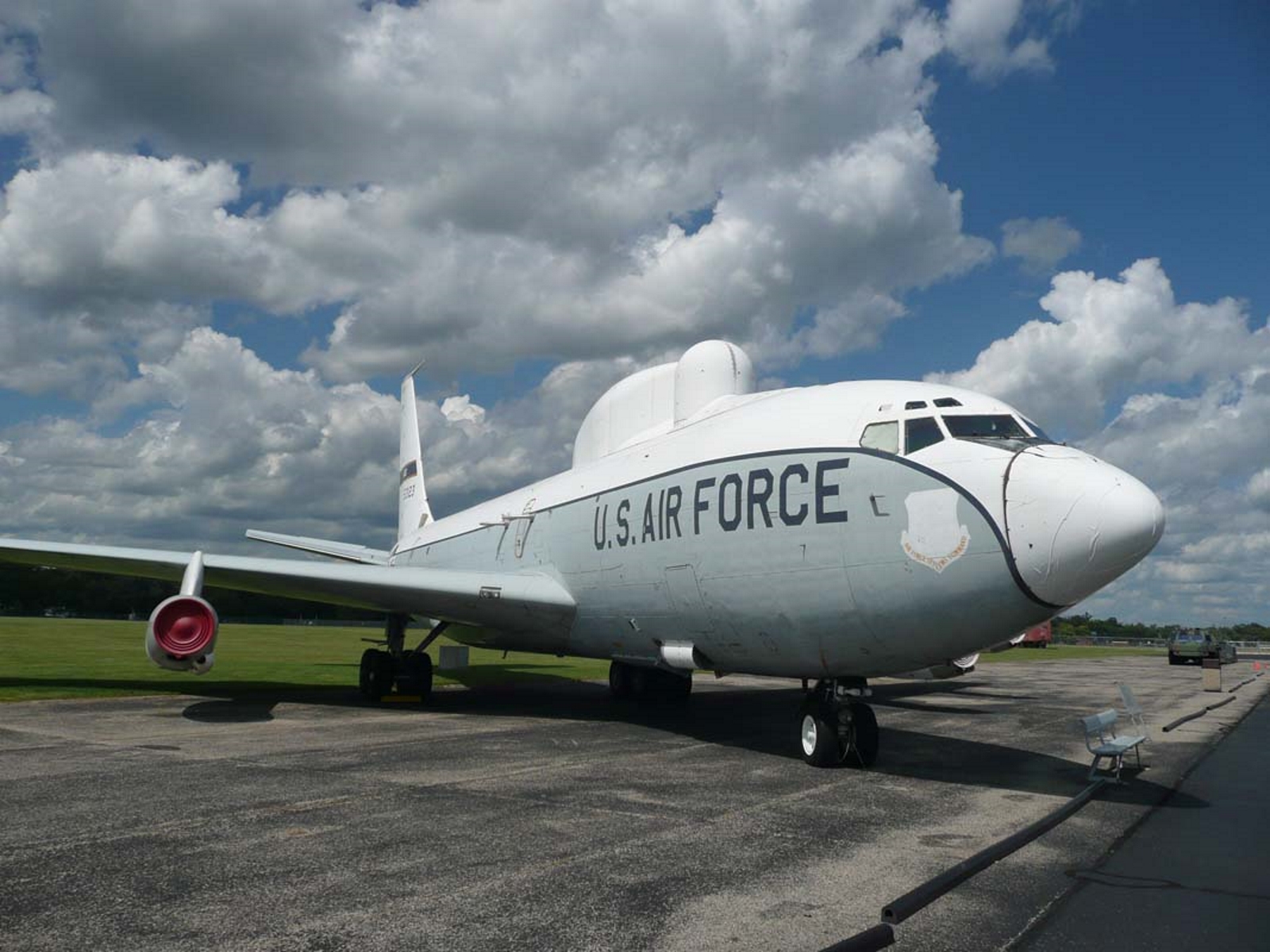
Boeing NC-135 | |
|---|---|
| Země | SPOJENÉ STÁTY |
| Roli | Letouny pro speciální zkušební mise |
| Stav | V provozu |
| Výrobce | Boeing |
Tá Boeing NC-135 A NKC-135 jsou speciální verze Boeing c-135 Stratolifter a Boeing KC-135 Stratotanker upravené pro provoz na několika různých programech.
Zdroj: Boeing NC-135 na Wikipedii
| Boeing NKC-135A Airborne Laser Lab (ALL) Walk Around | |
|---|---|
| Fotograf | Vladimir Jakubov |
| Lokalizace | Národní muzeum USAF |
| Fotografie | 250 |

| Boeing KC-135F Stratotanker | |
|---|---|
| Fotograf | Cees Hendriks |
| Lokalizace | Neznámé |
| Fotografie | 42 |
| Boeing KC-135A Stratotanker Walk Around | |
|---|---|
| Fotograf | Vladimir Jakubov |
| Lokalizace | Zámecké letecké muzeum, Atwater |
| Fotografie | 186 |
Viz také:


Tá Boeing NC-135 is a modified version of the Boeing C-135 Stratolifter, a military transport aircraft derived from the Boeing 707. The NC-135 is used for various research and development missions, such as testing new sensors, radars, communications systems, and electronic warfare equipment. The NC-135 can also serve as an airborne command post or a flying laboratory for experiments in aerodynamics, propulsion, and flight control.
The NC-135 has a crew of up to 25 people, depending on the mission and the configuration of the aircraft. The aircraft can carry up to 45,000 pounds of payload and has a range of over 4,000 miles. The NC-135 is equipped with four turbofan engines that provide a maximum speed of 580 miles per hour and a service ceiling of 50,000 feet. The NC-135 has a wingspan of 130 feet, a length of 136 feet, and a height of 42 feet.
Tá NC-135 was first flown in 1961 and has been in service with the United States Air Force ever since. The NC-135 fleet consists of several variants, such as the EC-135N (electronic combat), the OC-135B (open skies treaty observation), the WC-135W (weather reconnaissance), and the E-8C Joint STARS (surveillance and target acquisition). The NC-135 is also used by NASA for various research projects, such as studying the effects of microgravity on human physiology and testing new technologies for space exploration.
Pohledy : 2607
Můžete také vidět:
 Boeing X-32 – Fotografie a videa
 Boeing KC-97 Stratofreighter – fotografie a videa
 Boeing X-40A – Fotografie & Videa
 Boeing X-45 – Fotografie a videa
 Boeing 307 Stratoliner - Fotografie & Videa
 Boeing EA-18G Growler – Fotografie & Video
 Boeing E-3 Sentry – Fotografie a video
 Boeing RC-135 – Fotografie & Video
 Boeing P-26 – Fotografie & Video
 B-29 Super Pevnost – WalkAround