Vought F4U-1A Corsair

Vought F4U Corsair

CountryUSA
RoleCarrier-based fighter-bomber
Produced1942–53
Number built12571

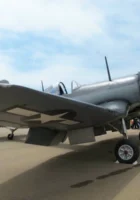
The Vought F4U Corsair is an American fighter aircraft that saw service primarily in World War II and the Korean War. Demand for the aircraft soon overwhelmed Vought’s manufacturing capability, resulting in production by Goodyear and Brewster: Goodyear-built Corsairs were designated FG and Brewster-built aircraft F3A. From the first prototype delivery to the U.S. Navy in 1940, to final delivery in 1953 to the French, 12,571 F4U Corsairs were manufactured, in 16 separate models, in the longest production run of any piston-engined fighter in U.S. history (1942–53)

Source: Vought F4U Corsair on Wiki

Continue reading

Views : 19865

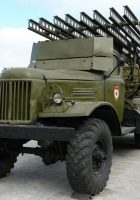
BM-13

CountrySoviet Union
RoleMultiple rocket launcher
In service1939–present
Produced1939–present

The Katyusha multiple rocket launcher (Russian: Катю́ша; IPA: [kɐˈtʲuʂə] (About this sound listen)) is a type of rocket artillery first built and fielded by the Soviet Union in World War II. Multiple rocket launchers such as these deliver explosives to a target area more quickly than conventional artillery, but with lower accuracy and requiring a longer time to reload. They are fragile compared to artillery guns, but are inexpensive, easy to produce, and usable on any chassis. The Katyushas of World War II, the first self-propelled artillery mass-produced by the Soviet Union, were usually mounted on ordinary trucks. This mobility gave the Katyusha, and other self-propelled artillery, another advantage: being able to deliver a large blow all at once, and then move before being located and attacked with counter-battery fire. Katyusha weapons of World War II included the BM-13 launcher, light BM-8, and heavy BM-31. Today, the nickname is also applied to newer truck-mounted post-Soviet – in addition to non-Soviet – multiple rocket launchers, notably the common BM-21 Grad and its derivatives.

Source: BM-13 on ZiL-157 on Wiki

Continue reading

Views : 4983

BM Smerch

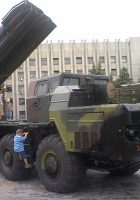
BM-30 Smerch

CountrySoviet Union
RoleMultiple rocket launcher
In service1989–present
Produced1989–present

The BM-30 Smerch (Russian: Смерч, “whirlwind”), 9K58 Smerch or 9A52-2 Smerch-M is a Soviet heavy multiple rocket launcher. The system is designed to defeat personnel, armored, and soft targets targets in concentration areas, artillery batteries, command posts and ammunition depots. It was created in the early 1980s and entered service in the Soviet Army in 1989. When first observed by the West in 1983, it received the code MRL 280mm M1983. It is expected to be superseded by the 9A52-4 Tornado

Source: BM-30 Smerch on Wiki

Continue reading

Views : 2474

ASU-85

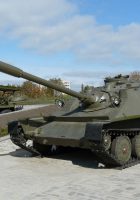
ASU-85

CountrySoviet Union
RoleSelf-propelled gun
In service1959–1993
Produced1959–1966

The ASU-85 (Russian: Авиадесантная самоходная установка, АСУ-85, Aviadesantnaya Samokhodnaya Ustanovka, ‘airborne self-propelled mount’) is a Soviet-designed airborne self-propelled gun of the Cold War Era. From 1959, it began to replace the open-topped ASU-57 in service. It was, in turn, replaced by the BMD-1 beginning in 1969.

Source: ASU-85 on Wiki

Continue reading

Views : 5961

M103A2

M103

CountryUSA
RoleHeavy tank
In service1957–74
Built300

The M103 Heavy Tank (officially designated 120mm Gun Combat Tank M103) served in the United States Army and the United States Marine Corps during the Cold War. The last M103s were withdrawn from service in 1974. The M103 was the last heavy tank to be used by the US military as the concept of the Main Battle Tank evolved, making heavy tanks obsolete.

Source: M103 on Wiki

Continue reading

Views : 423

Grumman A-6DSD Intruder

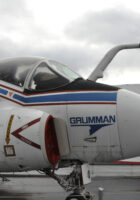
Grumman A-6A Intruder

CountryUSA
RoleAttack aircraft
Produced1962–1990
Built693

The Grumman A-6 Intruder was an American, twin jet-engine, mid-wing all-weather attack aircraft built by Grumman Aerospace. In service with the United States Navy and Marine Corps between 1963 and 1997, the Intruder was designed as an all-weather medium attack aircraft to replace the piston-engined Douglas A-1 Skyraider. As the A-6E was slated for retirement, its precision strike mission was taken over by the Grumman F-14 Tomcat equipped with a LANTIRN pod. From the A-6, a specialized electronic warfare derivative, the EA-6, was developed.

Source: Grumman A-6A Intruder – on Wiki

Continue reading

Views : 14861

Bolkow Bo-105

Bolkow Bo-105r

CountryGermany
RoleLight utility helicopter
Produced1967–2001
Built1500+

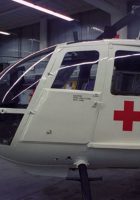
The Messerschmitt-Bölkow-Blohm Bo 105 is a light, twin-engine, multi-purpose helicopter developed by Bölkow of Ottobrunn, Germany. It holds the distinction of being the first light twin-engine helicopter in the world, and is the first rotorcraft that could perform aerobatic maneuvers, such as inverted loops. The Bo 105 features a revolutionary hingeless rotor system, at that time a pioneering innovation in helicopters when it was introduced into service in 1970. Production of the Bo 105 began at the then-recently merged Messerschmitt-Bölkow-Blohm

Source: Bolkow Bo-105 on Wiki

Continue reading

Views : 4114

Hiller OH-23C Raven

Hiller OH-23 Raven

CountryUSA
RoleMultipurpose light helicopter
Introduction1948
StatusRetired

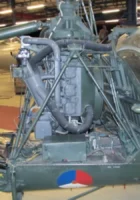
The Hiller OH-23 Raven was a three-place, light observation helicopter based on the Hiller Model 360. The Model 360 was designated by the company as the UH-12 (“UH” for United Helicopters), which was first flown in 1948. The OH-23 trainer was jokingly nicknamed the “Hiller Killer” by US Army Aviation student pilots who had to fly it

Source: Hiller OH-23 Raven on Wiki

Continue reading

Views : 3256

NH 90

NHIndustries NH90

CountryMultinational
RoleMedium utility military helicopter
Produced1995–present
Built300+

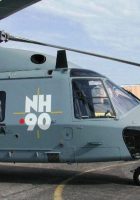
The NHIndustries NH90 is a medium-sized, twin-engine, multi-role military helicopter. It was developed in response to NATO requirements for a battlefield helicopter which would also be capable of being operated in naval environments. The NH90 was developed and is manufactured by NHIndustries, a collaborative company, which is owned by Airbus Helicopters, Leonardo (formerly AgustaWestland) and Fokker Aerostructures. The first prototype conducted its maiden flight in December 1995; the type first entered operational service in 2007. As of January 2017, the NH90 has logged 127,000 flight hours in the armed forces of thirteen nations.

Source: NHIndustries NH90 on Wiki

Continue reading

Views : 4335