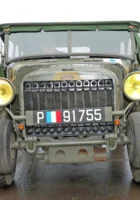
Laffly V15T

Laffly V15

CountryFrance
RoleGun tractor
PeriodWorld War II
BuiltUnknow

The Laffly V15T was a French light 4WD artillery tractor used during World War II. It was used to tow the 25 mm SA anti-tank gun. A personnel carrier and reconnaissance vehicle based on the same chassis was designated as V15R. The Laffly company itself only manufactured the first batch of 100 V15s, the rest of the production being taken over by Corre La Licorne.

Source: Laffly V15 on Wikipedia

Continue reading

Views : 4630

Gaz-46 MAV

GAZ 46

CountrySoviet Union
Role4×4 amphibious jeep
Production1954-1958
BuiltUnknow

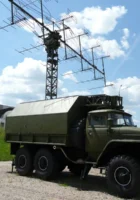
The GAZ-46, army designation MAV (Russian, малый автомобиль водоплавающий, small floating car), is a Russian-made light four-wheel drive amphibious military vehicle that entered service in the 1950s and has been used by many Eastern Bloc allied forces since. During the Second World War Canada, Britain and the US forwarded large quantities of military materials to Russia. Among those were jeeps, trucks, and amphibious vehicles like the 6×6 DUKW and the 4×4 Ford GPA. The latter were used to help men and equipment get across the many rivers of Eastern Europe and combat the Germans. Seeing merits of such vehicles, after the war, Russia decided to develop two similar vehicles, using domestic automotive parts, the BAV, an equivalent of the DUKW, and the MAV, an equivalent of the Ford GPA.

Source: GAZ 46 on Wikipedia

Continue reading

Views : 2564

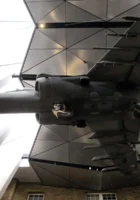
British Aerospace Harrier GR.9

British Aerospace Harrier II

CountryUK
RoleV/STOL strike aircraft
First flight30 April 1985
Built143

The British Aerospace Harrier II is a second-generation vertical/short takeoff and landing (V/STOL) jet aircraft used previously by the Royal Air Force (RAF) and, between 2006 and 2010, the Royal Navy (RN). The aircraft was the latest development of the Harrier Jump Jet family, and was derived from the McDonnell Douglas AV-8B Harrier II. Initial deliveries of the Harrier II were designated in service as Harrier GR5; subsequently upgraded airframes were redesignated accordingly as GR7 and GR9.

Source: British Aerospace Harrier II on Wikipedia

Continue reading

Views : 4537

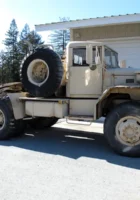
M123A1C

Mack M123 Truck

CountryUSA
Type10‑ton 6×6 trucks
Produced1955–1969
Built3580

In 1949 the US Army set a requirement for a family of extra heavy-duty 10‑ton (9,072 kg) off-road load rated 6×6 tactical trucks. Mack’s design, influenced by their WWII era NO, was chosen. Designed as an entire family, only the semi-tractor and cargo/prime mover were built. 392 M123s were built between 1955 and 1957 and 552 M125s in 1957 and 1958. In 1965 CONDEC began building 3188 diesel powered M123As, Mack began building 420 in 1968. In 1969 Mack then upgraded 210 gas engine models to diesel power. With the Army using more self‑propelled artillery, the need for prime movers was reduced, no follow‑up orders for M125s were made. Both M123s and M125s saw service in the Vietnam War. M123 tractors remained in Army service into the 1990s.

Source: Mack M123 Truck on Wikipedia

Continue reading

Views : 4307

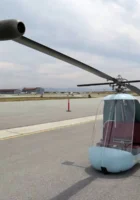
Hiller HJ-1 Hornet

Hiller HJ-1 Hornet

CountryUSA
RoleExperimental helicopter
First flight1950
Built18

The Hiller YH-32 Hornet (company designation HJ-1) was an American ultralight helicopter built by Hiller Aircraft in the early 1950s. It was a small and unique design because it was powered by two Hiller 8RJ2B ramjet engines mounted on the rotor blade tips which weigh 13lbs each and deliver an equivalent of 45 h.p. for a total of 90 h.p. Versions of the HJ-1 Hornet were built for the United States Army and the United States Navy in the early 1950s. The Hiller Museum identifies the YH-32A, named the Sally Rand, as the first helicopter gunship.

Source: Hiller HJ-1 Hornet on Wikipedia

Continue reading

Views : 2456

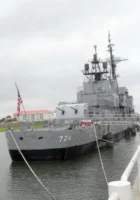
USS Laffey

USS Laffey (DD-724)

CountryUSA
Class and typeAllen M. Sumner-class destroyer
Launched21 November 1943
Out of service9 March 1975

USS Laffey (DD-724) is an Allen M. Sumner-class destroyer, which was constructed during World War II, laid down and launched in 1943, and commissioned in February 1944. The ship earned the nickname “The Ship That Would Not Die” for her exploits during the D-Day invasion and the battle of Okinawa when she successfully withstood a determined assault by conventional bombers and the most unrelenting kamikaze air attacks in history. Today, Laffey is a U.S. National Historic Landmark and is preserved as a museum ship at Patriots Point, outside Charleston, South Carolina.

Source: USS Laffey (DD-724) on Wikipedia

Continue reading

Views : 2694

USS Jeremiah O Brien

SS Jeremiah O’Brien

CountryUSA
RoleLiberty ship
Launched19 June 1943
Out of service7 February 1946

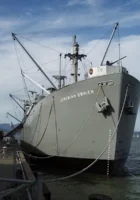
SS Jeremiah O’Brien is a Liberty ship built during World War II and named for American Revolutionary War ship captain Jeremiah O’Brien (1744–1818). Now based in San Francisco, she is a rare survivora of the 6,939-ship armada that stormed Normandy on D-Day, 1944. Jeremiah O’Brien, SS John W. Brown, and SS Hellas Liberty are the only currently operational Liberty ships of the 2,710 built

Source: SS Jeremiah O’Brien on Wikipedia

Continue reading

Views : 2774

Fokker S14 Machtrainer

Fokker S.14 Machtrainer

CountryNetherlands
RoleJet trainer
First fly19 May 1951
Built21

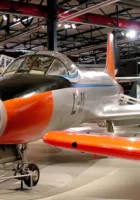
The Fokker S.14 Machtrainer is a Dutch two-seater military training jet aircraft designed and manufactured by Fokker for the Royal Netherlands Air Force. Development started in the late 1940s. It was one of the first jet fighter training aircraft in the world, making its first flight on 19 May 1951 and entering service in 1955.

Source: Fokker S.14 Machtrainer on Wikipedia

Continue reading

Views : 1480

Northrop JB-1 Bat

Northrop JB-1 Bat

CountryUSA
RolePrototype jet-powered flying wing
First flyAugust 27, 1943
BuiltUnknow

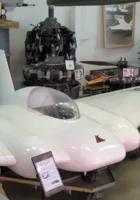
The Northrop JB-1 “Bat” was a United States surface-to-surface cruise missile that was a prototype jet-powered flying wing. The United States Army Air Forces MX-543 program was initiated in September 1942 to use license-built versions of Frank Whittle’s jet engine (General Electric J31). The Northrop Corporation was contracted in late 1943, and only 10 JB-1 airframes were built. A manned version was towed for the 1st flight on “August 27, 1943”, from Rogers Dry Lake and a glider version was launched from a rocket-propelled sled and crashed in December 1944. An unmanned JB-1 powered by an improvised General Electric B-1 turbojet with a wing span of 28 feet 4 inches (8.64 m) made its 1st flight from Eglin Field’s Santa Rosa Island, Florida, on December 7, 1944, and crashed 400 yards from the rail launcher.

Source: Northrop JB-1 Bat on Wikipedia

Continue reading

Views : 1739