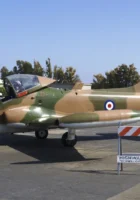
British Aircraft Jet Provost T.Mk.5A

BAC Jet Provost

CountryUK
RoleMilitary trainer aircraft
First flight26 June 1954
Built734

The BAC Jet Provost is a British jet trainer aircraft that was in use with the Royal Air Force (RAF) from 1955 to 1993. It was originally developed by Hunting Percival from the earlier piston engine-powered Percival Provost basic trainer, and later produced by the British Aircraft Corporation (BAC). In addition to the multiple RAF orders, the Jet Provost, sometimes with light armament, was exported to many air forces worldwide. The design was also further developed into a more heavily armed ground attack variant under the name BAC Strikemaster.

Source: BAC Jet Provost on Wikipedia

Continue reading

Views : 1114

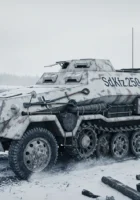
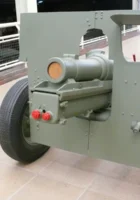
Sd.Kfz. 250 war

Sd.Kfz. 250

CountryGermany
TypeHalf-track armoured personnel carrier
In Service1941–1945
Built6600+

The Sd.Kfz. 250 (German: Sonderkraftfahrzeug 250; ‘special motor vehicle’) was a light armoured half-track, very similar in appearance to the larger Hanomag-designed Sd.Kfz. 251, and built by the DEMAG firm, for use by Nazi Germany in World War II. Most variants were open-topped and had a single access door in the rear. The Sd. Kfz 250 was adopted in 1939 to supplement the standard half-track. Production delays meant that the first vehicle did not appear until mid-1941.

Source: Sd.Kfz. 250 on Wikipedia

Continue reading

Views : 4100

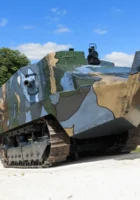
Schneider CA1

Schneider CA1

CountryFrance
TypeHeavy tank
In service1916–1918 (France) / 1921–1936 (Spain)
Built400

The Schneider CA 1 (originally named the Schneider CA) was the first French tank, developed during the First World War. The Schneider was inspired by the need to overcome the stalemate of trench warfare which on the Western Front prevailed during most of the Great War. It was designed specifically to open passages for the infantry through barbed wire and then to suppress German machine gun nests. After a first concept by Jacques Quellennec devised in November 1914, the type was developed from May 1915 onwards by engineer Eugène Brillié, paralleling British development of tanks the same year. Colonel Jean Baptiste Eugène Estienne in December 1915 began to urge for the formation of French armoured units, leading to an order in February 1916 for four hundred Schneider CA tanks, which were manufactured by SOMUA, a subsidiary of Schneider located in a suburb of Paris, between September 1916 and August 1918.

Source: Schneider CA1 on Wkipedia

Continue reading

Views : 2154

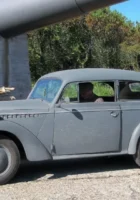
Opel Olympia

Opel Olympia

CountryGermany
TypeCar
Production1935–1970
BuiltUnknow

The Opel Olympia is a compact car produced by the German automaker Opel from 1935 to 1940, from 1947 to 1953 and again from 1967 to 1970. The 1935 Olympia was Germany’s first mass-produced car with an all-steel unitized body (monocoque). This revolutionary technology reduced the weight of the car by 180 kilograms (400 lb.) compared to its predecessor. Production of the unibody design required new production methods and materials. Spot welding, advanced types of steel, and a new production line layout were among the many advances introduced by the Olympia.

Source: Opel Olympia on Wikipedia

Continue reading

Views : 1919

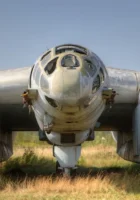
Bartini Beriev VVA-14

Bartini Beriev VVA-14

CountrySoviet Union
TypeAmphibious ASW aircraft
First flight4 September 1972
Built2

The Bartini Beriev VVA-14 Vertikaľno-Vzletayushchaya Amfibiya (vertical take-off amphibious aircraft) was a wing-in-ground-effect aircraft developed in the Soviet Union during the early 1970s. Designed to be able to take off from the water and fly at high speed over long distances, it was to make true flights at high altitude, but also have the capability of flying efficiently just above the sea surface, using aerodynamic ground effect. The VVA-14 was designed by Italian-born designer Robert Bartini in answer to a perceived requirement to destroy United States Navy Polaris missile submarines. The final aircraft was retired in 1987.

Source: Bartini Beriev VVA-14 on Wiki

Continue reading

Views : 3818

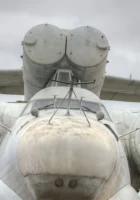
Lun-class ekranoplan

Lun-class ekranoplan

CountrySoviet Union
RoleAttack/Transport ground effect vehicle
In service 1987–late 1990s
Built2

The Lun-class ekranoplan (also called Project 903) is a ground effect vehicle (GEV) designed by Rostislav Alexeyev in 1975 and used by the Soviet and Russian navies from 1987 until sometime in the late 1990s. It flew using lift generated by the ground effect acting on its large wings when within about four metres (13 ft) above the surface of the water. Although they might look similar to traditional aircraft, ekranoplans like the Lun are not classified as aircraft, seaplanes, hovercraft, or hydrofoils. Rather, crafts like the Lun-class ekranoplan are classified as maritime ships by the International Maritime Organization due to their use of the ground effect, in which the craft glides just above the surface of the water.

Source: Lun-class ekranoplan on Wikipedia

Continue reading

Views : 2129

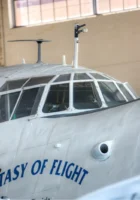
Short Sunderland ML814

Short Sunderland

CountryUK
RoleMilitary flying boat bomber
First flight16 October 1937
Built749

The Short S.25 Sunderland was a British flying boat patrol bomber, developed and constructed by Short Brothers for the Royal Air Force (RAF). The aircraft took its service name from the town (latterly, city) and port of Sunderland in North East England. Developed in parallel with the civilian S.23 Empire flying boat, the flagship of Imperial Airways, the Sunderland was developed specifically to conform to the requirements of British Air Ministry Specification R.2/33 for a long-range patrol/reconnaissance flying boat to serve with the Royal Air Force (RAF). As designed, it served as a successor to the earlier Short Sarafand flying boat. Sharing several similarities with the S.23, it featured a more advanced aerodynamic hull and was outfitted with various offensive and defensive armaments, including machine gun turrets, bombs, aerial mines, and depth charges. The Sunderland was powered by four Bristol Pegasus XVIII radial engines and was outfitted with various detection equipment to aid combat operations, including the Leigh searchlight, the ASV Mark II and ASV Mark III radar units, and an astrodome.

Source: Short Sunderland on Wikipedia

Continue reading

Views : 1374

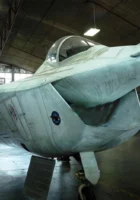
Boeing X-32 (Prototype)

Boeing X-32

CountryUSA
RoleConcept demonstrator aircraft
First flight18 September 2000
Built2

The Boeing X-32 is a concept demonstrator aircraft that was designed for the Joint Strike Fighter competition. It lost to the Lockheed Martin X-35 demonstrator, which was further developed into the Lockheed Martin F-35 Lightning II.

Source: Boeing X-32 on Wikipedia

Continue reading

Views : 1538