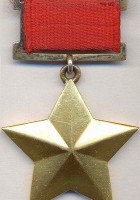
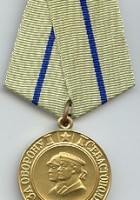
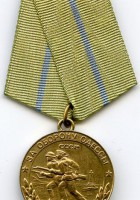
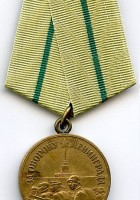
Medal "For the Defence of Odessa"

Soviet Union

TypeCampaign medal
EligibilityCitizens of the Soviet Union
Awarded forParticipation in the defence of Odessa
EstablishedDecember 22, 1942
Total awarded38,000

The Medal “For the Defence of Odessa” was a World War 2 campaign medal of the Soviet Union established on December 22, 1942 by decree of the Presidium of the Supreme Soviet of the USSR to reward the participants of the defence of the port city of Odessa from the armed forces of NAZI Germany.

Source: Wikipedia

Continue reading

Views : 1545

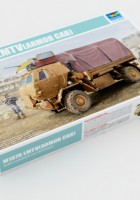
M1078 LMTV(ARMOR CAB) - Trumpeter 01009

Trumpeter

Ref01009
TypeModel kit
Scale1/35
Topic

M1078 LMTV(ARMOR CAB)

A model of the brand Trumpeter the kit: M1078 LMTV(ARMOR CAB) – Trumpeter 01009.

Features : Detailed multi-directional slide-molded cab. – Full drive train assembly complete with engine transmission, differential housing and suspension units. – The main tires are hollow rubber with very good tread pattern included as well as sidewall details consisting of raised section ribs. – Wheel hubs are in great details with separate hub rings. – The windshield and side windows are made of clear parts. – Photo-etched parts included

The M1078 Standard Cargo Truck is designed to transport cargo and soldiers. The M1078 has a payload capacity of 5,000 pounds and to facilitate loading/unloading, the bed side rails are mounted on hinges and can be lowered. The cargo bed can be equipped with an optional bench seat kit for transport of soldiers. The bench seats are constructed of a non-wood material and attach to the cargo bed side rails. The seats can be folded down and stowed when not in use. Soldiers are assisted climbing in and out of the cargo bed area with the aid of a ladder stowed on the vehicle when not in use. A canvas and bows kit is available to keep soldiers and cargo protected from the elements. The M1078 can be equipped with an optional self-recovery winch kit capable of fore and aft vehicle recovery operations. The winch has 308 feet of line capacity and 10,000 pounds bare.

Source: Trumpeter

Continue reading

Views : 1357

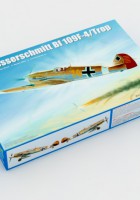
Messerschmitt Bf 109F-4/Trop - Trumpeter 02293

Trumpeter

Ref 02293
TypeModel kit
Scale1/32
Topic

Messerschmitt Bf 109F-4/Trop

A model of the brand Trumpeter the kit: Messerschmitt Bf 109F-4/Trop – Trumpeter 02293.

Features : The kit consists of over 240 parts Fuselage -Left and right fuselage moulded w/ authentic details Engine -Finely detailed engine. Interior -Finely detailed engine accessory compartment, -Finely detailed cockpit Wings – Optional position flaps – Rubber tires. PE -Photo-etched parts to upgrade details

The second major redesign of Bf109 is the F series. The “Friedrich” saw a complete redesign of the wings, the cooling system and fuselage aerodynamics, and was powered by the 1,175 PS DB 601N (F-1, F-2) or the 1,350 PS DB 601E (F-3, F-4). Considered by many as the high watermark of the Bf 109 development, the F series abandoned the wing cannon and concentrated all armament in the forward fuselage: a pair of machine guns above and a single 15 or 20mm cannon behind the engine, the latter firing between the cylinder banks and through the propeller hub and spinner. This configuration was used by all subsequent variants. A handful of Bf 109Fs were used operationally late in the Battle of Britain in 1940, but only become widespread in service in the first half of 1941, replacing the Bf109E.

Source: Trumpeter

Continue reading

Views : 2514

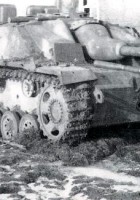
Sturmgeschütz

Sturmgeschütz

Topic

Album of 156 photos of the Sturmgeschütz

PeriodSecond World War
ArmyGerman Wehrmacht

Sturmgeschütz (or StuG) is an “assault gun” used by the German Wehrmacht during the Second World War. The vehicle was built on the chassis of the proven Panzer III. Initially intended as a mobile, armoured light gun for providing close fire support to infantry, panzer, and panzergrenadier units, the StuG was continually modified throughout its existence. It was often used as a mobile artillery platform to destroy bunkers, pillboxes and other entrenched positions. After the invasion of Soviet Russia in 1941, the StuG III was also converted to use as a tank destroyer because its main armament was the only weapon with sufficient power to take on the Soviet T-34 or KV-1 tanks. It would go on to become Nazi Germany’s most produced armoured fighting vehicle during World War II. The StuG was used primarily within the Sturmartillerie, a branch of the artillery in the Wehrmacht.

Source:

Continue reading

Views : 5834

Medal "For the Defence of Leningrad"

Soviet Union

TypeCampaign medal
EligibilityCitizens of the Soviet Union
Awarded forParticipation in the defence of Leningrad
EstablishedDecember 22, 1942
Total awarded1,470,000

The Medal “For the Defence of Leningrad” was a World War 2 campaign medal of the Soviet Union established on December 22, 1942 by decree of the Presidium of the Supreme Soviet of the USSR to recognise the valour and hard work of the Soviet civilian and military defenders of Leningrad during the 872 day siege of the city by the German armed forces between September 8, 1941 and January 27, 1944.

Source: Wikipedia

Continue reading

Views : 1517

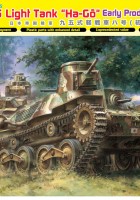
Imperial Japanese Army Type 95 Light Tank "Ha-Go" Early Production - DML 6767

Dragon Model

Ref 6767
Type1/35 Military
Scale1/35
Topic

Imperial Japanese Army Type 95 Light Tank “Ha-Go” Early Production

A model of the brand Dragon Model the kit : Imperial Japanese Army Type 95 Light Tank “Ha-Go” Early Production – DML 6767

Dragon has introduced a great many exciting new kits in 2012, and there is one more 1/35 scale AFV gem to come this year. The new item is a Type 95 “Ha-Go” light tank of the Imperial Japanese Army (IJA). The Type 95 tank was used in combat against China and Russia, as well as fully participating in operations in WWII. Weighing just 7.4 tonnes, it was designed primarily as an infantry support weapon. Indeed, it was the most common light tank used by the IJA in the Pacific, with about 2,300 units manufactured. It had a crew of three, and the main armament was a Type 94 37mm gun. Its maximum speed was 45km/h.

The kit depicts an Early-Production variant and it’s based on actual measurements from real tanks. Although it’s a small vehicle, Dragon’s 1/35 scale kit is brimming with detail, something facilitated by the widespread use of slide molds. In fact, every single sprue in the kit employs slide molds, which is an astounding achievement! For example, the turret is of single-piece construction, with the multi-directional slide mold allowing details such as rivets to be rendered. The commander’s cupola is a similar story. The one piece lower hull has the correct armor panels and bolts on it. The upper hull is also one piece, and the gun barrel has a hollow end. The road wheels, idlers, sprockets and return rollers are slide-molded too. The DS slide-molded track links are accurately replicated in miniature so as to incorporate side details. This is an extremely exciting subject from Dragon, and because the Ha-Go was used in such diverse locations, modelers can produce any scenario such as jungle-clad terrain or a Pacific island!

Source: Dragon Models
Continue reading

Views : 1439

Pz.Kpfw.III (5cm) Ausf.G, Sd.Kfz.141, Early Production - DML 6639

Dragon Model

Ref 6639
Type1/35 Military
Scale1/35
Topic

Pz.Kpfw.III (5cm) Ausf.G, Sd.Kfz.141, Early Production

A model of the brand Dragon Model the kit : Pz.Kpfw.III (5cm) Ausf.G, Sd.Kfz.141, Early Production – DML 6639

History: Panzer III was the common name of a medium tank that was developed in the 1930s by Germany and was used extensively in World War II. The official German designation was Panzerkampfwagen III Sd Kfz. 141 (abbreviated PzKpfw III) translating as “armoured fighting vehicle”. It was intended to fight other armoured fighting vehicles and serve alongside the infantry-supporting Panzer IV. However, as the Germans faced the formidable T-34, stronger anti-tank guns were needed. Since the Panzer IV had a bigger turret ring, the role was reversed. The Panzer IV mounted the long barreled 7.5 cm KwK 40 gun and engaged in tank-to-tank battles. The Panzer III became obsolete in this role and for most purposes was supplanted by the Panzer IV. From 1942, the last version of Panzer III mounted the 7.5 cm KwK 37 L/24, better suited for infantry support. Production of the Panzer III ended in 1943. However, the Panzer III’s capable chassis provided hulls for the Sturmgeschütz III until the end of the war.

Source: Wikipedia and Dragon Models

Continue reading

Views : 1453

Antonov AN-2W Colt - HOBBY BOSS 81706

Hobby Boss

Subject

Antonov AN-2W Colt

Scale1/48
Ref81706

A model of the brand HobbyBoss the kit : Antonov AN-2W Colt – HOBBY BOSS 81706

Features : the kit consists of over 230+ parts -Detailed fuselage&wing w/accurate design -Detailed cockpit

The An-2 Colt has been used as a paratroop transport, glider tug, navigation trainer, utility transport and light bomber. The An-2 prototype was first flown on August 31, 1947, and the aircraft is still in production, although the Antonov Bureau has not produced any since 1960. The An-2s designer, Oleg Antonov, had been an aircraft designer during the Second World War. Originally designed for the Ministry of Agriculture and Forestry in the former Soviet Union, the aircraft was soon adopted by the Soviet Air Force and built for its client states. It is ideally suited to less developed countries because it requires little maintenance and is easy to fly.

Source: Hobby Boss

Continue reading

Views : 1045

Pz.Kpfw.VI Tiger I Ausf.E mid production - ITALERI 6507

Italeri

Ref 6507
TypeModel kit
Scale1/35
Topic

Pz.Kpfw.VI Tiger I Ausf.E mid production

A model of the brand ITALERI the kit Pz.Kpfw.VI Tiger I Ausf.E mid production – ITALERI 6507.

The Tiger I tank, which has been produced in the second half of 1943, was based on the hull of the firstoperational version used in North Africa and Russia. At the beginning this tank had wheels with rubber rim,which will be replaced in the following productions starting from February 1944, but it was equipped withthe new turret with increased protection and better cupola for the commander. Besides some of thesevehicles maintained the characteristic system of dust filters Feifel, and the smoke grenade launchers. On thetanks produced since August 1943 was also applied a magnetic mine paste that will become standard on alltanks of the German Army.

Source: Italeri

Continue reading

Views : 1806

Sd. Kfz. 251/16 Flammpanzerwagen - ITALERI 7067

Italeri

Ref 7067
TypeModel kit
Scale1/72
Subject

Sd. Kfz. 251/16 Flammpanzerwagen

A model of the brand ITALERI the kit Sd. Kfz. 251/16 Flammpanzerwagen – ITALERI 7067.

History:

The Sd.Kfz.251 half-track was an armored fighting vehicle and was used by the Wehrmacht on all fronts, during the Second World War. Powered by a Maybach 6-cylinder petrol engine was able to achieve, even in off-road terrain, the speed of 55 km / h. Produced in huge numbers, it was mainly used to transport the “Panzergranadiers” but, during the war, several versions has been developed to meet various operational needs. The half-track Sd.Kfz. 251/16 Flammpanzerwagen was developed as real flame tank to support infantry attacks against fortification or enemy positions. It was equipped with two flamethrowers on the sides of the vehicle. Furthermore, inside the vehicle, two tanks of flammable liquid, that allowed weapons to operate for about 160 seconds, has been installed.

Source: Italeri

Continue reading

Views : 1639