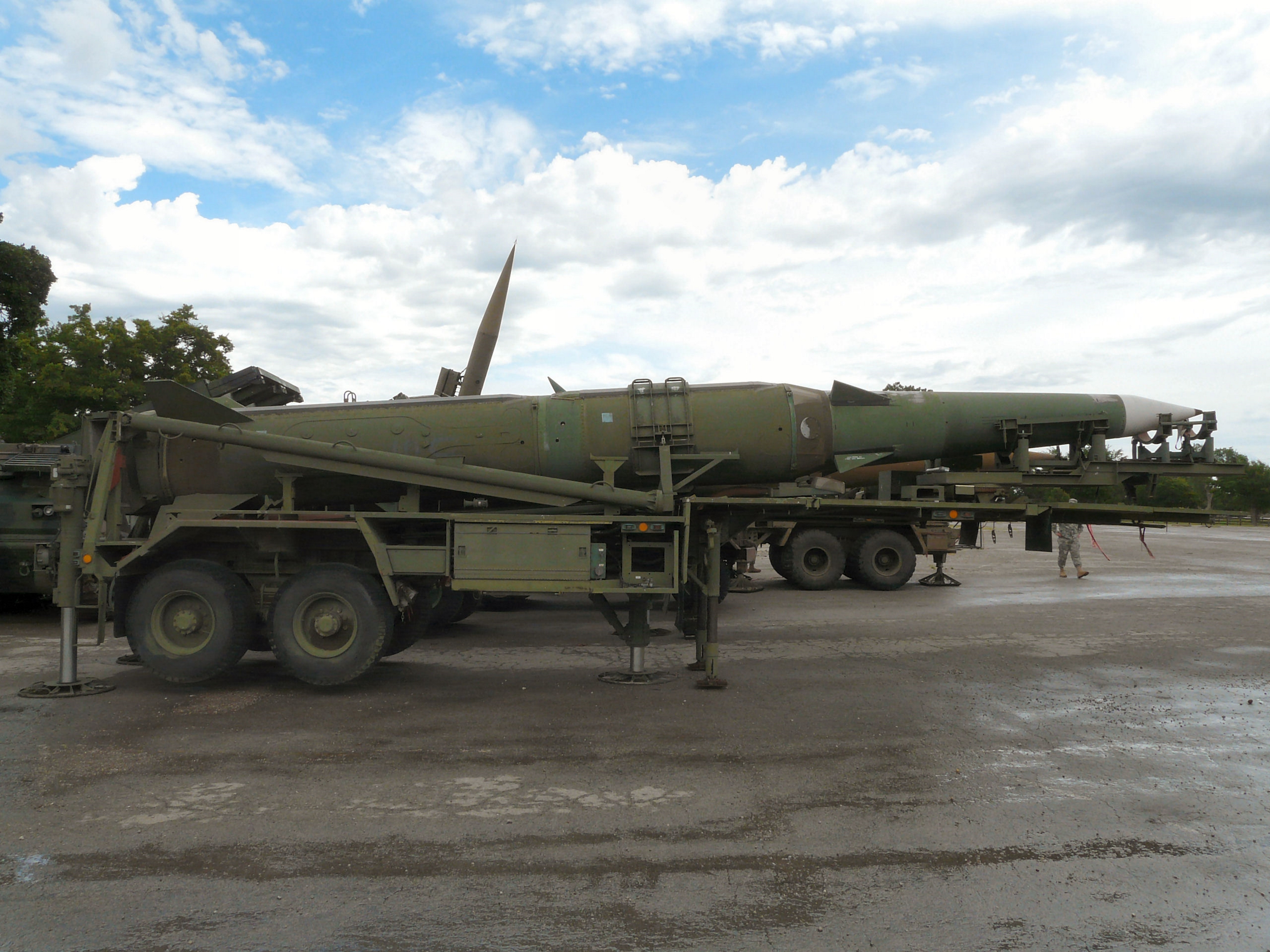
Pershing II |
|
|---|---|
| País | Eua |
| Papel | Míssil balístico de médio alcance |
| Em serviço | 1983–1991 |
| Construído | 276 |
O Sistema de Armas Pershing II foi um míssil balístico de dois estágios de combustível sólido projetado e construído por Martin Marietta para substituir o Sistema de Mísseis de Artilharia de Campanha Pershing 1a como a principal arma de nível de teatro com capacidade nuclear do Exército dos Estados Unidos. O Exército dos EUA substituiu o Pershing 1a pelo Pershing II Weapon System em 1983, enquanto a Força Aérea Alemã manteve o Pershing 1a até que todos os Pershings fossem eliminados em 1991. O Comando de Mísseis do Exército dos EUA (MICOM) gerenciou o desenvolvimento e as melhorias, enquanto o Ramo de Artilharia de Campanha implantou os sistemas e desenvolveu a doutrina tática.
Fonte: Pershing II na Wikipédia
| Pershing II Erector Launcher Walk Around | |
|---|---|
| Fotógrafo | David Lueck |
| Localização | Desconhecido |
| Fotos | 102 |

Veja também:


O Pershing II was a medium-range ballistic missile developed by Martin Marietta to replace the Pershing I as the primary nuclear-capable weapon of the United States Army in Europe. It had a range of 1,100 miles and a variable-yield W85 warhead that could be set from 5 to 80 kilotons. The Pershing II was designed to be more accurate and survivable than its predecessor, using a maneuverable reentry vehicle with active radar guidance and a two-stage solid propellant rocket engine.
The Pershing II was deployed in 1983 in response to the Soviet Union’s deployment of the SS-20 Saber missile, which had a longer range and two warheads. The Pershing II and the SS-20 were both eliminated under the Intermediate-Range Nuclear Forces Treaty signed in 1987 by Ronald Reagan and Mikhail Gorbachev.
Views : 3873
Você pode ver também:
 Bomba voadora V-1 – Fotos e Vídeos
 Bristol Bloodhound – Fotos e Vídeos
 BM-30 Smerch – Fotos e Vídeos
 Northrop JB-1 Bat – Fotos e Vídeos
 MIM-3 Nike Ajax – Fotos e Vídeo
 S-75 Dvina – Fotos e Vídeo
 Kugisho/Yokosuka K-1 Ohka – Fotos e Vídeo
 Rapier Rastreado – Fotos e Vídeo
 Tipo 63 130mm no caminhão NJ 230 – Fotos e Vídeo
 SA-6 Gainful – Fotos e Vídeo