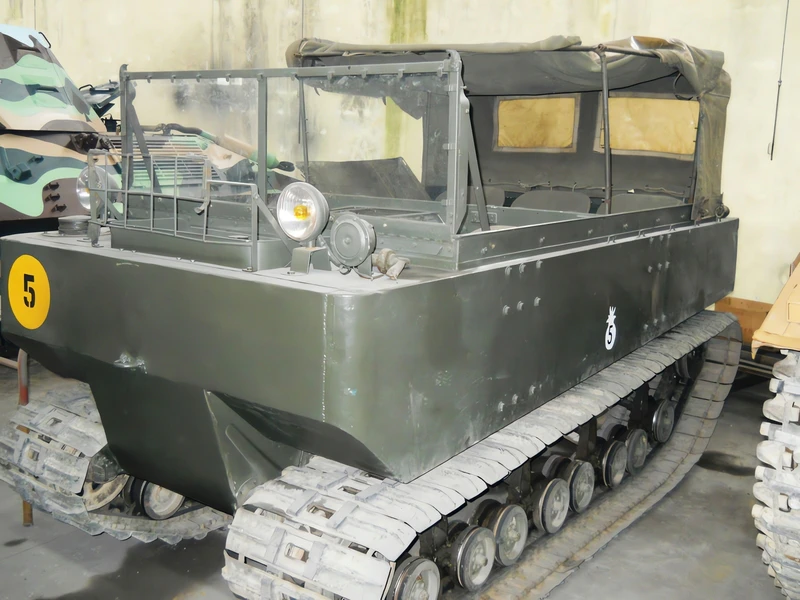
M29 Weasel | |
|---|---|
| Country | USA |
| Role | Tracked vehicle |
| Crew | 4 |
| Built | Unknow |
The M29 Weasel is a World War II tracked vehicle designed for operation in snow. Built by Studebaker, Weasels were also used in sandy, muddy, and desert terrains, including towing loads over terrain wheeled vehicles could not negotiate as in the US Marine invasions of Iwo Jima and Okinawa. Standard M29s were semi-amphibious, but with a very low freeboard. A M29C Water Weasel version was produced with fore and aft buoyancy cells and twin rudders. Capable of operating in inland waterways, it however also saw limited action in surf conditions in the Pacific Theatre.
Source: M29 Weasel on Wikipedia
| M29C Weasel Type A Walk Around | |
|---|---|
| Photographer | Unknow |
| Localisation | Unknow |
| Photos | 49 |


See also:


The M29 Weasel (originally designated T24) was a U.S. vehicle built by Studebaker for specialized, all-terrain operations. It was highly valued for its ability to traverse soft terrain.
General Information
- Official Designation: Cargo Carrier M29
- Nickname: Weasel
- Manufacturer: Studebaker Corporation
- Initial Role: Transport and supply over snow and swampy ground
- Crew: 4 (Driver and 3 passengers/load)
- Variants:
- M29: Standard version, semi-amphibious with low freeboard.
- M29C (Water Weasel): Fully amphibious version with bow and stern buoyancy cells and twin rudders.
Technical Specifications (M29)
| Characteristic | Detail |
|---|---|
| Weight (Dry) | 1,700 kg (3,800 lb) |
| Length | 3.20 m (10 ft 6 in) |
| Engine | Studebaker Model 6-170 Champion 6-cylinder Gasoline, 70 hp |
| Max Speed (Road) | 58 km/h (36 mph) |
| Tracks | 20-inch wide tracks for low ground pressure |
| Ground Pressure | Approx. 1.9 psi (less than a human foot) |
Service History and Use
The Weasel was extensively used by Allied forces in diverse conditions:
- It saw action on the beaches and marshlands of Normandy and the Scheldt Estuary.
- It was highly effective in the snowy conditions of the Battle of the Bulge and mountainous terrain in Italy.
- U.S. Marines used it on the sandy and muddy beaches of Iwo Jima and Okinawa in the Pacific.
- It was often used for supply, liaison, ambulance service, and minefield crossing (due to its light weight).
Views : 2046