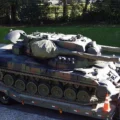
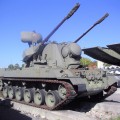
Flakpanzerkampfwagen IV | |
|---|---|
| 국가 | 독일 |
| 형식 | Char antiaérien |
| 설명 | 의 앨범 69 사진«Flakpanzerkampfwagen IV»의 산책 |
Tthe 플락칸처 IV est un char antiaérien allemand de la Seconde Guerre mondiale, qui était utilisé pour protéger les unités blindées. Il a été décliné en quatre versions, Möbelwagen, Wirbelwind, Ostwind et Kugelblitz. En août 1944 est décidé le développement d’un système anti-aérien basé sur le châssis du PzKpfw IV et avec pour armement un canon 43 L/60 de 3,7 cm. Le canon placé dans une tour de six côtés pouvait effectuer une rotation de 360° et par conséquent pouvait donner une protection efficace contre les menaces aériennes. Il fut utilisé dans les unités Flugabwehrzug (pelotons antiaériens) dans les régiments Panzer.


| 3,7cm Flakpanzer IV Mobelwagen Walk Around | |
|---|---|
| 사진 작가 | Unknow |
| 로컬라이제이션 | Unknow |
| 사진 | 78 |
참고 항목:


Tthe 플락칸처 IV was the general designation for a series of German self-propelled anti-aircraft guns (SPAAG) built on the reliable 기갑캄프와겐 IV (Pz.Kpfw. IV) chassis during World War II. These vehicles were developed as Germany lost air superiority, making mobile protection for armored columns an urgent necessity.
Key Variants and Development
The need for a fully protected anti-aircraft vehicle led to several stopgap and specialized designs:
- 뫼벨바겐 (“Furniture Van”): The earliest variant, it used a low, boxy, armored superstructure with walls that folded down for firing, leaving the crew highly exposed.
- 비벨윈드 (“Whirlwind”): The first design featuring a rotating, open-top turret, offering much better traverse and protection than the 뫼벨바겐.
- Ostwind (“East Wind”): Developed to replace the 비벨윈드, it housed a single, more powerful 3.7 cm Flak 43 in a larger hexagonal turret.
- Kugelblitz (“Ball Lightning”): The final, most advanced design with a fully enclosed, spherical turret, though only prototypes were produced.
Comparative Technical Specifications (Wirbelwind & Ostwind)
| 특징 | 비벨윈드 (Sd.Kfz. 161/4) | Ostwind (Sd.Kfz. 161/3) |
|---|---|---|
| 주무장 | Quad 2 cm Flakvierling 38 (Four 20 mm cannons) | Single 3.7 cm Flak 43 (One 37 mm cannon) |
| Rate of Fire (Theoretical) | Up to 1,800 rounds/minute (Combined) | Up to 160 rounds/minute |
| Primary Advantage | High rate of fire, excellent against low-flying aircraft and soft ground targets. | Heavier, more damaging shell; better range and punch against armored ground targets. |
| Chassis Base | 으로 바뀌었습니다 기갑 IV (Pz.Kpfw. IV) chassis | |
| 승무원 | 5 (Commander, Driver, Radio Op., 2 Gunners) | 5 (Commander, Driver, Radio Op., Gunner, Loader) |
Operational Context
Tthe 플락칸처 IV vehicles were urgently needed mobile anti-aircraft platforms. Due to the high volume of smoke generated by their rapid-fire guns, the turret designs were often open-topped. While this provided excellent visibility and ventilation, it left the crew vulnerable to shrapnel, air-bursting shells, and strafing attacks by enemy fighters, particularly in the later stages of the war.
Views : 5290