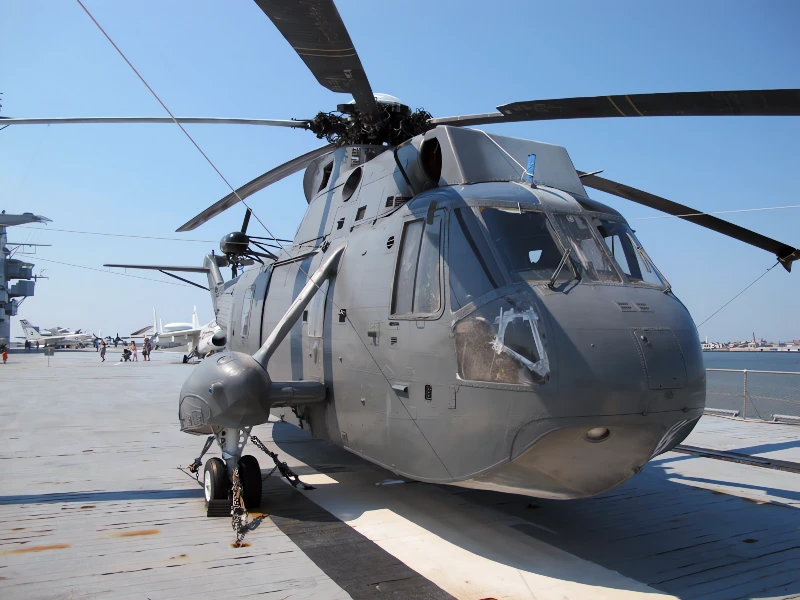
Sikorsky SH-3 Sea King | |
|---|---|
| Paese | Usa |
| Ruolo | Guerra antisommergibile, ricerca e soccorso ed elicottero utility |
| Primo volo | 11 marzo 1959 |
| Costruito | Inconsapevole |
Le Sikorsky SH-3 Re del Mare (designazione S-61) è un elicottero da guerra antisommergibile bimotore statunitense progettato e costruito dalla Sikorsky Aircraft. Un design storico, è stato il primo elicottero anfibio al mondo e uno dei primi rotorcraft ASW ad utilizzare motori turboalfase.
| Sikorsky SH-3G Sea King Cammina | |
|---|---|
| Fotografo | Vladimir Jakubov |
| Localizzazione | USS Yorktown CV-10, Patriots Point |
| Foto | 148 |

| Sikorsky SH-3D Sea King Walk Around | |
|---|---|
| Fotografo | Vojtech Peterka |
| Localizzazione | Inconsapevole |
| Foto | 20 |
Vedi anche:


The Legendary Amphibious Anti-Submarine Warfare Pioneer
Le Sikorsky SH-3 Re del Mare (factory designated as the S-61) was a twin-turboshaft medium amphibious hunter-killer helicopter designed and built by the Sikorsky Aircraft Corporation. Introduced in 1961 for the United States Navy, the SH-3 was a revolutionary rotary-wing design: it was the world’s first amphibious helicopter and the first to combine both anti-submarine detection (hunter) and weapon delivery (killer) capabilities into a single integrated airframe. Featuring a boat-hull fuselage, retractable main landing gear housed in side sponsons, and twin General Electric turboshaft engines, the Sea King served for over four decades as the U.S. Navy’s primary carrier-based Anti-Submarine Warfare (ASW) and Search and Rescue (SAR) platform, while also gaining global fame as the primary Presidential transport helicopter (“Marine One”) and Apollo spacecraft recovery vehicle.
| Attribute | Technical Specification (U.S. Navy SH-3H Sea King Standard) |
|---|---|
| Ruolo | Carrier-Based Anti-Submarine Warfare (ASW) / Combat Search & Rescue (CSAR) Helicopter |
| Equipaggio | 4 (Pilot, Co-Pilot, Tactical Coordinator / Tactical Sensor Operator, Acoustic Sensor Operator) |
| Motopropulsore | 2 × General Electric T58-GE-10 turboshaft engines (1,400 shp each) |
| Velocità massima | 267 km/h (166 mph / 144 knots) max speed | ~219 km/h (136 mph / 118 knots) cruise speed |
| Gross / Takeoff Weight | 9,525 kg (21,000 lbs) maximum gross weight | ~5,382 kg (11,865 lbs) empty weight |
| Service Ceiling / Operational Range | 4,480 m (14,700 ft) ceiling | ~1,000 km (621 miles) range |
| Rotor Systems | 5-bladed main rotor (power-folding) + 5-bladed tail rotor (power-folding tail pylon) |
| ASW Sensors & Avionics | AQS-13D dipping sonar, ARR-75 sonobuoy receiver system, ASQ-81 Magnetic Anomaly Detector (MAD) bird, LN-66HP radar |
| Armament Options | Up to 380 kg (840 lbs) of ordnance: 2 × Mk 46/Mk 50 lightweight homing torpedoes or B57 nuclear depth charges |
| Production Total | 1,100+ units produced across Sikorsky, Westland (UK), Mitsubishi (Japan), and Agusta (Italy) license lines |
Design Engineering: Watertight Hull, Twin Turboshafts, and Integrated ASW Suite
- Watertight Hydrodynamic Boat Hull: The SH-3 was designed with a flying-boat style hull and outrigger sponsons housing retractable main wheels. This amphibious construction allowed the helicopter to execute emergency water landings or remain afloat during extended open-ocean dipping sonar operations in rough sea states.
- Twin-Turboshaft Powerplant Advantage: Departing from earlier piston-powered predecessors (like the H-34), the Sea King incorporated two General Electric T58 turboshaft engines mounted above the main cabin. This provided immense lifting capacity, low vibration, and critical single-engine safety margins while hovering close to the wave tops at night.
- Integrated “Hunter-Killer” Electronics Suite: Prior to the SH-3, ASW operations required two separate helicopters—one to search and one to attack. The SH-3 merged these roles into one platform equipped with a dipping active sonar transducer lowered via cable, deployable sonobuoys, a towed Magnetic Anomaly Detector (MAD) tail bird, and lightweight homing torpedoes.
- Automated Hovering & Flight Control Systems: Operating over water at night required precise flight controls. Sikorsky integrated an Automatic Flight Control System (AFCS) with automatic transition-to-hover capabilities, allowing the crew to maintain a rock-steady position over a fixed ocean coordinate while dipping sonar cables.
Operational History: Apollo Recoveries, Marine One, and Global Military Service
- NASA Apollo Spacecraft Recoveries: The Sea King became an international television icon during the late 1960s and 1970s as the prime recovery helicopter for NASA’s manned spaceflight programs. A famous U.S. Navy SH-3A named Helicopter 66 personally plucked astronauts from the Pacific Ocean following five Apollo splashdowns, including Apollo 11.
- Presidential “Marine One” Fleet: Modified VH-3A and VH-3D variants were selected for executive transport duty with Marine Helicopter Squadron One (HMX-1). Decorated in the distinctive “White Top” livery, the Sea King served as the primary presidential transport for eleven consecutive U.S. presidents from John F. Kennedy to Joe Biden.
- Vietnam War Combat SAR and Fleet Protection: During the Vietnam War, U.S. Navy SH-3s operated off aircraft carriers in the Gulf of Tonkin, conducting high-risk Combat Search and Rescue (CSAR) missions (“Big Mother”) to pull downed Allied aviators out of hostile jungle terrain and coastal waters.
- Westland License Production and Global Service: The design was extensively modified in the United Kingdom by Westland Helicopters as the Westland Sea King, fitted with Rolls-Royce Gnome engines and British radar. Westland Sea Kings saw heavy combat during the 1982 Falklands War, the 1991 Gulf War, and served across dozen of international navies for over 50 years.
Visualizzazioni : 4458
Puoi anche vedere:
 Sikorsky MH-60 Jayhawk – Foto e video
 Sikorsky R-4 – Foto e video
 Sikorsky S-76 – Foto e Video
 Sikorsky HH-52 Seaguard – Foto e video
 Sikorsky SH-60B SeaHawk – Foto e Video
 Sikorsky S-64 Skycrane – Foto e Video
 Sikorsky CH-37 Mojave – Foto e Video
 Sikorsky CH-54 Tarhe – Foto e Video
 Sikorsky H-34 (S-58) – Foto e Video
 UH-60A Blackhawk – Foto e Video