A-7B Corsair II

A-7B Corsair II

PaísE.e.u.u
Papel

Aviones de ataque ligero subsónicos

Primer vuelo26 de septiembre de 1965
Construido1569

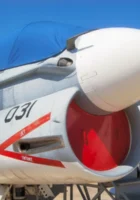
Galería de fotos de un A-7B Corsair II, El Ling-Temco-Vought A-7 Corsair II is a carrier-capable subsonic light attack aircraft introduced to replace the Douglas A-4 Skyhawk. The A-7 airframe design was based on the successful supersonic Vought F-8 Crusader. It was one of the first combat aircraft to feature a head-up display (HUD), an inertial navigation system (INS), and a turbofan engine. The Corsair II initially entered service with the United States Navy during the Vietnam War. It was later adopted by the United States Air Force, including the Air National Guard, to replace the Douglas A-1 Skyraider, North American F-100 Super Sabre and Republic F-105 Thunderchief. The aircraft was also exported to Greece in the 1970s, and Portugal in the late 1980s.

Fuente: Wikipedia

Continuar leyendo

Views : 6327

KFIR C-1

KFIR C-1

PaísIsrael
Tipo

Aviones de combate multirculo

Tema

Álbum de 44 fotos walk-around de un « KFIR C-1 »

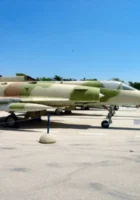
The Israel Aircraft Industries Kfir is an Israeli-built all-weather, multirole combat aircraft based on a modified French Dassault Mirage 5 airframe, with Israeli avionics and an Israeli-made version of the General Electric J79 turbojet engine. The project that would ultimately give birth to the Kfir can be traced back to Israel’s need for adapting the Dassault Mirage IIIC to the specific requirements of the Israeli Air Force (IAF). The all-weather, delta-winged Mirage IIICJ was the first Mach 2 aircraft acquired by Israel from then close ally France, and constituted the backbone of the IAF during most of the 1960s, until the arrival of the A-4 Skyhawk and, most importantly, the F-4 Phantom II, by the end of the decade. While the Mirage IIICJ proved to be extremely effective in the air-superiority role, its relatively short range of action imposed some limitations on its usefulness as a ground-attack aircraft.

Fuente: KFIR C-1 en Wiki

Continuar leyendo

Views : 6916

KrAZ-214B - Roden 804

Roden

Ref 804
TipoCamión Modelo de coche
Escala1/35
Tema

KrAZ-214B

During WWII under the terms of the Lend-Lease agreement, apart from thousands of the well-known ‘Studebakers’, a limited number of Diamond and White heavy ballast tractors appeared in the USSR. These trucks made a great impression on the Soviet military, because the ZIS-5 and GAZ-AA, which Soviet industry had been producing since the pre-war period, could not compare with the American vehicles, which were able to haul a trailer loaded even with heavy tanks. Immediately after the end of the war the Yaroslavl motor works, which had previously produced YAG-6 trucks in very small quantities, received an order to develop a new truck. So in 1947 appeared the YAZ-200, the first Soviet truck with a fourteen-cylinder diesel engine, and a year later, the YAZ-210 with a more powerful six-cylinder YAZ-206 diesel. These trucks began to figure in the inventory of the Soviet Army; however, the Army had need of a truck with much better characteristics, especially taking into consideration cross country ability…..

Fuente: KrAZ-214B on Roden

Continuar leyendo

Vistas : 810

Kayaba Katsuodori - Modelo Meng

Meng Model

Ref Kayaba
TipoAviones de ataque
Escala1/72
Asunto

Kayaba "Katsuodori"

historia:

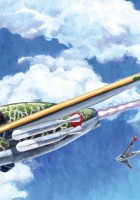
Japón ya había comenzado a desarrollar el planeador de ala mosca antes de la Segunda Guerra Mundial. Con el fin de satisfacer las nuevas demandas del ejército, Kayaba había desarrollado sucesivamente tres tipos de planeador de ala de mosca. Los planos del ala de mosca Kayaba "Katsuodori" se completaron a finales de abril de 1940 y el prototipo se produjo muy pronto. El fuselaje era de piel metálica. Su longitud, altitud y envergadura eran de 4,48 m, 1,85 m y 8,99 m respectivamente. A pesar de que el producto había hecho la transición de planeador a ala de vuelo motorizado, su número militar, proporcionado por el Ejército Japonés, todavía denotaba planeador: "Ku-4". La actitud del ejército japonés fue decepcionante por el accidente del Tipo 2 que ocurrió en el aeropuerto de Tachikawa el 10 de mayo de 1941. Los fondos de Kayaba "Katsuodori" fueron retenidos. Además, la guerra del Pacífico se intensificó para expandirse al mismo tiempo, la mayor parte de la atención del ejército japonés se centró en la producción de aviones militares. Por lo tanto, el ejército japonés no se dedicó más al desarrollo de las técnicas de alas de mosca. Al final, Kayaba "Katsuodori" se convirtió en el experimento en el que invirtió la propia empresa Kayaba. Este kit es el tipo de potencia de chorro de ariete según los diseños originales. Su motor está copiado del motor ariete HeS001 Tipo A de Alemania. El armamento es un par de cañones de 30 mm a ambos lados de la nariz. Y para un bombardero, es fácil llevar Kayaba "Katsuodori" para aumentar el alcance.

Caza japonés a reacción Kayaba "Katsuodori" de la Segunda Guerra Mundial altamente detallado en escala 1/72 con su longitud de 62 mm, altura de 21 mm y envergadura de 125 mm. En la caja se incluyen dos kits. Delicada presentación del preciso fuselaje, detallada cabina y entrada de aire. El propulsor de cohetes, el carro de asistencia en tierra y el pilón del bombardero también se suministran para diversas aplicaciones. Se incluyen los estilos de pintura IJA e IJN.
Continuar leyendo

Vistas : 1969

Bofors Archer BD 77

Bofors Archer BD 77

PaísSuecia
Tipo

Artillería autopropulsada

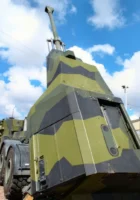
El Sistema de Artillería Archer o Archer – FH77BW L52 es un proyecto internacional destinado a desarrollar un sistema de artillería autopropulsada de próxima generación para Suecia y Noruega. El corazón del sistema es un obús de cañón L52 de 155 mm/L52 totalmente automatizado y una estación de armas controlada a distancia montada en un chasis 6×6 modificado del Volvo A30D, camión articulado todoterreno. El compartimiento de la tripulación y el motor está fuertemente blindado y la cabina está equipada con ventanas a prueba de balas y fragmentación. Aparte de esto, el sistema consta de un vehículo de reabastecimiento de municiones, un vehículo de apoyo, un proyectil de artillería con espoleta de sensor BONUS y el proyectil guiado M982 Excalibur.

Continuar leyendo

Vistas : 2484

BTR-40

BTR-40

PaísUnión Soviética
Tipo

Portaaviones blindado

Descripción

Álbum de 203 fotos walk-around de un «BTR-40»

El BTR-40 es un vehículo soviético no anfibio de transporte de personal blindado con ruedas y vehículo de reconocimiento. A menudo se conoce como el Sorokovka en el servicio soviético. También es el primer APC soviético producido en masa. Finalmente fue reemplazado en el papel de APC por el BTR-152 y en el papel de coche explorador por el BRDM-1.

Fuente: BTR-40 en Wiki

Continuar leyendo

Vistas : 3574

Lockheed F-22A Raptor

Lockheed Martin F-22 Raptor

PaísE.e.u.u
Tipo

Caza de superioridad aérea furtivo

Primer vuelo7 de septiembre de 1997
Construido195

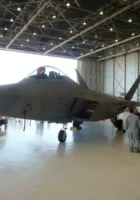
Galería de fotos de un Lockheed F-22A Raptor, El Lockheed Martin/Boeing F-22 Raptor es un avión de combate monoplaza bimotor de quinta generación que utiliza tecnología de sigilo.

Fuente: Lockheed Martin F-22 Raptor en Wikipedia

Continuar leyendo

Vistas : 5424

PLAN FUZHOU - Cyber-Hobby 7080

Afición cibernética

Ref 7080
TipoSerie Naranja
Escala1/700
Tema

PLAN FUZHOU

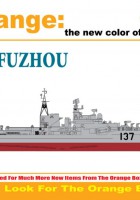
Un modelo de la marca Afición cibernética el kit : PLAN FUZHOU – Cyber-Hobby 7080.

Paquete Serie Value

Orange Box is again showing its true colors with the release of a 1/700 scale ship model. The subject is a Project 956 Sovremenny-class missile destroyer. Although it is a Russian-built ship, this Cyber-Hobby kit depicts it in Chinese People’s Liberation Army Navy (PLAN) service. In 1996 China decided to acquire two unfinished Russian Navy vessels. The Hangzhou (hull number 136) was delivered in 1999, and the second destroyer – Fuzhou (137) – arrived in 2000. It is precisely these destroyers that are represented in this Orange Box release. These destroyers in service with the PLAN East Sea Fleet are designed mainly for surface strike missions.

Fuente: PLAN FUZHOU on Cybber-Hobby

Continuar leyendo

Vistas: 847