Mikoyan-Gurevich MiG-21 sky

Mikoyan-Gurevich MiG-21-F

CountryURSS
RoleSupersonic jet fighter aircraft
First flight14 February 1956
Built11496

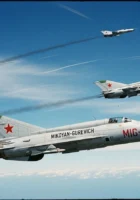
The Mikoyan-Gurevich MiG-21 is a supersonic jet fighter aircraft, designed by the Mikoyan-Gurevich Design Bureau in the Soviet Union. It was popularly nicknamed “Balalaika”, from the aircraft’s planform-view resemblance to the Russian stringed musical instrument or pencil by Polish pilots due to the shape of its fuselage.

Source: Mikoyan-Gurevich MiG-21 on Wikipedia

Continue reading

Views : 6966

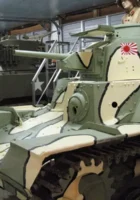
Type 95 Ha-Go

Tank Type 95 Ha-Go

CountryJapan
TypeLight tank
DescriptionAlbum of 28 photos walk-around of a tank «Type 95 Ha-Go»

Photo gallery of a Tank Type 95 Ha-Go, The Type 95 Ha-Gō was a light tank used by the Imperial Japanese Army in combat operations of the Second Sino-Japanese War, at Nomonhan against the Soviet Union, and in the Second World War. It proved sufficient against infantry, however, like the American M3 Stuart, it was not designed to fight other tanks. Approximately 2,300 units were produced, making it the most numerous Japanese armored fighting vehicle of the time.

Source: Wikipedia

Continue reading

Views : 3359

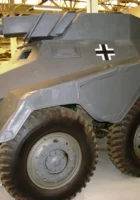
Sd.Kfz.234-3

Sonderkraftfahrzeug Sd.Kfz 234-3

CountryGermany
TypeSonderkraftfahrzeug
Produced1943–1945
Built478

Photo gallery of a Sd.Kfz 234-3, The Sonderkraftfahrzeug 234 also named SdKfz 234 was a German Army’s eight-wheeled armoured car used in the Second World War.

Version 234/3 : 1 x 7.5 cm K51 L/24 in open-topped superstructure replacing the turret. 88 built between June and December, 1944

Source: Wikipedia

Continue reading

Views : 12486

B-25J Mitchell

B-25J Mitchell

CountryUSA
RoleMedium bomber
First flight19 August 1940
Built9800+

The North American B-25 Mitchell is an American twin-engine, medium bomber manufactured by North American Aviation (NAA). The design was named in honor of Major General William “Billy” Mitchell, a pioneer of U.S. military aviation. Used by many Allied air forces, the B-25 served in every theater of World War II and after the war ended many remained in service, operating across four decades. Produced in numerous variants, nearly 10,000 Mitchells rolled from NAA factories. These included a few limited models, such as the United States Marine Corps’ PBJ-1 patrol bomber and the United States Army Air Forces’ F-10 reconnaissance aircraft and AT-24 trainers.

Source: B-25J Mitchell on Wikipedia

Continue reading

Views : 3215

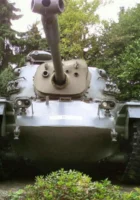
M48 Patton

Tank M48 Patton

CountryUSA
TypeMedium tank
In service1953—1990s

The M48 Patton was a main battle tank (MBT) that was designed in the United States. It was the third tank to be officially named after General George S. Patton, commander of the U.S. Third Army during World War II and one of the earliest American advocates for the use of tanks in battle. It was a further development of the M47 Patton tank. The M48 Patton was in U.S. service until replaced by the M60 and served as the U.S. Army and Marine Corps’ primary battle tank during the Vietnam War. It was widely used by U.S. Cold War allies, especially other NATO countries.

Source: M48 Patton on Wikipedia

Continue reading

Views : 11463

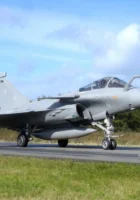
Dassault Rafale

Dassault Rafale M

CountryFrance
Type

Twin-engine delta-wing fighter aircraft

Photo gallery of a Dassault Rafale M, The Dassault Rafale is a French twin-engine delta-wing fighter aircraft designed and built by Dassault Aviation. Dassault described the Rafale as being an omnirole fighter with semi-stealth capabilities. The Rafale is a multirole combat aircraft; capable of simultaneously undertaking air supremacy, interdiction, reconnaissance, and airborne nuclear deterrent missions. The Rafale is distinct from other European fighters of its era in that it is almost entirely built by one country, involving most of France’s major defence contractors, such as Dassault, Thales and Safran.

Source: Wikipedia

Continue reading

Views : 10639

Wydawnictwo Militaria 101 Grille
Wydawnictwo Militaria
SerieWydawnictwo Militaria
Ref101
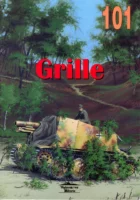
TopicGrille – Sdkfz.138/1

While the design utilized the hull of the Pz.Kpfw. 38(t), including its original engine covers, the front armor plate with the driver’s as well as the radio operator’s visors, and the ball mount for the machine gun was eliminatcd. Thus, Sd.Kfz. 138/1 was the first modified vehicle without the original heavy machine gun ZB vd7 (MG-37(t»), which was replaced by a portable standard German machine gun. In place of the original fro nt plate. the vehicle was fitled with a new 25 mm thick plate angled at 17°. At the same time. this 150 cm high plate also acted as the gun’s shield. In the lower right corner there was a cast visor for the driver, in the middle a deep opening for the gun’s barrel, and in the upper left hand corner another small opening for the periscopic sight of the gun. The radio operator was moved into the open fighting compartment, where he functioned as an auxiliary loader when necessary.

Source: Marder III & Grille – MBI Editions
Continue reading

Views : 1930

LAV-25

LAV-25

CountryUSA
RoleAmphibious reconnaissance vehicle
In service1983–present

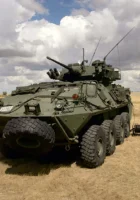
The LAV-25 is an eight-wheeled amphibious reconnaissance vehicle used by the United States Marine Corps. It was built by General Dynamics Land Systems Canada and is based on the Swiss MOWAG Piranha I 8×8 family of armored fighting vehicles.

Source: Wikipedia

Continue reading

Views : 8312

2C19 Msta-S

Self-propelled howitzer 2C19 MSTA-S

CountryRussia
Role

Self-propelled howitzer

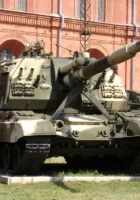
The 152 mm self-propelled howitzer 2C19 is a modern combat tracked vehicle with powerful armament, NB protection, high mobility and it conforms to all modern artillery requirements. The 2C19 can fire against observed targets from indirect position and by direct laying including mountain conditions and contaminated environment (elevation up to +50° C in the mountains). The 2C19 fires both the on-board rounds and the rounds from the ground with a high firing rate. The rounds used in the howitzer make provision for all the artillery tasks. The howitzer armouring provides a protection against armour-piercing bullets and projectile fragments to crew, armament, equipment, mechanisms; onboard rounds.

Continue reading

Views : 4672