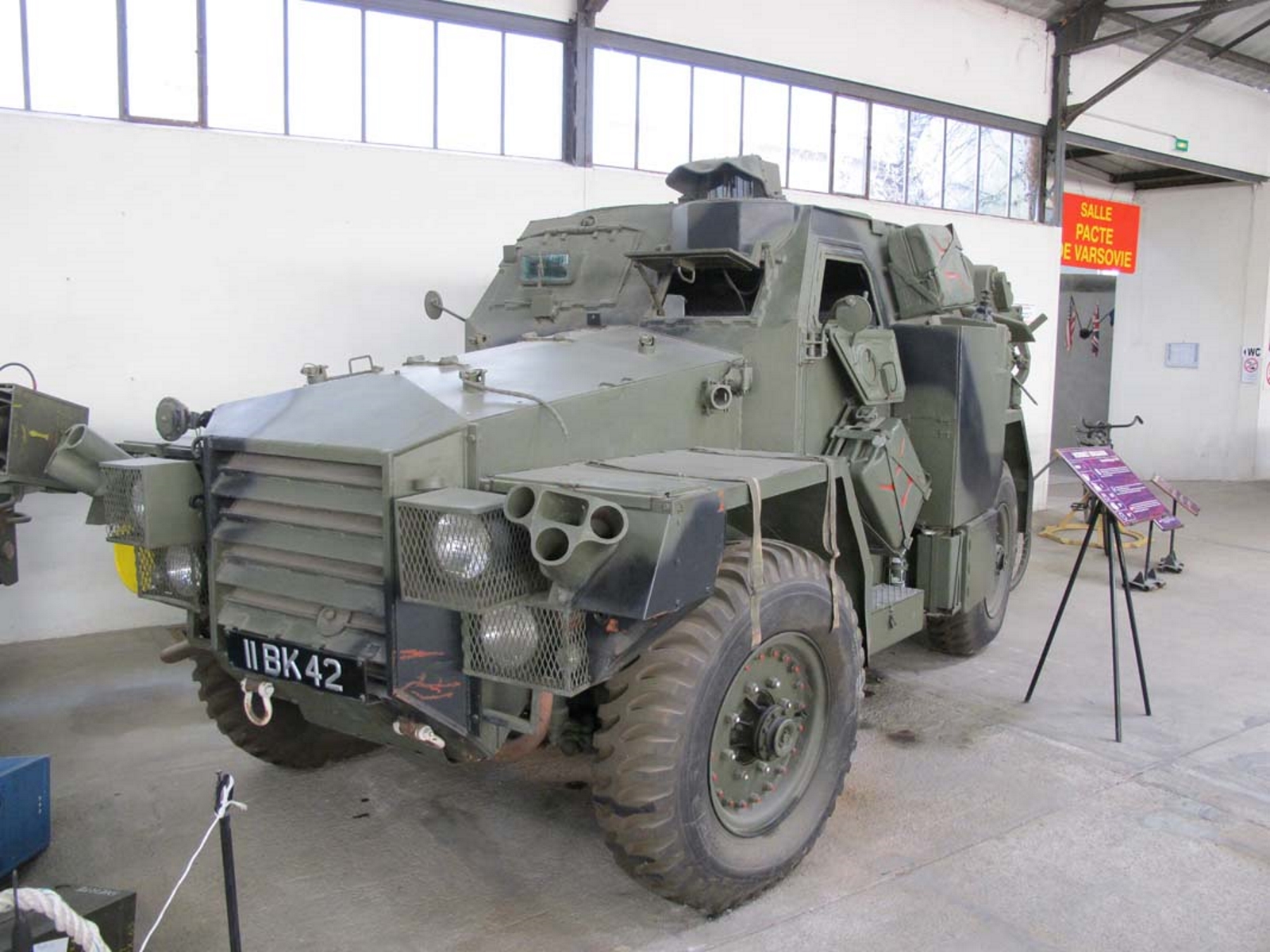
FV1620 Humber Hornet | |
|---|---|
| Land | Storbritannien, Australien |
| Roll | Tank jagare |
| Produceras | 1958-1961 |
| Tillverkare | Humber |
Den FV1620 Humber Hornet (FV1620, lastbil 1 ton, luftburen, bepansrad bärraket, Hornet-bärraket) var ett specialiserat luftutplaceringsbart pansarfordon designat för att bära Malkara, en pansarvärnsrobot utvecklad av Australien och Storbritannien.
Källkod: FV1620 Humber Hornet på Wikipedia
| FV1620 Humber Hornet Gå Runt | |
|---|---|
| Fotografer | Vladimir Yakubov |
| Lokalisering | Musee des Blindes, Saumur |
| Bilder | 98 |

Se även:


Den FV1620 Humber Hornet was a British light armoured vehicle designed in the 1950s for airborne operations. It was based on the chassis of the Humber FV1600 series, but fitted with a Malkara anti-tank guided missile launcher and a small turret with a 7.62 mm machine gun. The Hornet had a crew of three: a driver, a commander and a missile operator. The vehicle was air-portable by a Blackburn Beverley transport aircraft or a heavy-lift helicopter.
Den Bålgeting entered service with the British Army in 1958 and was used by the 16th Parachute Brigade until 1967, when it was replaced by the Ferret Mk 5 Swingfire. The Hornet saw combat during the Suez Crisis in 1956 and the Indonesian Confrontation in 1962-1966. It was also exported to Australia and Jordan.
Visningar : 1836